
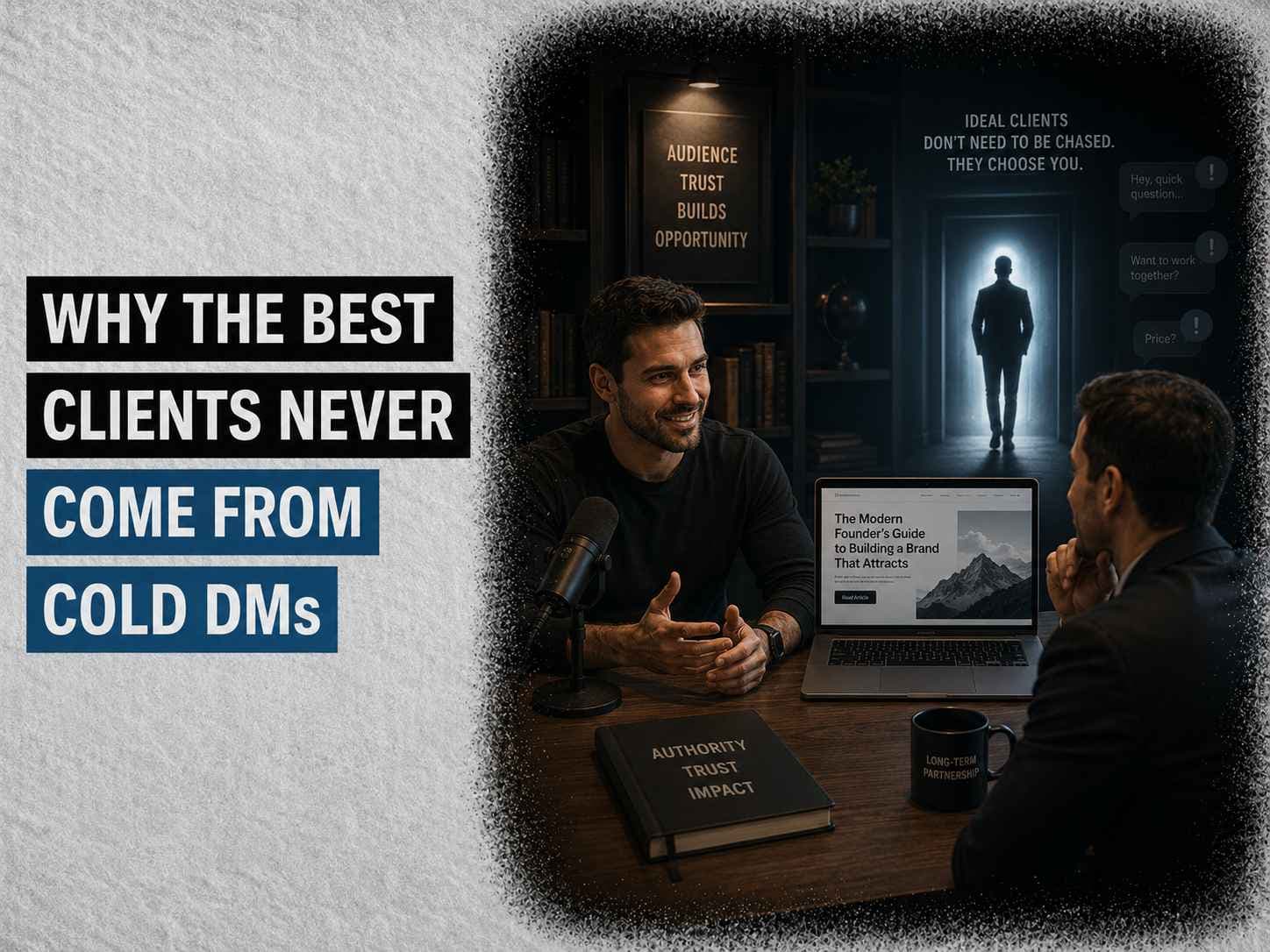
This post maps cold outreach against the four neurological gates of ROAC, reframes the famous $50,000 cold DM story as cause and effect reversed, runs the trust cost math founders never run, and ends with what to build instead of a cold DM pipeline.
Key Takeaways
LinkedIn DMs average a 10.3 percent response rate. Cold email averages 5.1. Both are worse than the numbers suggest for premium clients.
Cold DMs fail every gate trust uses to form: Register, Retention, Resonate, Reinforce. They ask for the close before the deposit.
The famous $50,000 cold DM story reverses cause and effect. Andy Kennedy closed because he behaved like an authority, not because the channel worked.
Cold-sourced clients cost more to close, retain less, expand less, and negotiate harder than inbound clients.
Authority does not feed the funnel. Authority replaces the funnel. The content qualifies before the conversation starts.
"Cold" stops being cold when your internet activity has already done the trust work in advance.
The Best Clients Arrive Already Convinced

The best clients arrive already convinced. They show up at a discovery call referencing a podcast you appeared on six months ago. They quote a sentence from your book back at you. They name a framework you wrote about in a piece they read on a flight. Their first question is not "do you do this work." Their first question is "when can we start."
That arrival state is the asset. Premium clients do not move through a sales process. They move through a trust process, and the sales conversation is the end of that process, not the beginning. The work of closing has already been done by the work of being found.
Cold DMs assume the opposite. They assume the conversation creates the trust. They assume proximity equals interest. They assume the message itself can carry the weight of becoming someone's authority. It cannot. The best clients are not made inside a DM. They are made inside the social media game most founders are losing every day.
Cold DMs Fail Every Gate That Makes a High-Ticket Sale Possible
I map this in GURU, INC. through a framework I call ROAC, or Return on Attention Created. ROAC tracks how attention moves through four neurological gates: Register, Retention, Resonate, Reinforce. Register means the brain noticed you. Retention means the brain held on long enough to process. Resonate means the brain agreed. Reinforce means the brain saw you again and decided you were credible.
Cold DMs skip the first three gates and try to extract a transaction at the fourth. The brain has no prior file on you. There is no signal to retain. There is nothing to resonate with. The only reinforcement is the message itself, asking for something.
That is the structural reason cold outreach numbers stay low. LinkedIn DMs average a 10.3 percent response rate. Cold email lands at 5.1. Un-warmed single-action DMs sit at 4.88. The numbers are not a tactics problem. They are a gate problem.
When I ran video editing work, my inbox filled every week with cold DMs from editors selling their services. The more that arrived, the lower their perceived value sank. Every new message piled on the previous one and defaulted into the wrong folder. None of them registered as people.
They all registered as the same person, repeated. That is what skipping the first three gates feels like to the receiver. It is invisibility wearing the costume of outreach. The Authority Efficiency Principle shows up here in reverse: structured expertise scales across brains, generic volume does not.
The $50,000 Cold DM Story Reverses Cause and Effect

Justin Welsh tells the story in his newsletter. A web designer named Andy Kennedy sent him a useful first DM about a problem on his landing page. Months later, Andy followed up at the right moment with another value-loaded message. He eventually closed a $50,000 contract. Welsh teaches this as proof that cold DMs work when you use a "3-touch with value" approach.
Read it again. Andy was already publishing his expertise. He was already studying Welsh's content. He was already showing up at the right time with insights only an authority could produce. He was not winning because he sent a cold DM. He was winning because his behavior, his timing, and his expertise had already passed every gate that matters. The DM was the delivery mechanism. The authority was the asset.
Personalized cold outreach lifts response rates by 71 percent over generic templates. Top performers using research and AI hit 18 to 25 percent. Those numbers are real. They also measure how much authority you are leaking into the channel. They do not measure how good the channel is.
The Trust Cost of a Cold-Sourced Client Is the Math Founders Never Run
A cold prospect pays you to find out if you are worth trusting. An inbound prospect pays you because they have already decided to trust you. Same fee, two different transactions. One starts at zero credibility. One starts at full credibility. That difference shows up in everything after the contract is signed.
Cold-sourced clients cost more to close, retain less, expand less, and negotiate harder. They ask more discovery questions. They want more proof on the call. They send contracts back with more changes. They are slower to refer because they are still verifying you in real time. The deal closes, but the relationship arrives shallow.
Inbound clients arrive deep. They paid before they paid. They consumed the content, shared the work, argued with the framework, and came in ready to begin. Those clients renew. Those clients refer. Those clients write the testimonial without being asked. Inside the way brand work compounds, this gap shows up in pricing power and deal size. It compounds across the pillar of creator economics.
Authority Is Not an Input to the Funnel. Authority Is the Funnel.
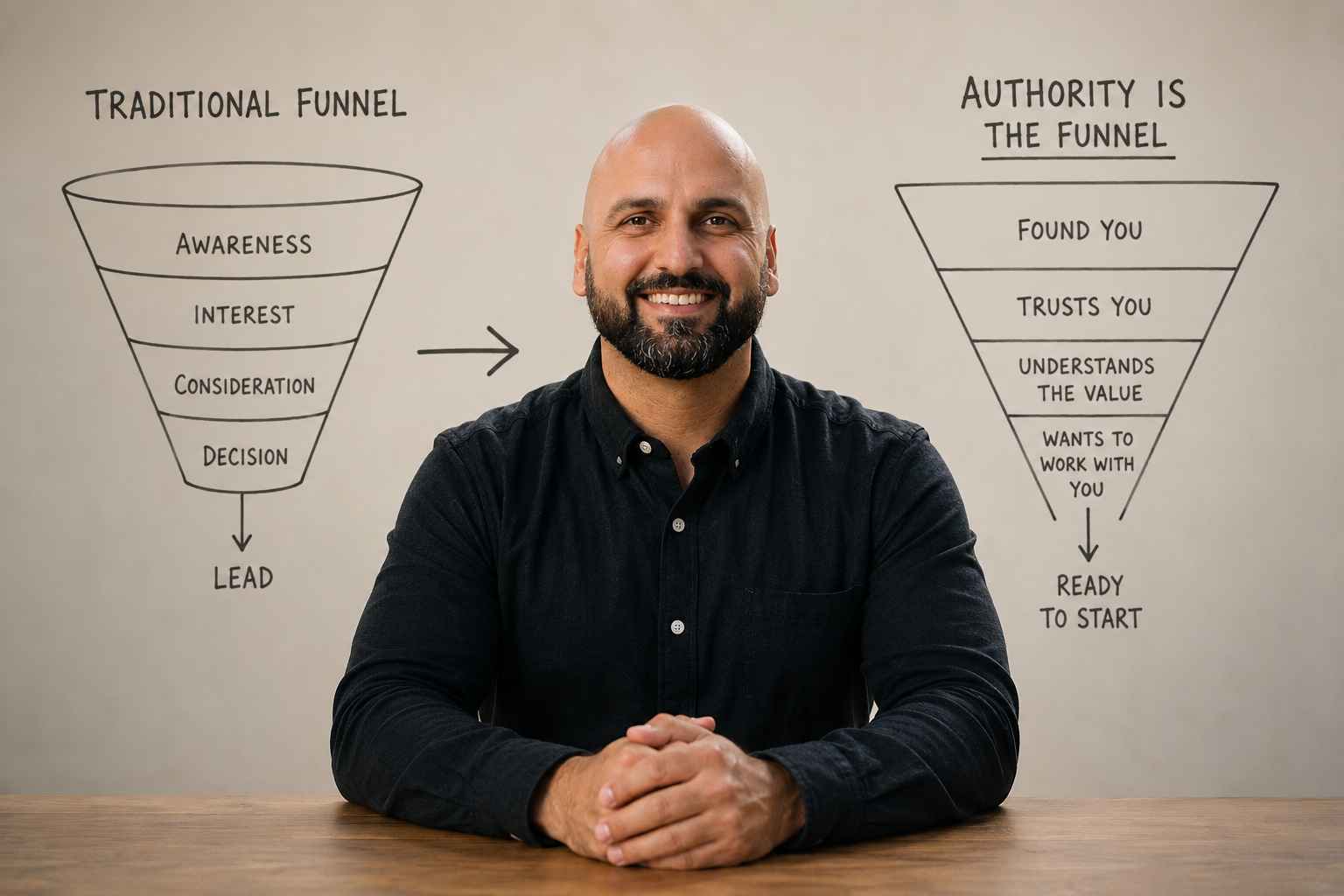
Most consulting marketers position thought leadership as one channel of many. The pipeline still exists. The CRM still exists. The discovery call still exists. Content is one of the things you do to feed those machines. That model is wrong. Content is the qualifier, the educator, the negotiator, and the closer. All of that happens before the prospect ever fills out a form.
When a founder maps the prospect's problem better than the prospect can, the funnel has already done its work. The prospect has self-qualified. The prospect has self-educated. The prospect has self-priced themselves out of the deal or self-priced themselves in. By the time they reach out, the only thing left is logistics.
Thought leadership takes 6 to 9 months to generate measurable lead flow. It takes 12 to 18 months to compound into recognized authority. That is not a slow funnel. That is a brand moat. And the moat is not how the funnel gets filled. The moat is the funnel.
"Cold" Is Not Really Cold When the Internet Has Already Done the Work
A few years ago I needed to bring on a content creator for some projects. I had no relationship with anyone in mind. Then I saw a comment somewhere from a person whose profile showed he had worked at a company I recognized. I did not know him directly. But the recognition of the company carried weight. His comment carried weight. The trail of activity I could scroll through carried weight. I reached out. We talked. I hired him.
That conversation looked cold from the outside. It was not cold. His internet activity had already cleared the gates. His comment was a signal. The company on his profile was a signal. The breadcrumbs were a signal. By the time I opened the conversation, he had already made the trust deposit. He did not know I was watching.
This is what most founders miss when they default to cold DMs. The internet is a digital architecture where every public surface does the work. Every byline. Every appearance. Every reply. Cold DMs cannot do that work. The trail can.
What to Build Instead of a Cold DM Pipeline
It is the daily, deliberate act of leaving signals the right people can find. Three substitutions handle most of it. First, take the hours you would spend writing personalized cold outreach and write the post instead. Publish where your buyers already are.
Solve their problem out loud. Second, take the calls you would book from cold pitches and turn them into recorded conversations. A podcast appearance is not free exposure. It is owned authority you control after the fact.
Third, take the templates you would use to follow up and turn them into frameworks you publish. A named idea travels farther than a sales script, because it can be quoted, taught, and remembered. Frameworks compound. Templates expire.
This is the math your competitors will run six months from now and you can run today. The founders who stop sending cold DMs and start building authority do not lose pipeline. They route it. They route it into the kind of consulting work that arrives pre-qualified, pre-priced, and pre-trusted. That is the conversation no DM ever wins.
Frequently Asked Questions
Why do cold DMs not work for high-ticket consulting clients?
High-ticket purchases require trust, and trust forms across multiple exposures over time. A cold DM compresses the entire process into one message. That is not enough cognitive surface for a meaningful trust signal to register. The math is structural, not stylistic.
What is the average response rate for cold DMs on LinkedIn in 2026?
LinkedIn DMs average about 10.3 percent across all sends, but the spread is enormous. Generic single-action DMs sit near 4.88 percent. Top performers using deep personalization push into the 18 to 25 percent range. That lift is largely a function of how much authority the sender has built first.
How long does it take for inbound content to generate consulting clients?
Most founders see warmer conversations within 3 months. Real lead flow shows up within 6 to 9 months. Compounding authority arrives at 12 to 18 months. The early period feels slow because the gains compound silently before they show up in revenue.
Are referrals or content better for premium consulting clients?
Both work, but content scales and referrals do not. A referral is one warm introduction. A piece of content is a referral that runs in the background every hour of every day for years. The best founders treat content as the system that produces both.
How do I know what to write about if I am starting from zero?
Start with the questions your best client asked in the first 90 days of working with you. Each question is a post, a podcast topic, or a framework in disguise. The content that lands is rarely original. It is specific.