
Founders chase the first property and wonder why the second never arrives. The question is never how many follow. The question is what the following holds.
Key Takeaways
Follower count records past distribution. Revenue requires present trust, and the two move independently.
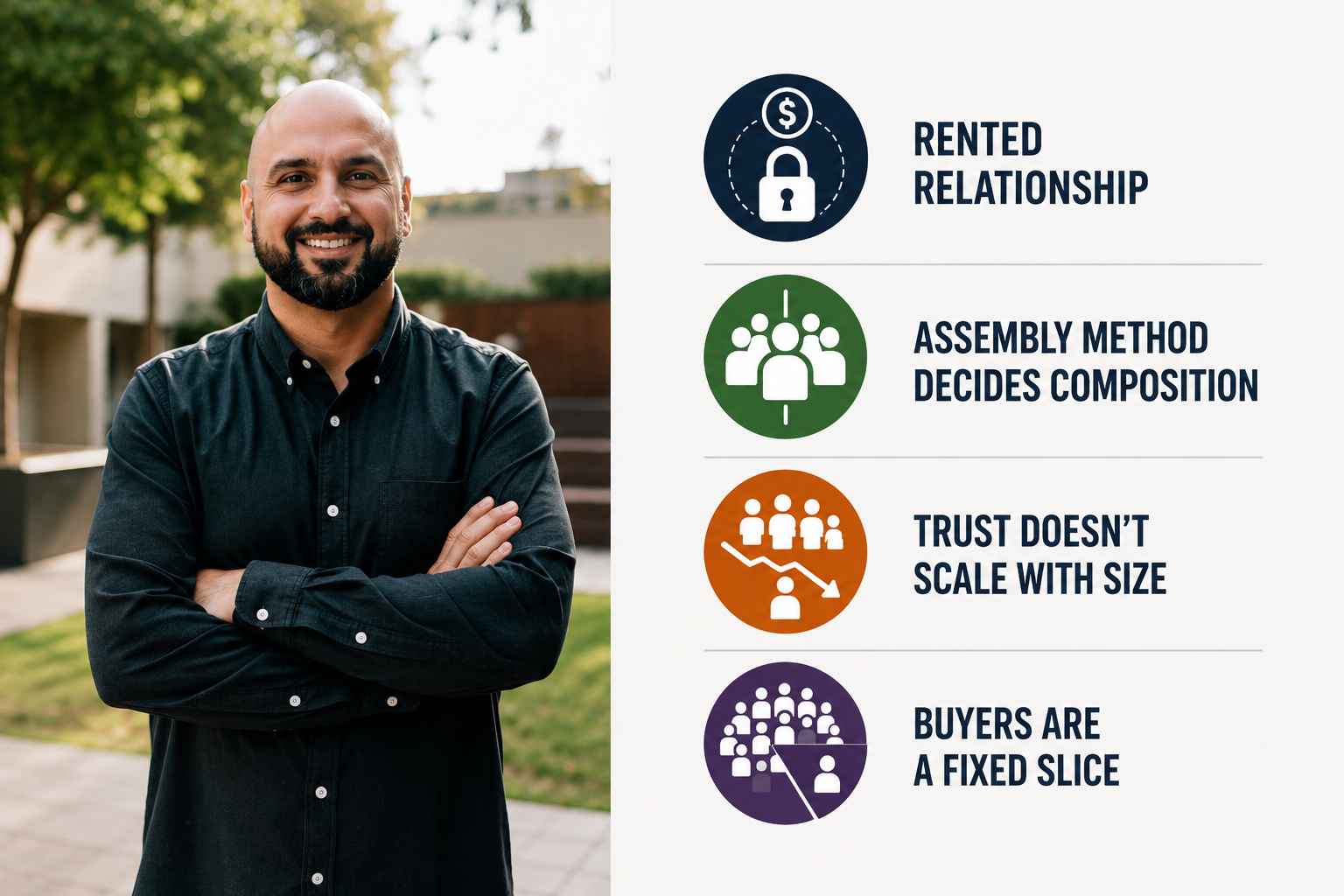
Four mechanisms break the size-to-revenue link: rented access, assembly method, trust dilution, and the fixed buyer slice.
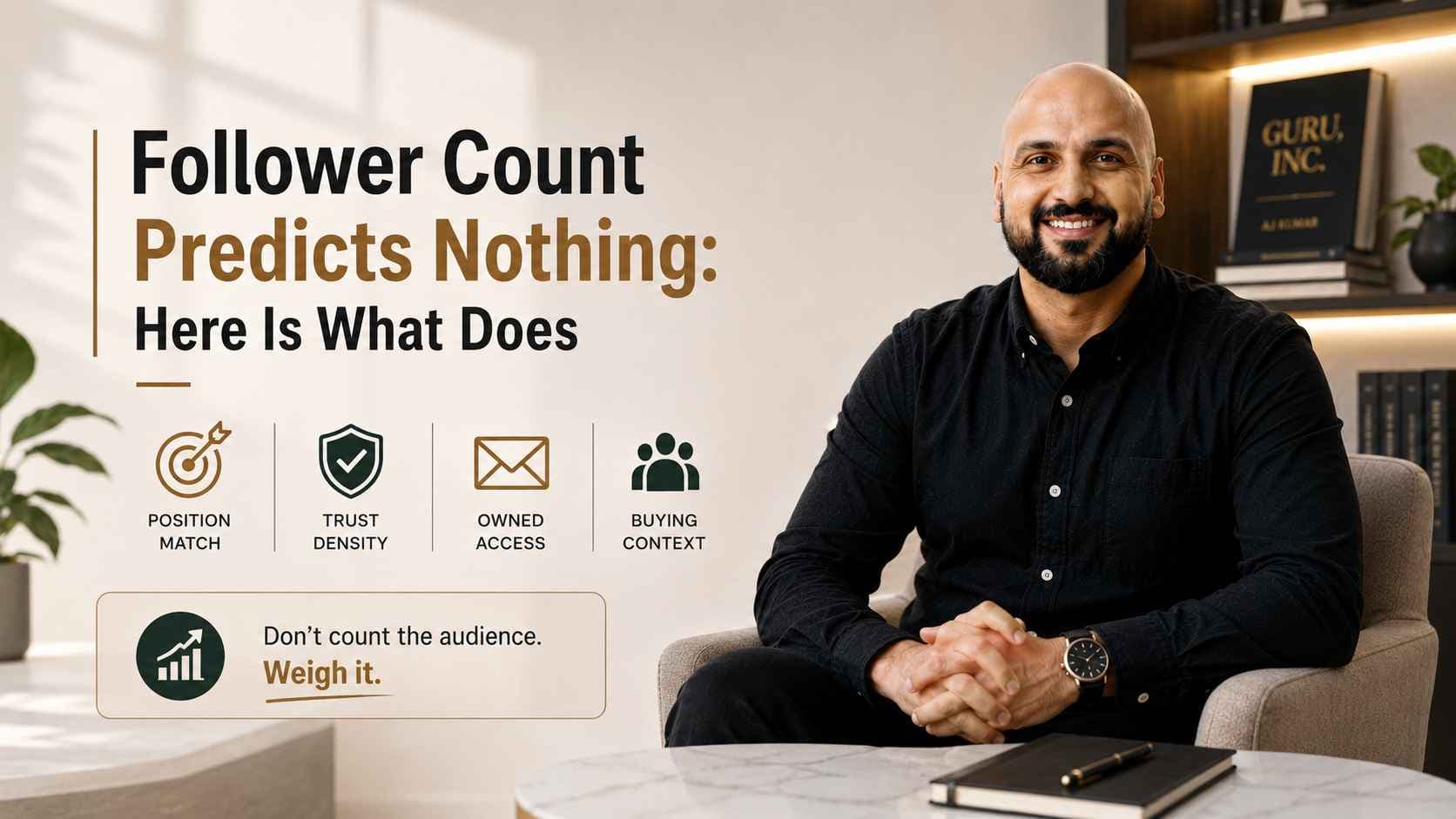
Four factors predict founder revenue: position match, trust density, owned access, and buying context.
Trust assets out-earn follower counts. Email lists, communities, and published authority convert while raw followings watch.
ROAC, Return on Attention Created, measures audience value directly: identity, trust, and leverage value.
Do not count the audience. Weigh it.
Follower Count Answers a Question Nobody Asked
A follower count records how many people once tapped a button, and nothing about what they believe now. Founders inherit the goal anyway. "We want to reach 100,000 followers this year" sounds like a revenue plan, and the sentence describes a scoreboard the platform controls.
The number stores past distribution: every trend, giveaway, and viral moment that ever crossed the account, frozen into a total. Revenue asks a different question. A business converts belief, held by the right people, reachable on the founder's terms.
Audience size versus audience value is the split that decides everything downstream, and the follower count sits entirely on the size side. A founder optimizing the total optimizes the property that pays nothing.
Four Mechanisms Break the Size-to-Revenue Link
Size fails to predict revenue for four structural reasons. The four mechanisms are given below:
The relationship is rented. The platform owns the access, prices the reach, and rewrites the terms without notice. A million followers reached at 2 percent is an audience of twenty thousand, on loan.
Assembly method decides composition. An audience assembled by trends contains trend-followers. An audience assembled by a position contains believers. The count hides which one the founder owns.
Trust refuses to scale with size. Growth through broad content recruits ever-colder followers, so the average trust per follower falls while the total climbs. The dashboard reads growth. The audience reads dilution.
Buyers are a fixed slice. The people with the problem, the budget, and the authority to buy stay a narrow segment. Growing the total mostly grows the noise around them.
Each mechanism runs silently, which is why the failure surprises founders. The count kept rising. Nothing in the count ever measured what was rising.
Four Factors Predict Revenue Instead
Revenue follows audience value, and audience value has four measurable factors. The four factors are given below:
Position match. The share of the audience that arrived for the founder's actual expertise, not a trend that passed through it.
Trust density. The share that acts on the founder's judgment: saves, replies with intent, booked calls, repeated positions.
Owned access. The share reachable without the algorithm's permission: email, community, direct channels.
Buying context. The share holding the problem, the budget, and the authority to purchase.
A five-thousand-person audience scoring high on all four out-earns a half-million-person audience scoring low, and the gap is not close. The revenue engine on the founder side is built from exactly these assets, which is why personal brand revenue streams run on owned lists and trust products rather than raw reach.
The Proof: Trust Assets Out-Earn Follower Counts
The pattern shows up in every audience I have built or audited across more than 20 years. Kimberly Snyder converted a $500 per hour nutrition practice into a multi-seven-figure wellness brand, and the revenue lives in trust assets: three New York Times bestsellers, a 150,000-subscriber email list, and a 22,000-member community.
Each asset scores high on position match, trust density, and owned access. The raw following was never the engine. The weighed audience was.
The inverse case fills my audit files. Founders arrive with six-figure followings and empty pipelines: audiences assembled by trends, reachable only through an algorithm, holding no buying context. The count promised a business. The composition never contained one.
ROAC Turns Audience Value Into a Measurement
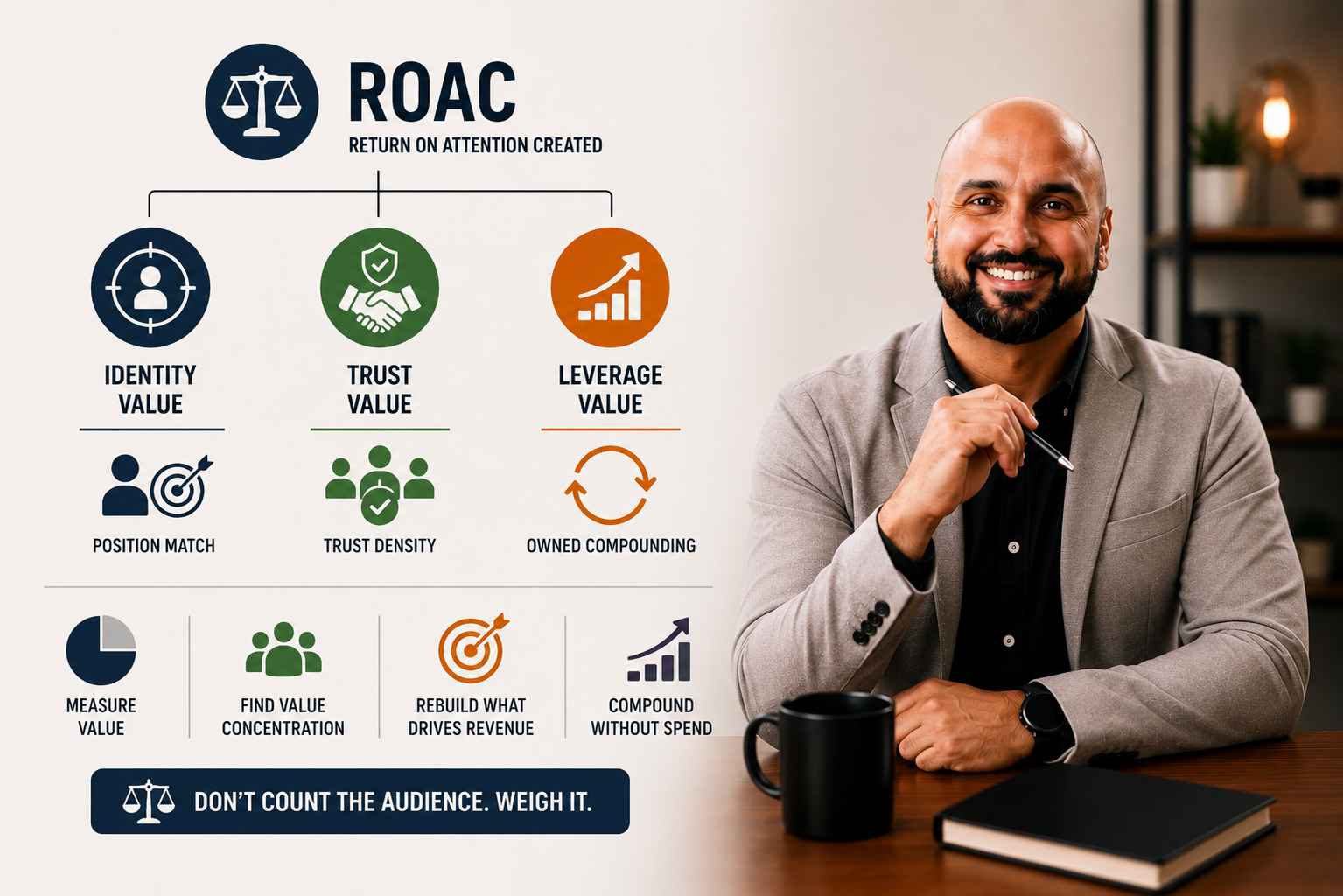
ROAC, Return on Attention Created, the framework from GURU, INC. by AJ Kumar, measures the value side directly. Identity value tracks position match: who knows the founder for the one thing the brand argues. Trust value tracks density: who acts on the judgment.
Leverage value tracks the compounding: what keeps arriving without new spend. The canonical definitions live on the ROAC page, and the full dashboard critique, including why engagement rate joins follower count on the noise side, lives in ROAC versus vanity metrics.
Weighing an existing audience is the fastest diagnostic in founder branding, and it is the first exercise inside personal brand consulting for founders: score the four factors, find where the value concentrates, and rebuild the content engine around what the weighing reveals. Most founders discover their revenue was hiding in five percent of their audience the whole time.
Follower count fails to predict revenue because size and value are independent properties. Position match, trust density, owned access, and buying context predict it instead, and ROAC measures all three values they feed. Do not count the audience. Weigh it.
Does Follower Count Matter for Brand Deals
Sponsors price reach, so follower count sets rate cards in sponsorship markets. Businesses price trust, so conversion follows audience value. A founder monetizing expertise depends on the second market, where composition outweighs the count entirely.
How Many Followers Make a Founder Brand Profitable
No threshold exists, because profitability follows composition. A four-figure audience with high position match and buying context books calls today. Founders monetize trust density at any size, and waiting for a round number delays revenue already available.
When Does a Large Following Help Revenue
A large following helps when the assembly was position-led and the founder captures owned access: email, community, direct channels. Scale multiplies value that already exists per follower. Scale multiplies nothing when the per-follower value sits at zero.
Is Buying Followers Ever Worth It
Bought followers destroy every value factor at once: zero position match, zero trust density, zero buying context. The inflated count also suppresses distribution, since platforms read engagement against audience size. The purchase buys a bigger denominator and nothing else.