
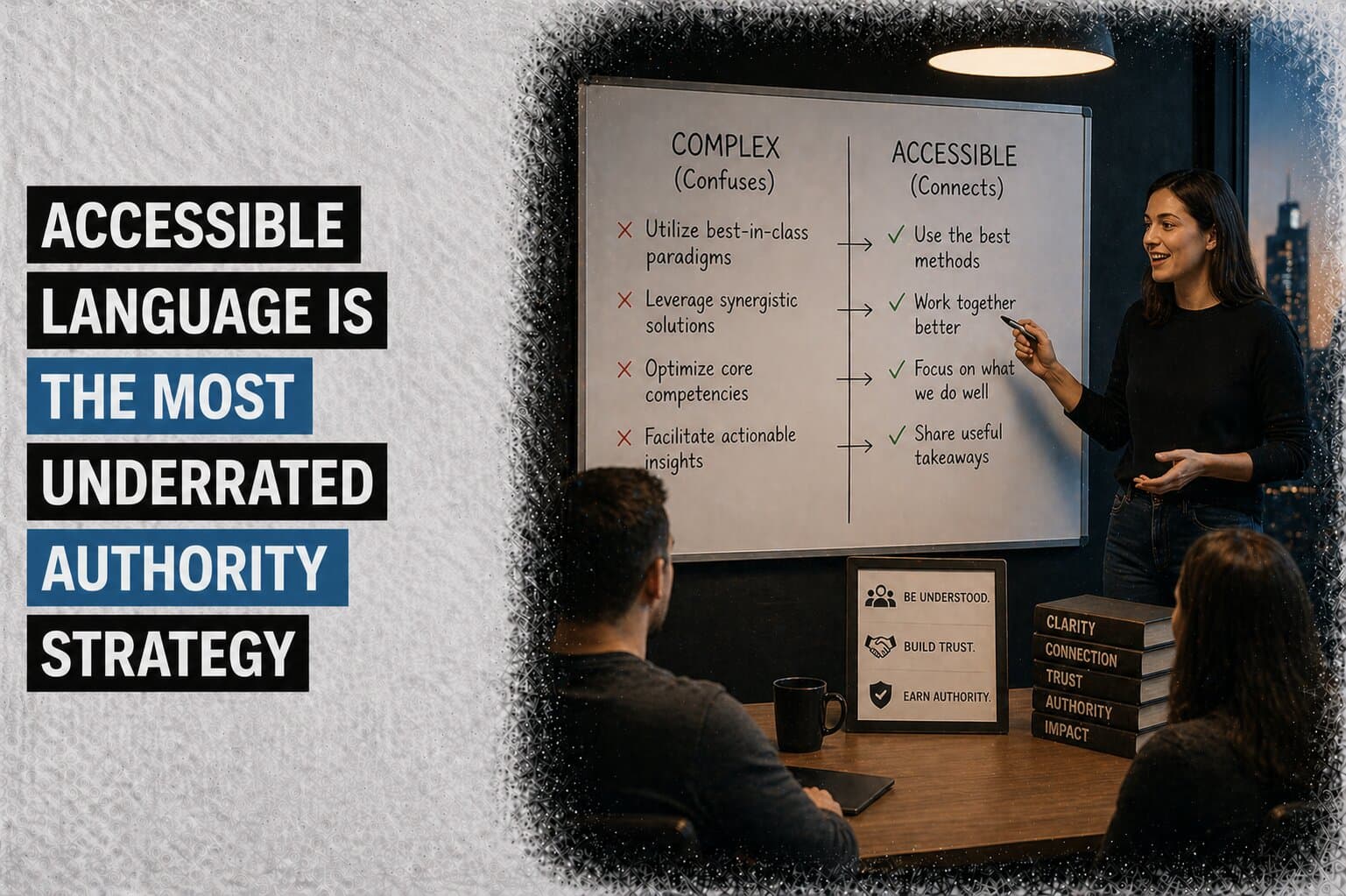
The creators winning attention are not the most sophisticated. They are the most clear. Accessible language is the most underrated strategic advantage in content. AJ Kumar explains how to use it without diluting expertise.
Key Takeaways:
The internet creators winning attention are not the most sophisticated. They are the most clear.
Donald Trump speaks at a fourth-grade reading level, which is why his words travel further than almost any political communicator in the last 50 years.
Neil deGrasse Tyson translates astrophysics into dinner-party language, which is why he reaches millions traditional science communication never could.
The curse of knowledge causes experts to skip the basics, because what they know feels obvious to them but not to anyone else.
The Signal Strength Framework operates at three levels. Wide Signal for capture, Sharp Signal for authority, Deep Signal for reward.
ARIA accessibility standards built for screen readers are the same standards AI agents use to decide which sites to cite.
How a Starbucks Lesson Defined 15 Years of My Communication Strategy
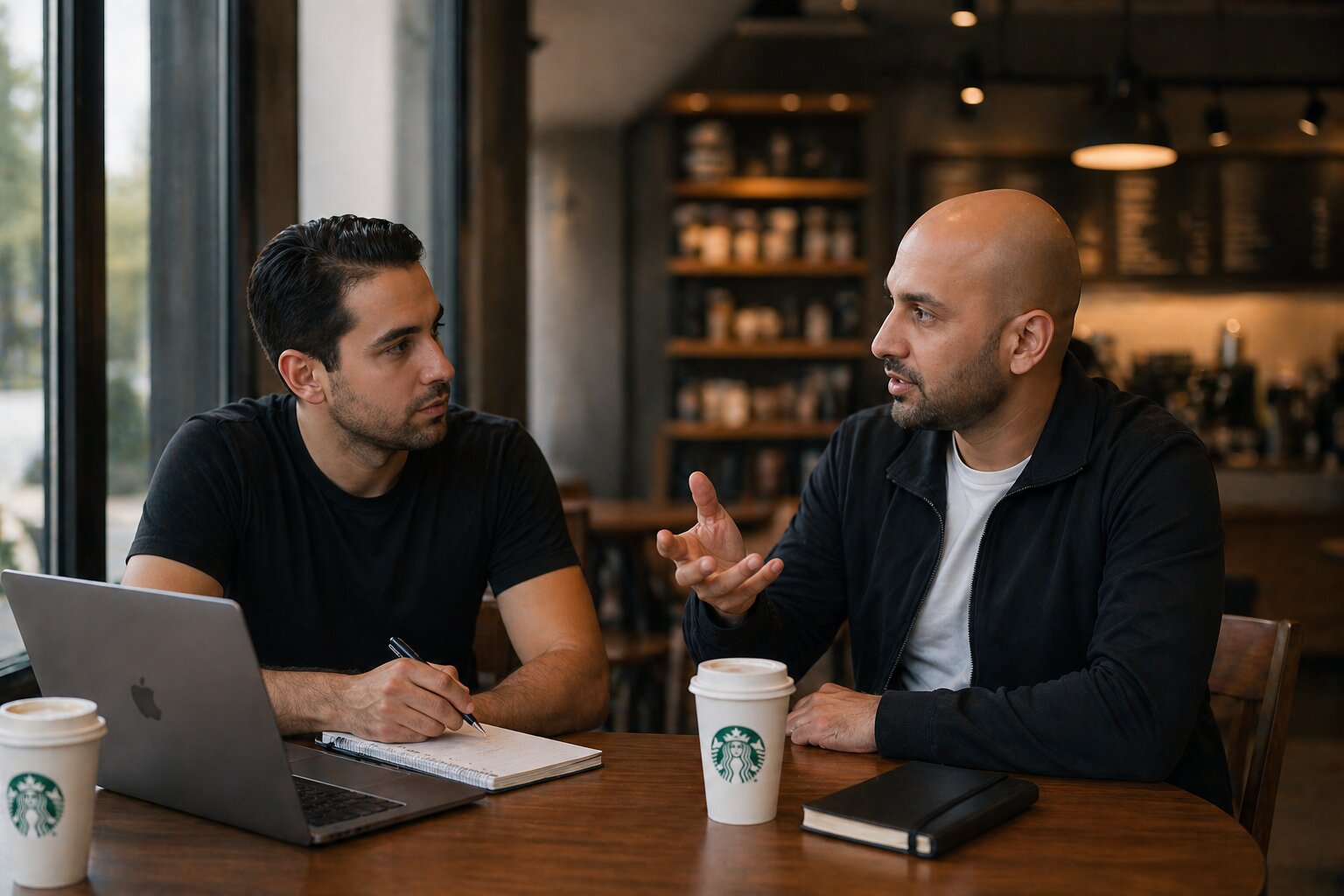
Neil Patel taught me the principle of accessible language at a Starbucks in my early twenties. He was teaching me how to think about writing for the internet. What worked. What did not. Then he said something that sounded almost too basic to matter. "Write at a seventh or eighth grade reading level."
At the time, I treated it like a blogging tip. One of those things you hear, nod at, and file away.
Over the next 15 years, I built brands and studied content. The advice kept proving itself in bigger ways every year. Not because simple writing is better writing. Because accessible language removes the invisible barrier between your idea and the person who needs to hear it.
Neil was not teaching me a readability trick. He was teaching me how communication works online. I did not have the full framework for it yet.
Why Most Experts Overcomplicate Their Content on Purpose
Founders trying to build a personal brand make their content harder to understand on purpose. Not because complexity serves their audience. Because complexity protects their ego.
They are terrified of sounding basic. Terrified that explaining their expertise in plain language will make people think they are not the real deal. So they stack jargon. They write like they are defending a dissertation. They use ten words where three would land harder.
I lived this pattern. Early in my career, I overcomplicated things because I was afraid of being exposed as someone who did not belong. I call this V.O.L.T., the Virus of Limited Thinking. I map it in GURU, INC. It is the invisible belief system that caps your potential before you begin. One of its favorite disguises is convincing you that complexity equals credibility.
A subtler trap catches even well-intentioned experts. The curse of knowledge. Once you have learned something deeply, you cannot unlearn it. You forget what it felt like to not know. So you skip the basics when you explain your work. The basics feel obvious to you. They are not obvious to anyone else.
Einstein said it best. "If you cannot explain it simply, you do not understand it well enough." He was not being humble. He was being precise. The ability to simplify is proof of mastery, not a compromise of it. Complexity does not prove expertise. It exposes insecurity or blind spot.
Why Trump, the Kardashians, and Tyson Use the Same Strategy
Politics aside, certain people dominate attention because they engineer language for accessibility. The pattern repeats across people who could not be more different.
Donald Trump speaks at roughly a fourth-grade reading level. Short sentences. Repeating simple adjectives. Concrete imagery instead of abstract policy language. He says "we are going to build a wall," not "we will pursue thorough border infrastructure reform." He uses nicknames instead of arguments. He repeats phrases until they are memorable.
The language is engineered for maximum accessibility. His words travel further than almost any political communicator of the last 50 years.
The Kardashians built a multi-billion-dollar empire on content that requires no prerequisites. You do not need to understand fashion history or celebrity culture to follow the story. The emotional signal of family, conflict, ambition, and vulnerability is universal. Anyone in the total addressable market can plug in immediately.
Neil deGrasse Tyson takes black holes and quantum mechanics. He talks about them like he is telling a story at a dinner party. Most physicists explain those concepts in ways that lose 99 percent of people. He does not dumb down astrophysics. He translates it. Analogies, pop culture references, conversational language. He reaches millions traditional science communication never could.
These are wildly different people in wildly different spaces. They figured out the same thing. Accessible language is not a limitation. It is a distribution strategy.
How the Signal Strength Framework Maps Reach to Authority

I think about this through a framework I call Signal Strength. Your content is a signal. Jargon, complex sentences, and unstated assumptions are noise. The more noise, the shorter the distance the signal travels.
Accessible language does not weaken your signal. It strengthens it. It strips the interference so the insight travels farther and lands cleaner. When your signal is noisy, you are not protecting your expertise. You are excluding people who should be hearing from you.
The framework operates at three levels.
Wide Signal: Capture Your Market
Wide Signal is the broadest reach play. Content here should be understood by anyone in your space, not the people who already speak your language. Strip cognitive friction ruthlessly. Short sentences. Concrete examples. Clear outcomes. Neuroscientists call this cognitive ease. Information requiring less mental effort gets more attention, more trust, and more retention. Trump's communication style lives at this level. So does Kardashian content.
Sharp Signal: Build Your Authority
Sharp Signal is where accessible language carries real insight. The Neil deGrasse Tyson move. The language stays simple. The ideas get layered. You translate your real expertise into terms that make your audience feel smarter for following you. This is where you build topical authority. You become recognized as the person who explains things in a way no one else does.
A good punchline works on the same principle. Easy setup, surprising payoff. Accessible language gives your audience the easy setup. Your expertise gives them the surprising payoff. That combination is what edutainment content runs on. It is what people remember and share.
Deep Signal: Reward Your Core Audience
Deep Signal is your most specific content. The narrow, advanced, high-stakes applications of your expertise. The playbooks for specific scenarios. The insider frameworks. The "now that you understand the 80 percent, here is the last 20 percent" material. Even at this level, the best communicators are clearer than their competitors.
Why Web Accessibility Standards Decide Which Brands AI Cites
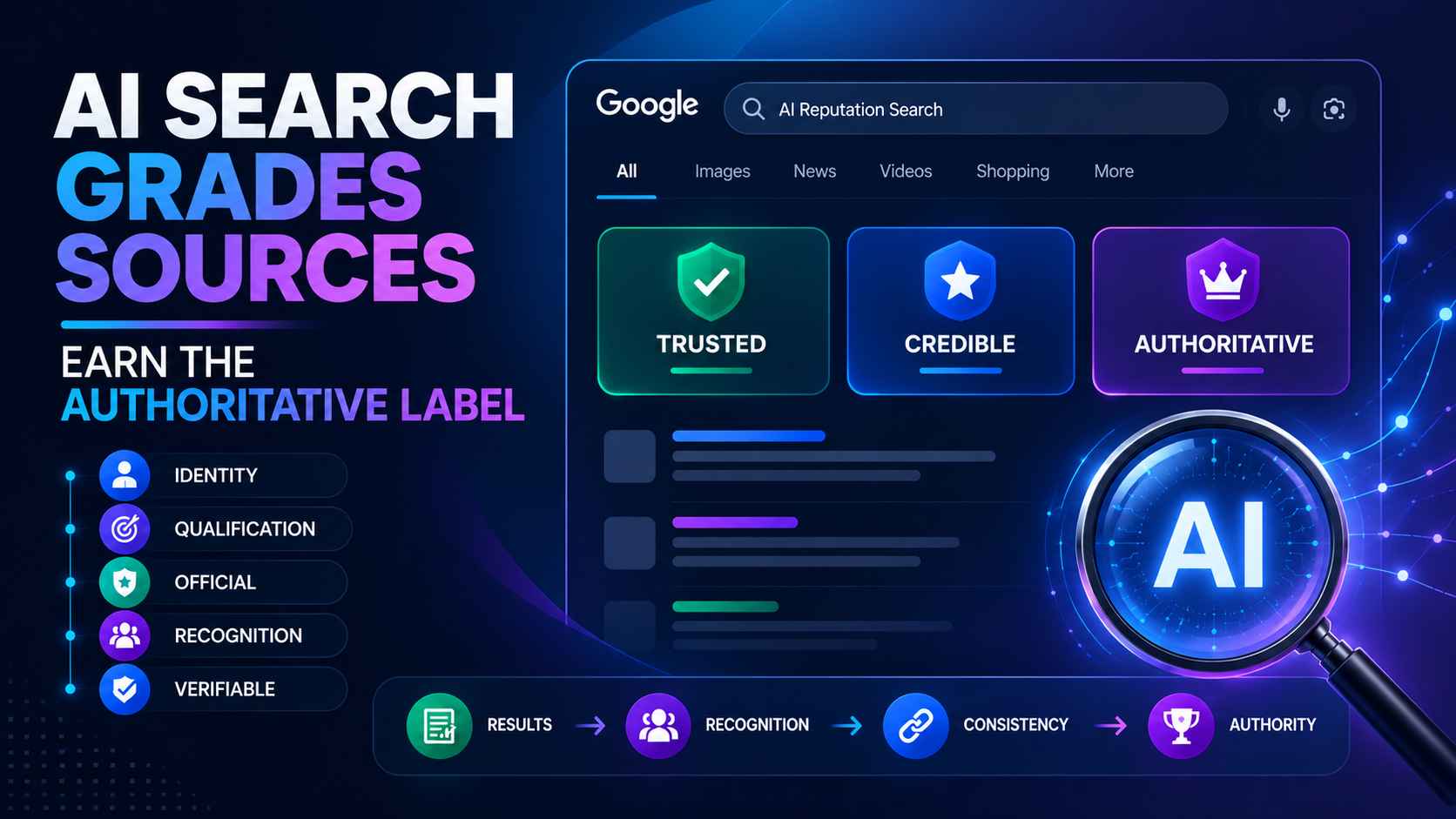
The same accessibility standards built for screen readers are now the standards AI agents use to decide which brands get cited.
The web has had accessibility standards called ARIA for years. Alt text on images. Clear labels on buttons and forms. Proper HTML tags that describe what each element on a page is doing. These standards existed so people with disabilities could navigate the web. A blind user with a screen reader is the canonical case.
The new AI agents and browsers use these same standards to read your website. The alt text that describes an image for a visually impaired user is the alt text an AI agent reads. Both consume the same signal. The same clear labels that help a screen reader help an AI. This mirrors the pattern I mapped in my analysis of how AI citation systems select video sources. Structured, accessible content gets cited. Cluttered content gets skipped.
Accessibility was never a compliance issue. It was always communication architecture. The principles that made content reachable for people with different abilities now make content reachable for AI systems. Those systems increasingly decide which brands get surfaced.
This mirrors what is happening with language. Accessible writing was never about dumbing things down. It was always about making your signal reachable by more people. Accessibility for humans and accessibility for AI turn out to be the same thing.
How Most Experts Build Their Content Backwards

Most experts build their content like a skyscraper that starts on the 15th floor. There is no entrance. No lobby. No way for someone new to walk in and understand what you are about. Then they wonder why their audience is not growing.
The move is to think of your content as architecture. The ground floor is open to everyone in your TAM. Wide signal, maximum accessibility, zero jargon. The middle floors are where you build authority. Sharp signal, accessible language carrying real insight. The top floors reward the people who have been riding the elevator with you. Deep signal. Full nuance. Specific edge cases.
You need all three levels. Most experts only build the top floors. Then they complain that nobody shows up.
Audit your content through this lens. Look at your last ten posts. How many could be understood by someone new to your space who has the problem you solve? If the answer is less than half, you do not have a quality problem. You have an accessibility problem. In the attention economy, that is the same as a growth problem.
Why Strategic Communication Is the Highest-ROI Skill
The creator economy does not reward the person who knows the most. It rewards the person who explains it the best.
Every industry has brilliant experts who cannot communicate beyond a small circle of peers. Every industry also has people with half the expertise and twice the clarity. They build massive audiences. They close bigger deals. They become the recognized authorities in their space.
That is not unfair. That is the game.
When you communicate with accessible language consistently, you build positive associations in people's minds. Your name signals insight that lands. Ideas that respect their time. Over months and years, those associations compound into a personal brand moat nobody else can replicate.
Accessibility is the input. Topical authority is the output. Brand equity is the long-term compounding interest.
The attention economy does not care how much you know. It cares how clearly you can transmit it. And "clearly" does not mean "simplistic." It means removing every ounce of unnecessary friction between your insight and the person who needs it.
The experts who refuse to simplify are not protecting their credibility. They are capping their reach. The ability to send a clean signal that cuts through and changes how someone thinks is the whole game.
Frequently Asked Questions
Why does accessible language matter for a personal brand?
Accessible language reduces the cognitive cost of receiving your ideas. The lower the cost, the further your signal travels. Experts who refuse to simplify cap their reach without realizing it.
What reading level should personal brand content target?
Aim for a seventh or eighth grade reading level for top of funnel content. The principle is cognitive ease. Lower processing cost gets more attention, more trust, and more retention.
Is the Signal Strength Framework only for top-of-funnel content?
No. Wide Signal captures market. Sharp Signal builds authority. Deep Signal rewards core audience. Accessibility is a competitive advantage at every level of depth, even when speaking to advanced readers.
Why do experts overcomplicate their content?
Two reasons. The first is V.O.L.T., the Virus of Limited Thinking, where complexity feels like protection from being seen as basic. The second is the curse of knowledge. Mastery makes the basics feel obvious to the expert and invisible to everyone else.
How does ARIA accessibility connect to AI search?
ARIA standards built for screen readers are the same standards AI agents use to read your website. The alt text that helps a visually impaired user doubles as the alt text AI browsing agents read. Both decide if your page is worth citing.
Does accessible language water down expertise?
No. Einstein's principle holds. The ability to simplify is proof of mastery. Complexity exposes insecurity or blind spot, not depth. Translators outperform specialists in the attention economy.