
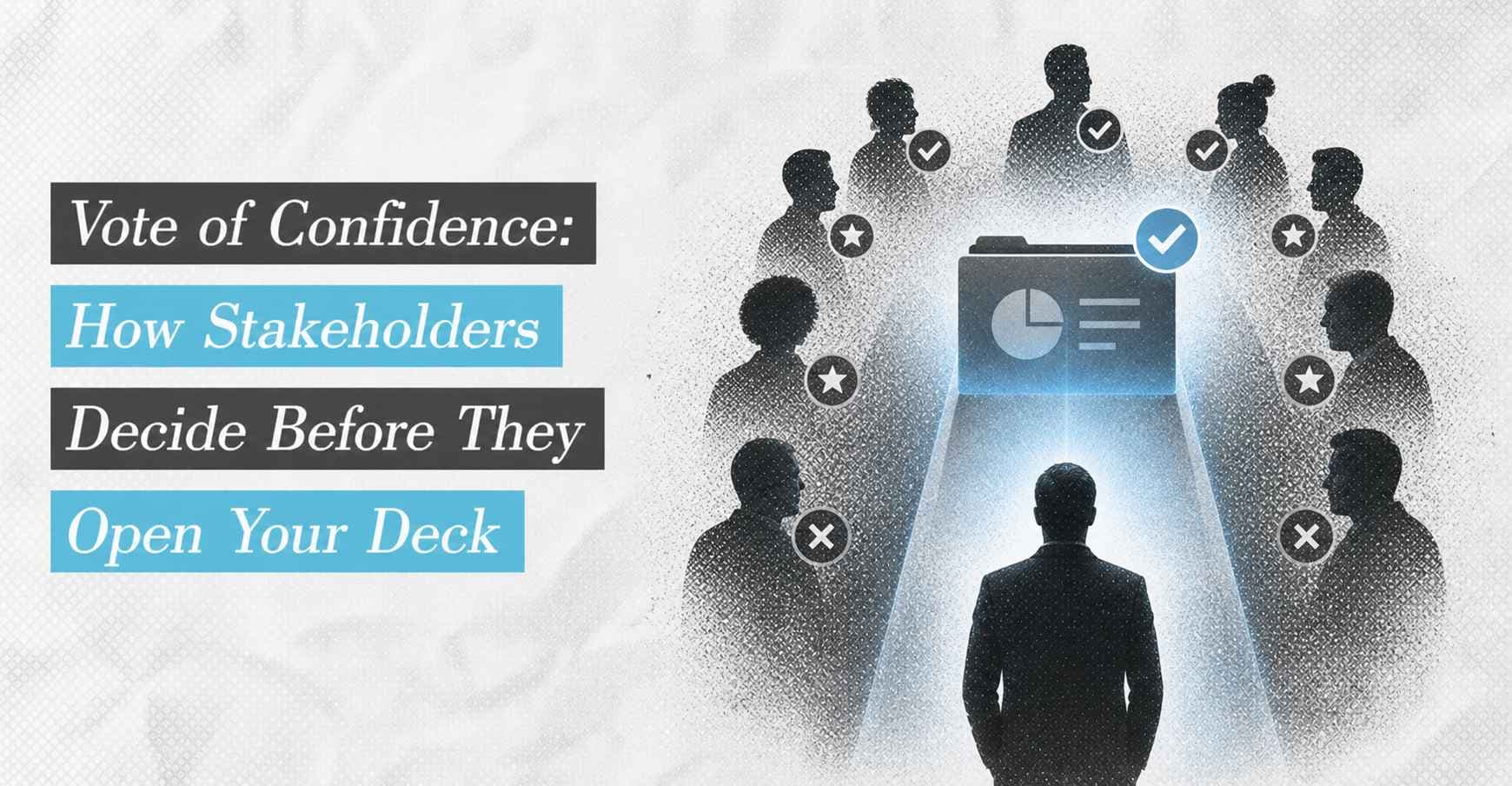
AJ Kumar argues that boards and founders both measure the wrong scoreboard. The fame metric tracks followers. The confidence metric tracks if the people who decide your fate already trust how you think.
Key Takeaways
Harvard professor Gerald Zaltman estimates 95 percent of cognition runs below conscious awareness, including most purchasing and funding decisions
Benjamin Graham's "Mr. Market" framework from 1949 treats markets as emotional first, with prices swinging on mood not fundamentals
A 2025 Journal of Management Studies analysis of 320 S&P 1500 CEOs found posting volume, positive tone, and topic variety predict authority
Content uniqueness and controversy showed no statistically significant effect on CEO social media authority in the same JMS study
2026 Prolific Voices data shows CEO posts get 7x more impressions and 4x more engagement than company page content
Repeated exposure to a founder's thinking builds schema in the stakeholder brain that bypasses re-evaluation and defaults to trust
Why Stakeholders Decide Before the Spreadsheet Opens
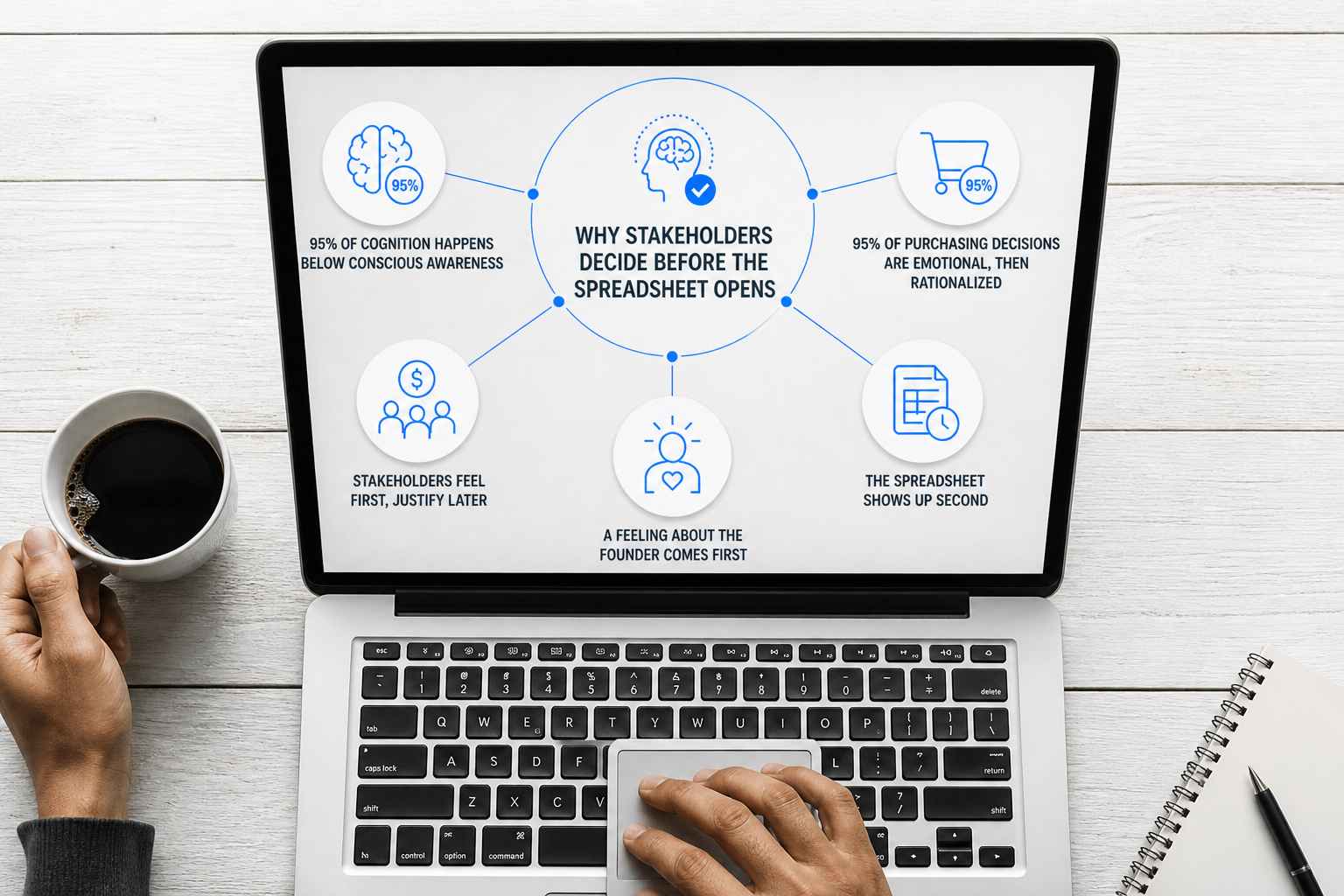
Harvard professor Gerald Zaltman estimates that 95 percent of cognition happens below conscious awareness. Journal of Consumer Psychology research links the same percentage to purchasing decisions made emotionally and rationalized after the fact.
The number has been stable across decades of behavioral research. The implication has not been priced into how founders are evaluated.
Every investor, board member, acquirer, and senior hire believes the spreadsheet drove the decision. The neuroscience says the spreadsheet showed up second. The first thing that happened was a feeling about the founder. The second thing was a financial frame built to justify it.
I saw this up close working alongside Neil Patel at NP Digital. The enterprise clients who converted fastest had been reading Neil for years before any sales conversation started. By the time the call happened, the emotional work was already done. The prospect did not need convincing. They needed a rationalization for a decision they had already made.
Markets Have Always Run on Confidence, Not Fundamentals
Benjamin Graham introduced "Mr. Market" in 1949. A fictional partner who shows up daily offering wildly different prices for the same business based on his mood. The fundamentals do not change. Mr. Market's emotional state does. Graham used the metaphor to explain why prices swing without any change to the underlying company.
John Maynard Keynes wrote about the same mechanism a decade earlier. He compared the stock market to a newspaper beauty contest where the goal is not to pick the prettiest face. The goal is to predict which face the other judges will pick.
Price becomes a recursive confidence game. You are not evaluating the business. You are evaluating what other people feel about the business.
This is not a flaw in markets. It is the operating system. Every fundraise. Every acquisition negotiation. Every public market valuation. The spreadsheet is the second thing that happens. The confidence is the first.
Why the Brain Processes a Founder Through a Different System
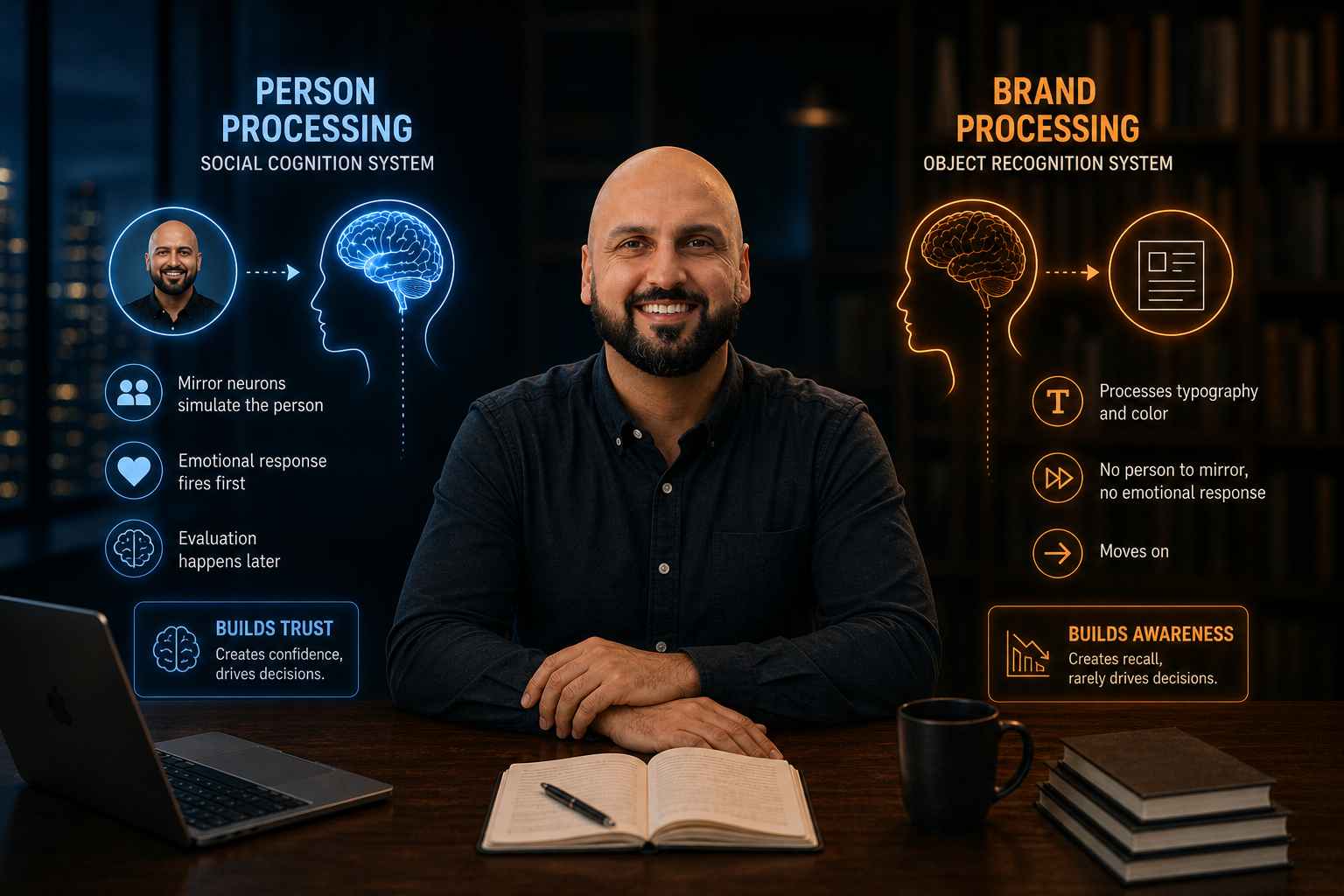
The brain processes a person and a brand through different neural circuits. People run through social cognition. Brands run through object recognition. These are entirely different systems built for different purposes.
Mirror neurons fire when a person observes another person and unconsciously simulate their internal state. If a founder projects certainty in a video, the viewer feels certainty. If the founder projects anxiety, the viewer feels risk. This happens before conscious evaluation. The limbic system fires before the prefrontal cortex finishes reading the deck.
A corporate brand post triggers none of this. There is no person to mirror. The brain processes typography and color, then moves on. This is why CEO posts on LinkedIn get 7 times more impressions and 4 times more engagement than company pages.
The 2026 Prolific Voices Influence Index documents the gap. The algorithm is not biased toward individuals. The biology of brand building is.
The Wrong Scoreboard Boards and Founders Both Use
Both sides of the boardroom misread the metric. The board member who tells the founder to "build a brand" is picturing Elon Musk. The founder who resists the request is picturing the same person. Both are measuring fame instead of confidence.
The fame scoreboard tracks followers, views, likes, and press mentions. The confidence scoreboard tracks something different. Do the 12 people who control your next round, hire, or acquisition already trust your judgment? Fame is loud. Confidence is dense. They look identical from the outside and operate on completely different return models.
Founders confuse the two and avoid visibility because they do not want to perform like an entertainer. Boards confuse the two and benchmark their founder against the wrong reference points. Neither side notices that the game underneath is concentrated trust among a small number of high-leverage people. Followers compound slowly. Confidence compounds among the people who matter, which is what builds a real personal brand moat.
What the Research Rewards in CEO Content
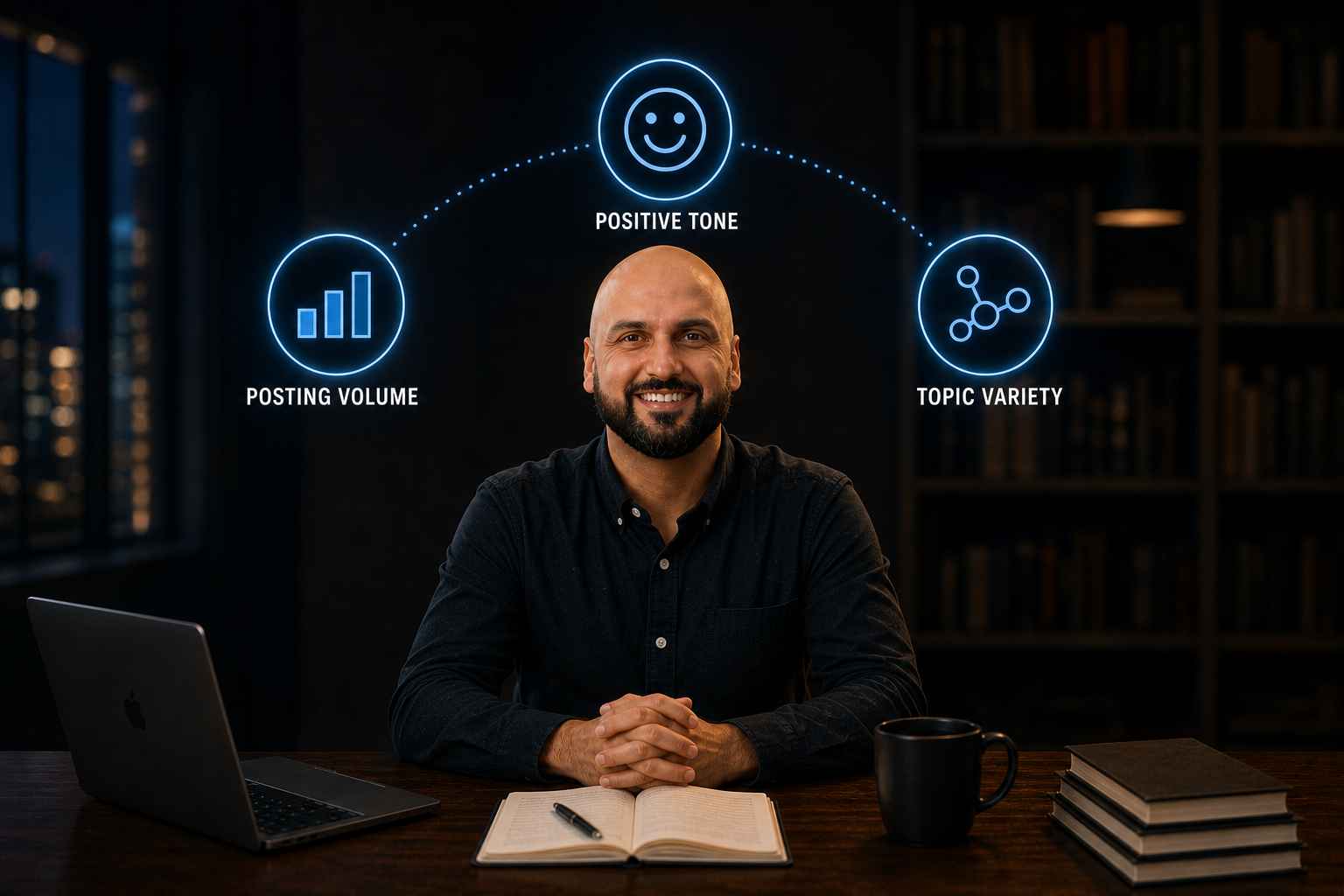
A 2025 Journal of Management Studies analysis examined 320 CEOs of S&P 1500 companies. Three behaviors predicted CEO social media authority. Posting volume. Positive tone. Topic variety. Content uniqueness and controversy showed no statistically significant effect. Loudness was not the variable. Volume of consistent presence was.
This finding flips the Musk model on its head. The behaviors that build CEO authority are not the same behaviors that drive viral attention. The data rewards repetition over outrage. Calm conviction over hot takes. Curiosity across topics over single-issue dominance.
For the founder who resists visibility because the only model in their head is performance art, the research is permission. You do not have to be entertaining. You have to be consistent, positive, and varied across topics. Show up frequently with thoughtful range. The audience that matters is not looking for spectacle. They are looking for evidence of how you think and the authority signals that prove the thinking is yours.
The Hidden Decision-Makers Reading in Silence
The 2026 Prolific Voices Influence Index identified what researchers call "hidden decision-makers." Senior stakeholders who consume executive content silently and form opinions long before any formal conversation. They read posts. They watch interviews. They build a mental model of the founder over months. By the time outreach happens, the trust is already built.
These are the readers founders cannot see in their analytics. The data shows CEO posting frequency increased 52 percent over two years. CEO video usage increased 68 percent. The hidden audience is consuming all of it without leaving a trail.
Laura Lorenzetti at LinkedIn described the gap. Executive content feels closer to how decisions get made. The judgment calls. The tradeoffs. The lived experience. A polished corporate post performs none of that work. There is no person behind it to mirror, simulate, or trust by default. This is also why long-form formats outperform shorts for building authority among hidden stakeholders.
How Repeated Exposure Builds Schema That Bypasses Evaluation
The brain does not evaluate every input from scratch. It builds schema. Mental shortcuts that compress repeated experience into pattern recognition. Once a stakeholder has consumed a founder's thinking 30 times, the brain stops processing them as new. It defaults to the pattern.
The shift is what most founders never see. The first 10 pieces of content do almost nothing. The next 20 build the pattern. After that, the trust is automatic. The audience does not evaluate the founder anymore. They reference the model they already built.
I write about this in GURU, INC. through a framework I call ROAC, or Return on Attention Created. ROAC tracks how attention moves through four neurological gates: Register, Retention, Resonate, and Reinforce. The Reinforce gate is where schema lives. Repeated exposure compounds. It turns a stranger into a stakeholder who trusts your judgment before they meet you.
Confidence Compounds. Fame Decays.
Fame is a stock. It spikes, peaks, and fades. The viral moment delivers a burst of attention that the brain processes once and then forgets unless it gets reinforced. The dopamine hit is loud and short. The schema effect is silent and long.
Confidence is a flywheel. Every consistent piece of content deposits a small amount of trust into the high-leverage stakeholders watching from the side. The deposits look invisible until they suddenly are not. The investor reaches out without warning.
The acquirer mentions you to a partner. The senior candidate accepts before the offer letter arrives. None of those moments show up in a marketing dashboard. All of them show up in the bank account.
The wrong scoreboard makes founders chase the wrong outcomes. The right scoreboard rewards founders who show up with confidence and consistency, in front of the people whose decisions matter. Fame is louder. Confidence is more expensive to ignore.
Frequently Asked Questions
What is the confidence layer in founder branding?
The confidence layer is the emotional and perceptual trust that stakeholders form before any business conversation begins. It sits underneath every financial decision. Stakeholders feel something about the founder before they ever read the deck.
How does the brain process a founder differently than a brand?
A founder runs through social cognition circuits, including mirror neurons that simulate the founder's emotional state. A corporate brand runs through object recognition, which produces no comparable simulation. The brain treats the two as fundamentally different objects.
What does the research say about controversial CEO content?
The 2025 Journal of Management Studies analysis examined 320 S&P 1500 CEOs. Content uniqueness and controversy showed no statistically significant effect on CEO authority. Only volume, positive tone, and topic variety predicted authority growth. Loud is not the same as influential.
Are hidden decision-makers really reading silently?
The 2026 Prolific Voices Influence Index identified senior stakeholders who consume executive content without engaging publicly. They form opinions long before any sales or fundraising conversation begins. The audience founders cannot see is often the audience that matters most.
How long does it take to build parasocial trust with stakeholders?
Parasocial trust forms through repeated exposure over weeks and months, not days. Most founders see traction after 20 to 30 pieces of consistent content. The compounding effect happens silently until it shows up as inbound from people who already trust you.
Why do CEO posts outperform company page posts?
The brain processes a person and a brand through different neural circuits. CEO posts trigger social cognition and mirror neurons. Company page posts do not. The 2026 Prolific Voices Index measured the gap at 7x more impressions and 4x more engagement.