
They follow him like a movement. Eric Hoffer wrote the operating system in 1951. AJ Kumar maps the four ingredients of every cult brand and the ethical line every founder must hold.
Key Takeaways
A cult brand is a small mass movement. Eric Hoffer described the operating system in 1951. Modern founders run on the same code.
Alex Hormozi sold 2,917,443 copies of $100M Money Models in 24 hours. The audience acts like a religion, not a customer base.
Your brain treats cult brands like real relationships. The ventromedial prefrontal cortex processes loyal founder brands using self-knowledge circuits.
Every cult brand has four ingredients: Doctrine, Devil, Ritual, Identification. Most founders have one, maybe two. Cult brands have all four.
Hoffer warned that movements need belief in a devil more than belief in a God. Most founders are too polite to name theirs.
Cult brand mechanics work for movements that improve lives and for actual cults. The founder chooses which one to build.
A cult brand is a small mass movement.

Most marketing literature defines cult brands by the symptoms. Loyal customers, tattoos, line-ups outside stores, defenders in the comment section. The symptoms are real, but the cause is older than marketing. Eric Hoffer wrote the operating system in 1951 in a book called The True Believer.
He was studying religion, politics, and revolution. He never wrote a marketing book in his life. But every cult brand worth following is now running his code.
Hoffer's central observation is brutal. People do not join movements because they are persuaded. They join because they are looking to escape an unwanted self. They surrender the small self to a bigger story. That is the same dynamic underneath every cult brand. The audience is not buying products. The audience is borrowing a future identity.
Joel Osteen runs a one-show system in a 45,000-seat venue. Martha Stewart built a personal media company that still moves a billion dollars at Kmart. Hormozi is the modern version on a phone. The platforms collapsed the cost of religification. A founder with a camera can now do what used to require a denomination or a network.
Alex Hormozi turned acquisition into a religion.
On August 17, 2025, Hormozi sold 2,917,443 copies of $100M Money Models in twenty-four hours. Each copy was priced at $29. The launch happened in Las Vegas. He broke the Guinness World Record for the fastest-selling nonfiction book in history. He broke the prior record in under three hours. The launch event ran nine hours live.
That is not a book launch. That is a religious holiday. Customers showed up at midnight to buy a book they could have read for free. The full content was already on his YouTube channel. The behavior makes no sense if you frame Hormozi as a business author. The behavior makes complete sense if you frame him as a founder running Hoffer's operating system.
The doctrine is one line: offers are everything. The devil is fake gurus who sell information without ever building a real business. The rituals are daily content, free playbooks, and the annual summit. The identification markers are the black-and-white aesthetic, the shaved head, the bodybuilder cadence, the word "operator." Every signal repels the wrong audience and bonds the right one.
The Acquisition.com empire architecture is one layer. The cult brand is the layer underneath.
Your brain treats cult brands like real relationships.

When a viewer forms a long-term attachment to a founder, the encoding pathway changes. New content from that founder shifts from hippocampus to medial prefrontal cortex. The brain no longer processes the founder as a stranger. It processes them through the same circuit it uses for friends and family.
The deeper layer is parasocial identification. Mitchell, Macrae, and Banaji published foundational fMRI work in 2006 in the journal Neuron. They found that the ventromedial prefrontal cortex activates when subjects think about people they perceive as similar to themselves. That same region activates when subjects think about themselves. The neural overlap is real.
The implication is the wiring inside a cult brand. A loyal audience does not merely admire the founder. The brain literally processes the founder using the self-knowledge circuit. That is why audiences defend founders like they are defending themselves.
The neural gate I built around this in ROAC is called Reinforce. ROAC tracks attention through four gates: Register, Retention, Resonate, Reinforce. Cult brands are won at the fourth.
Eric Hoffer wrote the operating system in 1951.
Hoffer was a longshoreman who became a self-taught philosopher. The True Believer is his analysis of why people surrender themselves to mass movements.
He studied early Christianity, Islam, the French Revolution, Bolshevism, Nazism, Zionism, and the Puritan revolution. He found something disturbing. The doctrines were different. The mechanics were identical.
The operating system has five components. A holy cause that demands self-renunciation. A doctrine that promises a future and tolerates no critique. A devil that unifies the followers through hatred. Rituals that strip individual identity and replace it with collective belonging. And three leader types in succession. The man of words discredits the old order. The fanatic hatches the movement. The practical man of action consolidates it.
Hoffer never wrote a sentence about cult brands. He did not have to. The system was already in the human operating system. Modern founders are rediscovering it with cameras instead of pulpits.
The line I keep returning to comes from his chapter on hatred. "Mass movements can rise and spread without belief in a God, but never without belief in a devil."
The four ingredients every cult brand has.
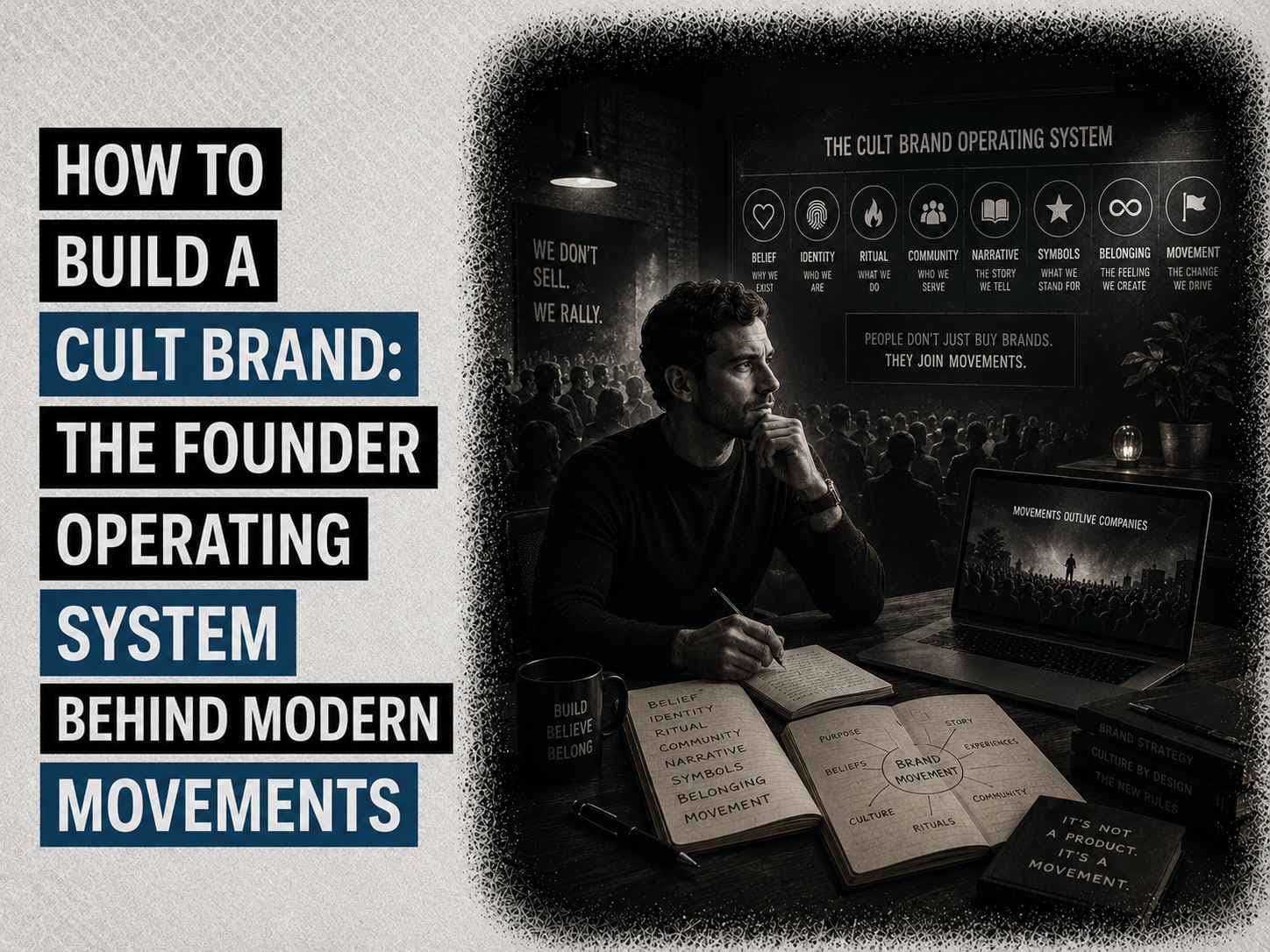
Every cult brand runs on four ingredients. Doctrine, Devil, Ritual, Identification. Call it the Cult Brand Stack. Most founders have one, maybe two. Cult brands have all four.
Doctrine is a worldview, not a content pillar. A pillar is a topic. A doctrine is a claim about how the world should be. Hormozi's doctrine is one line: offers are everything. The audience finishes the sentence for him.
Devil is the unifying enemy. Hoffer was right that movements need a devil more than a God. Hormozi's devil is fake gurus who sell information without operating a real business. Apple's devil was the man in the gray suit. The devil does not have to be a person. It has to be specific.
Ritual is the recurring rhythm. Daily content, free books, the annual summit, the morning post, the catchphrase, the closing line. Ritual is how identification becomes habit. Without ritual, devotion fades. The Reinforce gate is built on repetition.
Identification is the visible signal. Who you are for and who you are not for. Hormozi's black-and-white aesthetic, the shaved head, the language of operators versus marketers. Every cult brand signals this aggressively in the first three seconds. The signals repel the wrong audience faster than they attract the right one.
I have watched this play out with my own clients for more than 20 years. The founder who commits to one doctrine, one devil, one ritual, and one identification set builds something rare. The industry calls it a cult brand. The founder who tries to be liked by everyone builds nothing of consequence. The cult brand is built when the four ingredients are designed together, not assembled separately.
The line between religification and Darketing.

Hoffer was morally neutral on the mechanics he described. He observed that mass movements work the same way for liberating causes and destructive ones. The mechanics do not care. The doctrine does not care. The audience does not care in the moment. The founder is the one who decides which brand the mechanics are being used to build.
I call the exploitative version Darketing. Darketing is the use of cult brand mechanics on an audience the founder does not serve. The doctrine becomes a trap. The devil becomes a distraction from the founder's own failure to deliver. The rituals become hooks. The identification becomes a cage.
Hormozi has chosen the other side. He gives away the playbook for free. The book costs $29, not $5,000. The frameworks are the same ones he uses inside Acquisition.com. The doctrine is meant to make the audience richer, not the founder.
That is the test every founder must hold. The same mechanics that built Patagonia built Jonestown. The founder chooses which one to build.
How to start building your cult brand this week.
How to start building your cult brand this week is the work itself, not a posting strategy. It is the foundational work of building authority that compounds for decades.
First, write your doctrine in one sentence. Not three topics. Not a content calendar. One claim about how the world should be. Repeat it until the audience finishes it for you.
Second, name your devil. The person, the practice, the lazy assumption your brand exists to dismantle. Be specific enough that someone reading the sentence knows immediately who you are not for.
Third, design one ritual. A weekly format, a daily post, a recurring signature line. The ritual is not a tactic. It is the construction of the Reinforce gate where loyalty compounds.
Fourth, build the identification signals. Visual identity, language patterns, in-group vocabulary. Every signal makes the right person feel found and the wrong person feel excluded. That is the design, not the side effect.
The cult brand will not appear overnight. The four ingredients have to compound for years. Hormozi published daily for almost a decade before the audience showed up in cars at midnight. Your job for the next decade is the same. Doctrine. Devil. Ritual. Identification. Repeated until the audience finishes your sentences.
Frequently Asked Questions
What is a cult brand?
A cult brand is a brand whose audience behaves like a small mass movement. Loyalty patterns mirror religious or political devotion, not normal consumer behavior. The audience does not consume the brand. They identify with it.
Why is Hormozi considered a cult brand?
Hormozi's audience displays movement-level loyalty. Customers showed up at midnight to buy a book they could have read for free. The brand has doctrine, a clear enemy, daily rituals, and aggressive in-group identification signals.
What is religification in branding?
Religification is Eric Hoffer's term for turning a practical purpose into a holy cause. Applied to founder brands, it is the work of making what you do feel sacred. Audiences identify with the doctrine instead of merely buying the service.
What is the difference between a cult brand and a regular brand?
Regular brands sell products. Cult brands sell identity. Customers of a cult brand define part of who they are by association with the founder. Regular brands compete on features and price. Cult brands compete on meaning.
Is building a cult brand ethical?
The mechanics that build cult brands also built religions, political movements, and historical cults. The mechanics do not determine the outcome. The founder's intent does. The ethical question is this: does the doctrine improve the audience's life or extract from it?
How long does it take to build a cult brand?
Hormozi published daily for nearly a decade before his audience showed up at midnight. The book sold 2,917,443 copies in twenty-four hours at $29 each. Cult brands compound over years, not months.