
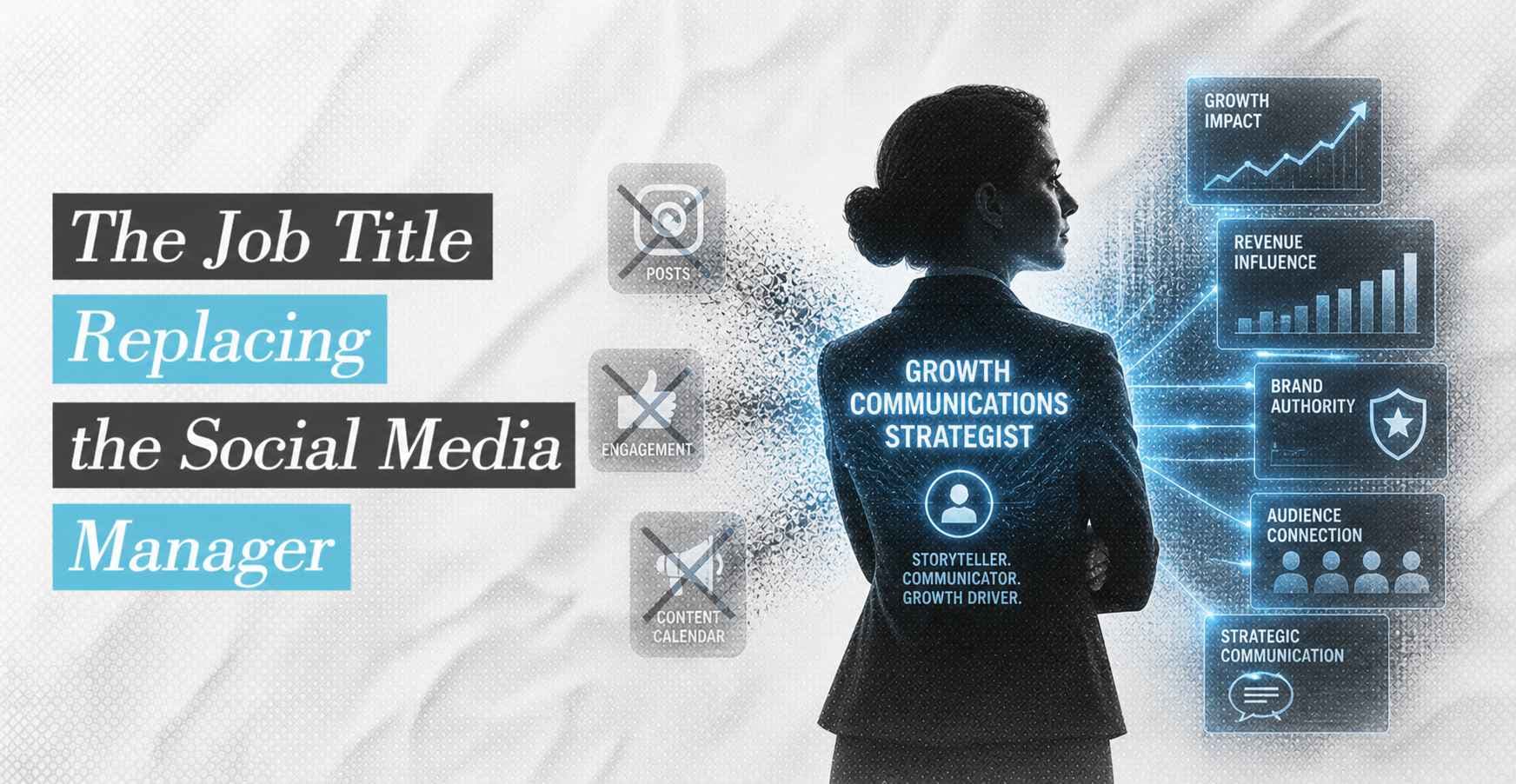
This post breaks down what the role does, why interconnected thinking now decides which businesses get found, and what to look for when building a content operation that runs across TikTok, Google, Reddit, and ChatGPT.
Key Takeaways
Discovery has shifted four times in fifteen years: Google to Yelp to social media to AI tools like ChatGPT and Perplexity.
The social media manager role was built for maintenance. The job most businesses need now is a full-stack content creator.
A full-stack creator owns three outcomes at once: visibility, demand, and booked appointments or sales.
Interconnected thinkers build ecosystems where TikTok, Reddit, blog posts, and AI tools all reinforce each other.
Taste, strategy, and consistency outperform technical skill. You can teach editing. You can not teach taste in a week.
For an in-house content creator, expect to pay $4,000 to $10,000 per month. One client typically funds the entire role.
There is a jewelry store on the third floor of a building in the Jewelry District in Los Angeles. No storefront. No street-level signage. No reason a stranger would ever find it.
I stumbled in with my girlfriend because her mom needed a ring repaired. While I was there, I asked the guy behind the counter how they get customers. Third floor, no foot traffic. The math did not add up.
He told me most of their business comes from TikTok. Not referrals. Not walk-ins. TikTok. They hired a full-time, in-house content creator a couple of years ago and have not looked back. Before that, it was Yelp. Before Yelp, Google. The channel kept changing. They kept moving with it.
We left to find a different jeweler for another part of the ring. My girlfriend searched on ChatGPT, found a place, messaged them, and mentioned how she found them. The owner wrote back: "That is funny. I do not even know what ChatGPT is. Apparently a lot of customers are finding us there. Reddit too."
He had no idea. But the infrastructure he had built, the content, the presence, the third-party mentions, was working without him.
That is the world your business is operating in right now. Not in five years. Today.
How People Find Businesses Has Changed Three Times in Fifteen Years
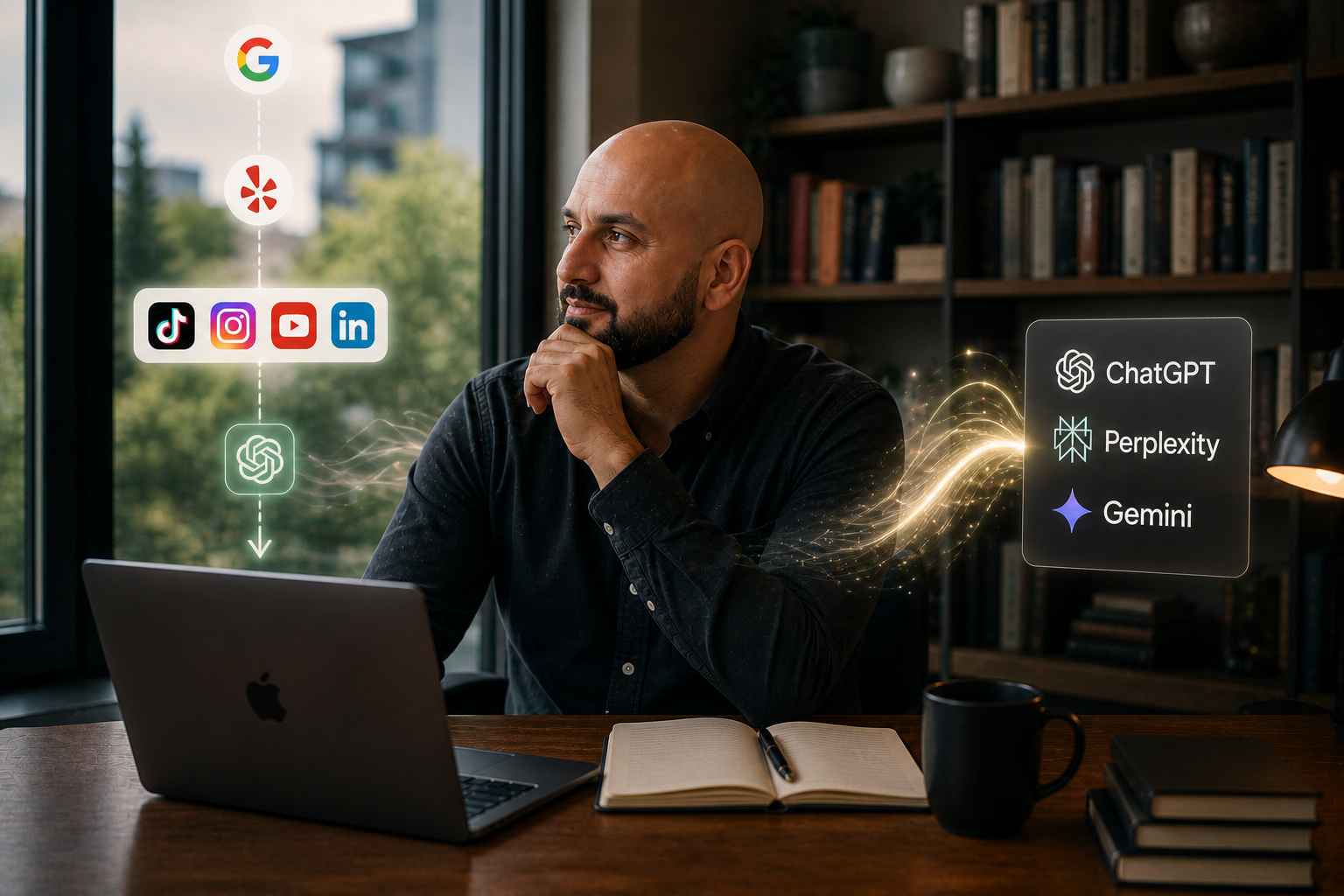
Discovery has shifted three times in fifteen years.
In the early 2000s, Google decided who got found. You ranked in search, you got customers. Businesses poured money into SEO and it worked. Then came Yelp and review platforms. Trust shifted from websites to other people's opinions. Presence meant having reviews.
Then came social media. Discovery moved into short videos, stories, and posts. The businesses generating attention were the ones growing.
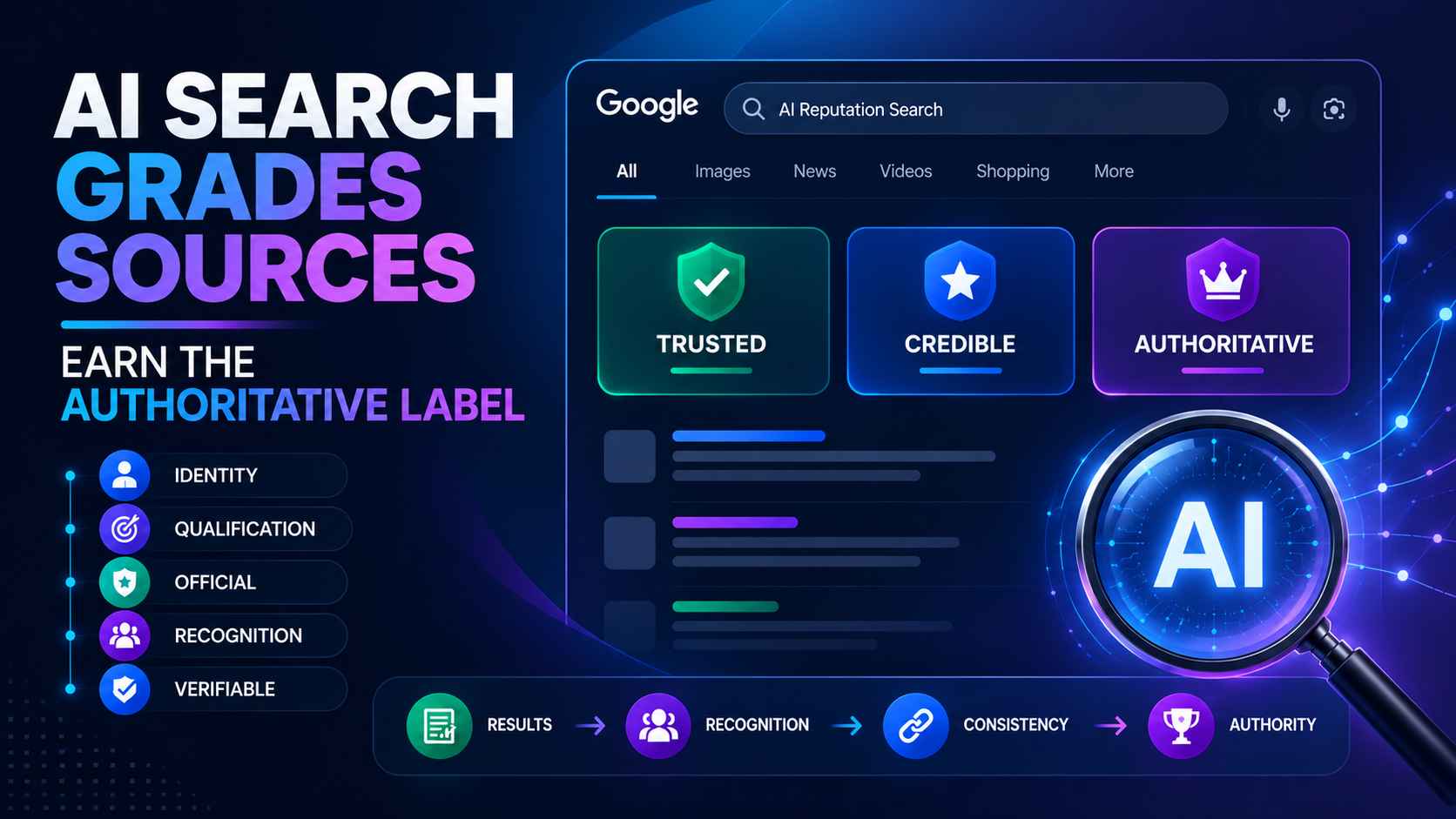
Now we are entering the next layer. AI systems like ChatGPT, Perplexity, and Gemini pull recommendations from across the internet: Reddit threads, TikTok comments, blog posts, third-party platforms. They surface businesses to people who never typed a query into a traditional search engine.
The authority signals these tools read live everywhere your audience already spends time, not on one domain.
Every time the channel shifted, the businesses that adapted earliest won. The ones that waited lost ground they never recovered. The businesses winning right now are not the ones with the best product. They are the ones that understood where attention moved and built there first.
Social media is where attention is now. AI systems are training on what social media and the web produce. Your content today is feeding your discoverability tomorrow.
Most businesses still have no real answer to this. The reason almost always traces back to one decision: they hired the wrong person for the job.
Why the Social Media Manager Era Is Over
The social media manager job title never matched what the job needed to be.
When social mattered for business, companies did what they always do. They created a title. Most social media managers were hired to do one thing: maintain a presence. Post consistently. Keep the accounts active. Respond to comments. Design graphics in Canva.
That is not a content operation. That is maintenance. And maintenance does not build businesses. It keeps the lights on.
What businesses need is not someone to manage their presence. They need someone to build it, from strategy to execution to results. Someone who understands how discovery works, how to turn a viewer into a lead, and how to turn a lead into a booked appointment or a sale.
The hire most businesses think they are making and the hire they need are not the same person.
What a Full-Stack Content Creator Does
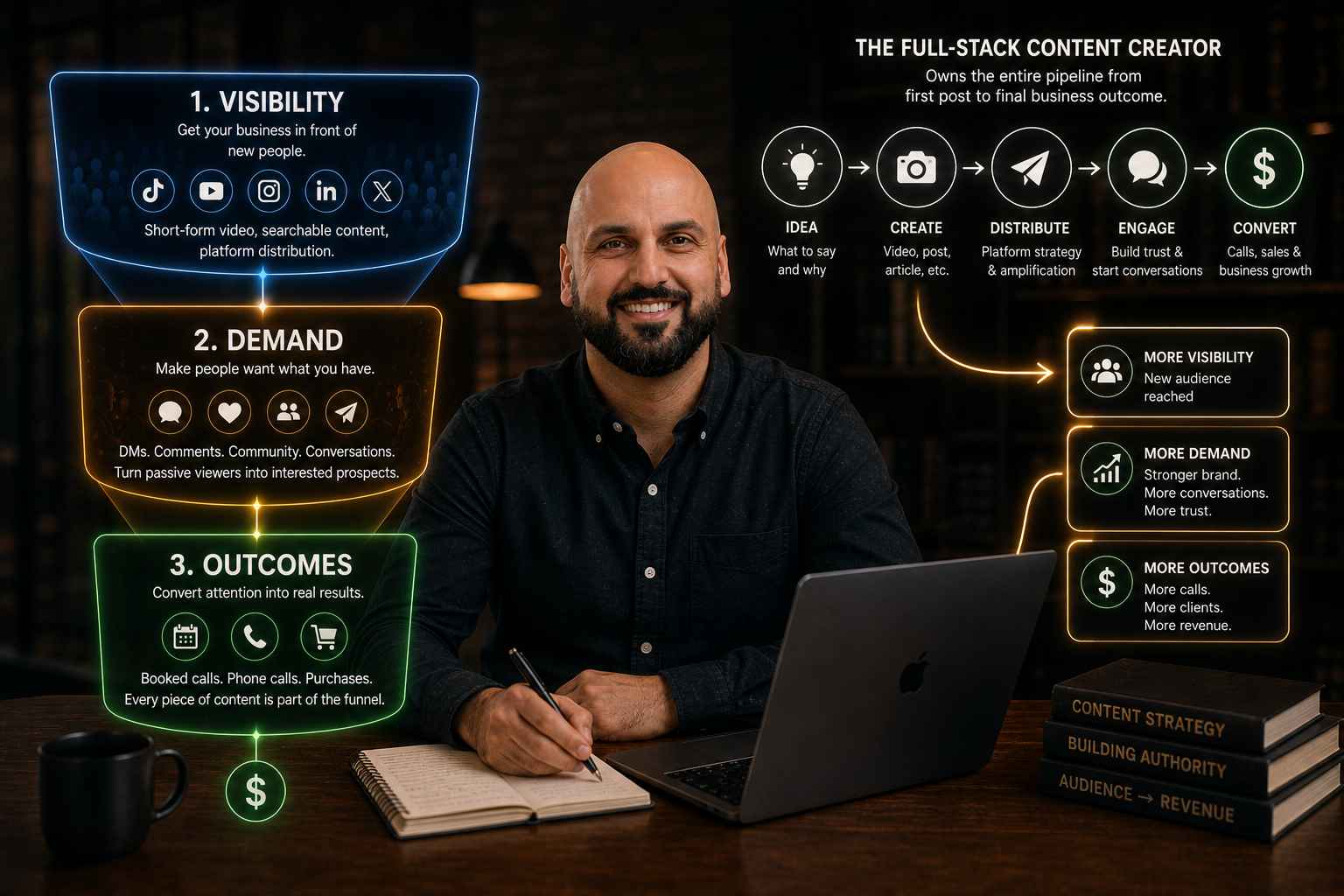
A full-stack content creator owns the entire pipeline from first post to final business outcome.
The term comes from software. A full-stack developer can build the front end and the back end. A full-stack content creator is the same idea applied to content. They do not film and stop. They do not post and stop. The role has three targets, and every piece of work serves one of them.
Visibility is the top of the funnel. Getting your business in front of people who do not know you exist. Short-form video, searchable content, platform distribution. Anything that expands reach into new audiences.
Demand is the middle. Once someone finds you, they have to want what you have. This is where content strategy gets sophisticated. It is not about going viral. It is about creating content that makes people feel they would be missing out by not engaging. The DMs, the comments, the community, the conversations that turn passive viewers into interested prospects.
Outcomes is the close. Booked appointments. Phone calls. Purchases. The full-stack creator treats every piece of content as part of a funnel, and the funnel has to convert. They are thinking about what happens after someone watches, and building the path that gets them there.
Most social media managers focus on visibility and stop. A full-stack creator treats all three as one job. That is the difference between a social account and a personal media company that compounds attention into revenue.
The Thinking Style That Separates Good Creators from Great Ones
There are two ways people approach content. Only one of them compounds.
The first is one-at-a-time thinking. Every post is its own isolated task. Film a video. Post it. Move on. Each piece is a separate event, disconnected from everything else.
The second is interconnected thinking. Every piece is part of a larger ecosystem. A short-form video on TikTok feeds discoverability on Instagram. A blog post surfaces in Google and gets cited by AI tools. A Reddit mention validates the brand to someone who found you on YouTube. Everything is talking to everything else.
The goal of interconnected thinking is topical authority. Becoming the most recognized name in your niche across every surface where people are looking. That does not happen one post at a time. It happens when someone treats social media as a strategic game where every move feeds the next one.
When you interview, probe for this. Ask how they think about content strategy. If they immediately say "we will post three times a week on Instagram," that is one-at-a-time thinking. If they start talking about platform distribution, content pillars, and how one piece of content can live in many places, that is an ecosystem thinker.
How to Find and Hire This Person
A full-stack creator is hard to find. The skill set does not come assembled out of the box. Here is how I rank what to look for.
Taste is hardest to teach and most valuable. In a world flooded with AI-generated content, taste is what makes work feel different. You either feel it or you do not. It develops over years of exposure. It can not be trained in a week. When you look at someone's work, ask yourself if it feels considered. Taste is the one creative skill that does not get cheaper as AI gets better.
Strategy is the ability to think through the full picture. What to make, where it goes, why it serves the business, how to adapt when something is not working. Strategic thinkers are not executing tasks. They are building something. You will know strategy is present when someone tells you not only what they would do, but why.
Consistency is a character quality more than a skill. Content compounds through repetition. Trust is built each time someone sees your content and gets value from it. A creator who shows up brilliantly for three weeks and then disappears does not build that.
Skills like filming, editing, writing, and analytics can be learned. They matter, but they are the easiest gap to close. Do not over-index on technical skill at the expense of the three above.
A red flag: someone highly entrepreneurial who is mainly trying to build their own brand. You want an intrapreneur. Someone who wants to win inside your organization, not use it as a launchpad for their own.
You do not need a creator with a big following. You need evidence they have tried to build something. A small but consistent YouTube channel. A TikTok account with a real strategy. Work for a previous employer. Ask for a video resume if the role is on-camera. That one request tells you more than an hour-long interview.
For an in-house hire, expect $4,000 to $10,000 per month depending on experience and market. That sounds like a lot until you compare it to what one customer is worth to your business. The jeweler on the third floor with no foot traffic generates most of his revenue from this one function. The math works.
What You Are Buying
When you hire a full-stack creator, you are not buying posts. You are buying a compounding asset.
GURU, INC. is built around a framework I call ROAC, Return on Attention Created. ROAC tracks attention through four neurological gates, Register, Retention, Resonate, Reinforce, that produce one algorithmic outcome: Reach. Every piece of content either compounds trust through those gates or burns it.
Most people measure views and follower counts. ROAC measures something different. It tracks if the attention you are creating is producing trust, intent, and revenue. Trust escalates from "I have seen them before" to "I follow everything they put out" to "I would not hire anyone else." Trust converts to intent. Intent converts to revenue.
This does not happen from one video. It happens from a content operation that runs consistently over time, with someone at the helm who understands the full system. The businesses that build this become the obvious choice in their market. People find them on TikTok, on ChatGPT, in Reddit threads, across every surface where attention lives, because their content is everywhere their audience is looking. That loop, run consistently, becomes a personal brand moat competitors can not buy their way past.
The Closing Thought
The second jeweler did not set out to build an AI-discoverable business. He built a real presence on the internet over time. Other people talked about him. Content existed. Third-party platforms picked it up. The infrastructure worked without him understanding it.
That is the opportunity and the warning. You do not need to understand every algorithm. You need someone on your team who does. Someone building the ecosystem on purpose, not hoping the algorithm figures it out.
Discovery is not waiting for you to be ready. It is happening right now, for every business in your category.
The question is if your business shows up when it does.
Frequently Asked Questions
What is a full-stack content creator?
A full-stack content creator owns content end to end: strategy, production, distribution, and conversion. Unlike a social media manager who maintains a presence, a full-stack creator is responsible for visibility, demand, and revenue outcomes from the same role.
Should I hire in-house or work with a freelancer?
For founder-led personal brand content, freelancers and agencies can work. For a product or service business that needs consistent output every week and tight integration with sales, an in-house full-stack creator is the long-term answer.
How much does an in-house content creator cost?
Expect $4,000 to $10,000 per month for an in-house hire, depending on experience and market. The break-even is usually one customer or client. For most service businesses, a single deal funds the entire role for the year.
Do they need a big personal following to be a good hire?
No. A large audience is not the qualifier. Evidence that they have tried to build something, a consistent channel, a strategic account, real client work, matters far more. Skills with no vehicle yet often make the best hires.
What does AI search like ChatGPT and Perplexity have to do with content hiring?
AI tools pull recommendations from social platforms, Reddit, blog posts, and third-party sites. The businesses cited are the ones with consistent, interconnected content across surfaces. A full-stack creator is the role that builds that footprint on purpose.
How do I know if a candidate is an interconnected thinker?
Ask them how a piece of content lives across platforms. One-at-a-time thinkers describe a posting cadence. Ecosystem thinkers describe how a video feeds a podcast clip, a blog post, a Reddit answer, and an AI citation, all reinforcing one topical authority.
Is the social media manager role completely dead?
The title still exists at large enterprises that already have separate content, brand, and performance teams. For most businesses, the role as commonly hired, posting and community maintenance, is no longer the job that drives growth. The full-stack creator is.