
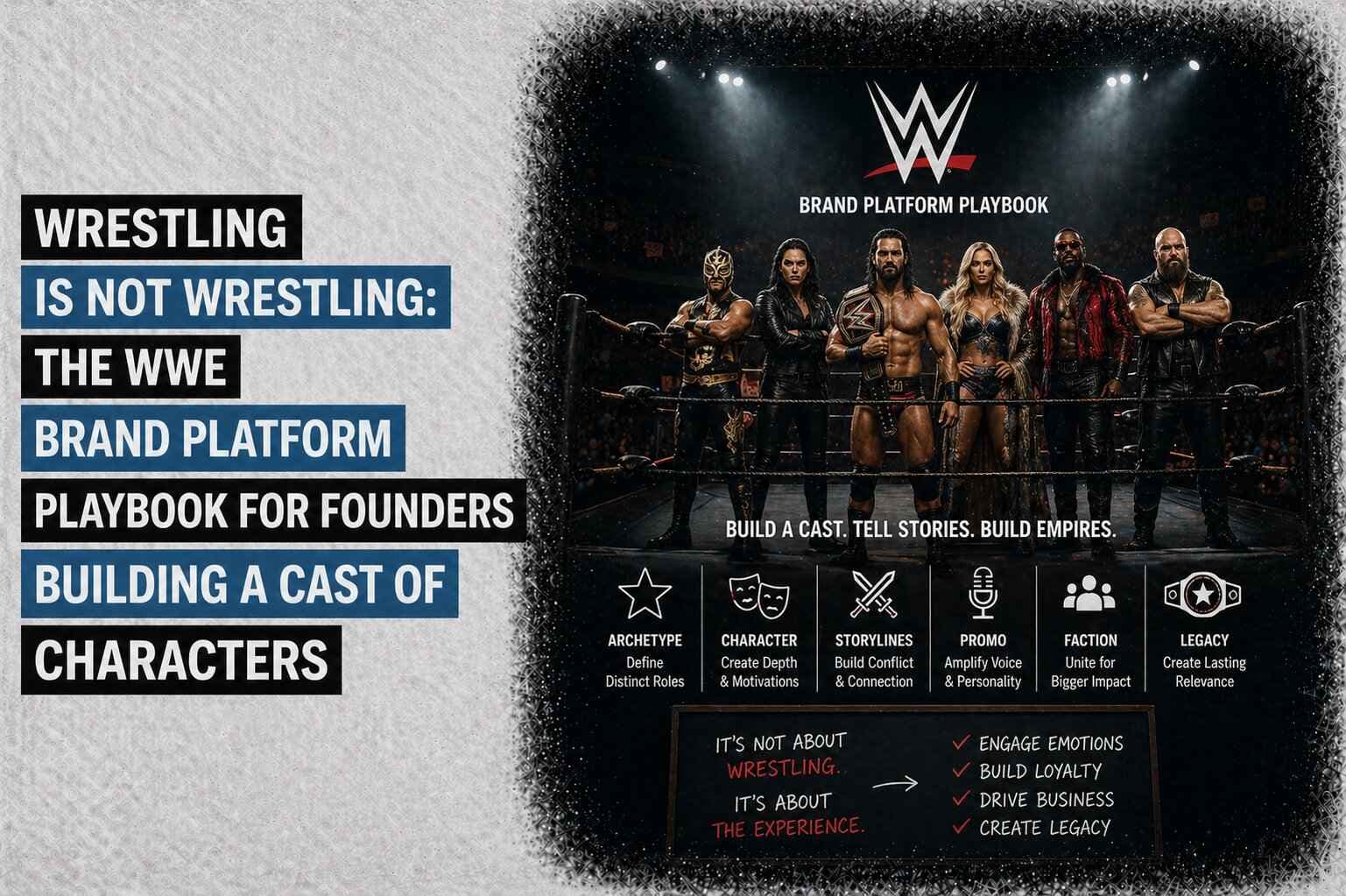
AJ Kumar breaks down how WWE built the model. He shows why iShowSpeed and Logan Paul prove the playbook still scales in 2026, and how founders copy it to multiply organic reach.
Key Takeaways
WWE swapped "Federation" for "Entertainment" in 2002, repositioning from a sport to a media platform that now operates the largest sports channel on YouTube with over 100 million subscribers.
A brand platform owns infrastructure, distribution, and audience. A cast of characters owns the emotional connection and parasocial trust.
The Cast of Characters system multiplies organic reach by capturing different psychographic segments without adding a second brand or budget.
iShowSpeed and Logan Paul show how WWE absorbs creators into a blurred-reality storyline that compounds across streams, clips, and podcasts.
Ramsey Solutions reaches 20 million weekly listeners across a five-character roster, eliminating the key-person risk in a single-founder show.
Founders should hire a showrunner, not a content manager. The studio model converts five hours of structured input into a permanent media asset.
Over a decade ago I watched a video essay by writer Max Landis called Wrestling Isn't Wrestling. It rewired the way I think about content and audience psychology.
Landis walked through the two-decade character arc of Triple H. He was not analyzing athletic performance. He was breaking down a multi-year narrative about an insecure man trading integrity for power. As Landis put it, the show "has more in common with Game of Thrones than it does with UFC."
After watching that video, every "influencer" online looked less like a person and more like a character in a shared universe. Every brand looked less like a company and more like a TV network. If you run a company that creates content, you are already writing these storylines. You are doing it accidentally instead of on purpose.
WWE Stopped Selling Wrestling in 2002
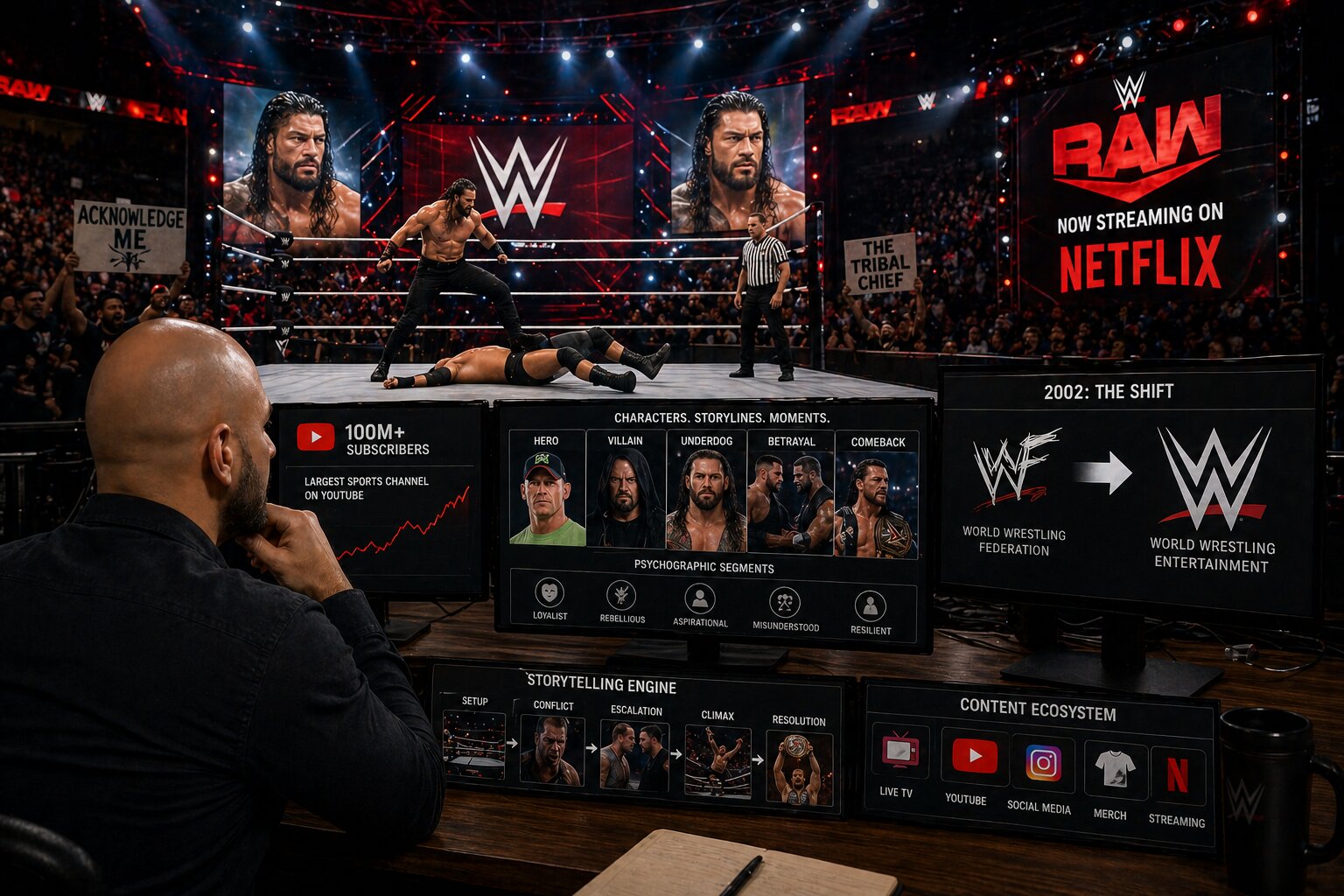
WWE stopped selling wrestling in 2002. That year the company swapped "Federation" for "Entertainment" in its name. World Wrestling Federation became World Wrestling Entertainment.
One word changed. The thesis of the entire business changed with it. They were no longer selling athletic competition. They were selling characters, storylines, and a media platform. Today WWE has more than 100 million YouTube subscribers, the largest sports channel on the platform. In January 2025 they moved Monday Night Raw to Netflix, the largest streaming service on earth.
The contrarian point most marketing teams miss is this. The thing wrestling skeptics dismiss as "fake" is what makes WWE a masterclass in brand-building. Every heel turn is scheduled. Every betrayal is plotted. Every underdog comeback maps to a specific psychographic segment. That is not chaos. That is content strategy.
Why a Brand Platform Beats a Single-Founder Show
A brand platform is the infrastructure that lets multiple personal brands launch underneath it. It is the stage, not the performer.
WWE provides the platform. Primetime slots. Global streaming. Live tours. Merchandise. Wrestlers provide the emotional connection. The character. The storyline. The parasocial bond that pulls people back week after week.
The diagnostic is simple. If the main character disappears tomorrow, would the audience still show up? If the answer is no, you do not have a platform. You have a personality dependency.
WWE passes the test. When Stone Cold left, The Rock filled the slot. When The Rock went to Hollywood, John Cena stepped up. The Kardashians ran the same playbook through one show. Skims hit a reported $4 billion valuation because the platform launched a brand for every segment. Oprah ran the same model through Harpo Productions, which I unpack inside the Oprah Authority Flywheel.
The Cast of Characters System Multiplies Brand Surface Area
The Cast of Characters system is the single biggest unlock for corporate brands scaling organic content.
The principle works in five parts. The platform owns infrastructure, distribution, and audience. Each character owns a different angle on the core message. Each character appeals to a different psychographic segment. All characters route attention back to the same brand. Total surface area compounds with every new character.
Ramsey Solutions proves the model. The company reaches more than 20 million weekly listeners across a five-character roster. Dave Ramsey alone does not carry that load. Rachel Cruze owns the relatable daughter angle. George Kamel speaks to millennial skeptics. Ken Coleman owns career content. Dr. John Delony covers mental health.
First We Feast crossed 14 million YouTube subscribers running multiple shows under one brand. Hot Ones is the flagship. The format system carries the rest. MrBeast does not work alone either. Karl, Nolan, Tareq, and Mack are recurring characters that different audience segments identify with. As MrBeast wrote in an internal memo, the directive is to empower the boys on camera. That is a casting directive, not a friendship note.
The most durable attention ecosystems deploy multiple faces, not one.
How iShowSpeed and Logan Paul Show the Playbook in Real Time
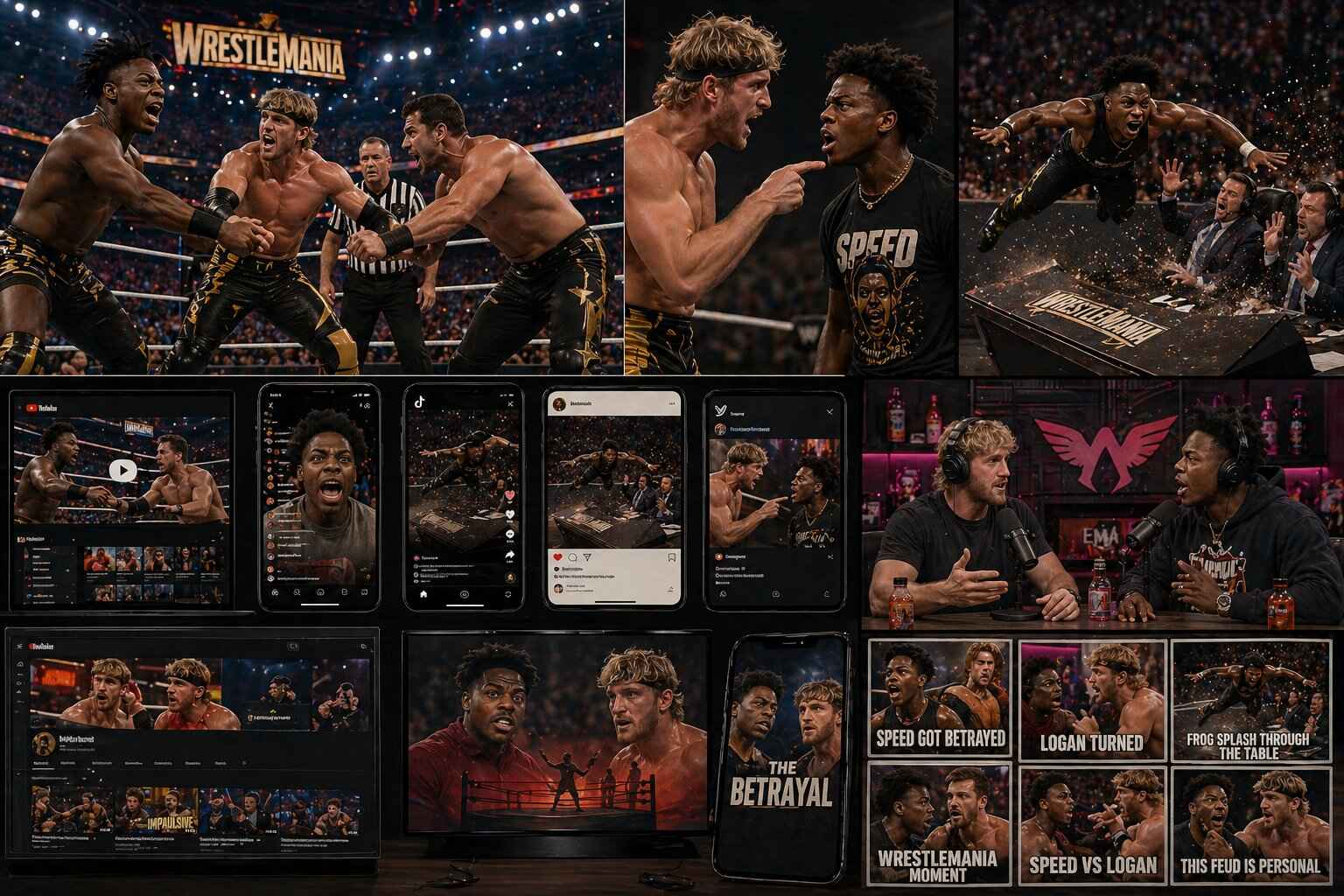
WWE is now using the cast of characters system to absorb internet creators directly into the storyline. WrestleMania 42 made it obvious.
iShowSpeed appeared with Logan Paul in a six-man tag match. Their team lost. Logan blamed Speed and turned on him on live television. Speed answered with a frog splash through the announcer's table. Clips traveled across every social platform within hours.
The choice was not random. It was a casting decision. Speed brings chaotic streaming energy and Gen Z reach. Logan brings polished influencer villainy and a podcast empire. Both already perform as heightened versions of themselves. WWE folded both personas into one feud. The storyline bled across stream, ring, podcast, and TikTok at the same time.
The blurred reality is the point. Live streaming feels real because it is live. WWE feels theatrical because it is scripted. Combine the two inside the same character and the audience can no longer tell where performance ends and identity begins. That ambiguity makes the content emotionally sticky.
The mechanism is omnipresence. The same characters appear in a match, a live stream, a podcast debate, a highlight reel, and a meme page. Each appearance reinforces the others. Repetition becomes environment. The brand platform supplied the scale. The personas supplied the marketing fuel. Every corporate brand will copy that trade by 2030.
Why the Brain Treats Characters Like People You Know
The reason WWE characters stick for decades is not nostalgia. It is biology.
The mechanism powering wrestling is the same one powering the entire creator economy. Parasocial relationships. One-sided emotional bonds with media figures the audience has never met. The brain treats their wins and losses almost as personal. Mirror neurons fire during emotional moments. Dopamine spikes on prediction error. The investment is biologically real even when the story is scripted.
The diagnostic for your own brand is direct. If people refer to your team members in third person ("Sarah explains this best," "Mike's take landed perfectly"), you have built characters. If they only reference "the company," you have not. Logos do not form bonds. Characters do.
A cast multiplies the entry points for those bonds. One face forms a limited number of connections. Five faces capture five times the emotional surface area.
Why Founder Brands Need a Studio, Not a Content Team
The shift most marketing departments have not absorbed is this. The winners are quietly building studios, not content teams.
A content team posts. A studio produces programming. A content team fills a calendar. A studio builds shows with recurring characters and evolving storylines.
MrBeast did not sign a brand deal with Amazon. He signed a Beast Games studio deal reported at $100 million. HubSpot built a media division by acquiring podcasts and launching original programming. The same architecture sits underneath Hormozi's Acquisition.com empire.
The cost of not running a studio is rising every quarter. Attention fragments faster. Single-channel, single-face content is a single point of failure.
A founder does not need a billion-dollar production company. The founder needs a brand platform and a cast of characters who can each capture a different segment. Every team member with a unique perspective is an untapped character. The question is not the talent. The question is the stage.
The Brand Platform Flywheel
The Brand Platform Flywheel is the operating system that converts a content team into a studio. Five stages turn one founder show into a permanent media asset. I built it as a companion to the Personal Media Company Model inside GURU, INC.
Stage 1. Build the platform. Establish the core brand identity, infrastructure, and distribution channels. Newsletter. YouTube channel. Product ecosystem. The Monday Night Raw of your business.
Stage 2. Launch the characters. Identify three to five people who can each own a different angle. The founder as visionary. The head of customer success as the operator. An outspoken client as the customer avatar.
Stage 3. Program the storylines. Give each character a recurring social-first show they own for at least 12 episodes. Format provides consistency. Topics keep episodes fresh. Think seasons, not campaigns.
Stage 4. Expand the surface area. Map each show to a psychographic segment the brand currently misses. New character, new audience, new entry point.
Stage 5. Consolidate the attention. Every show, every character, every clip routes back to the platform. The WWE logo lives in every corner of every screen. The same logic applies to your offer, funnel, or product page.
The flywheel compounds. More characters create more surface area. More surface area captures more attention. The platform invests in more characters. The cycle accelerates.
The Real Lesson From the Ring
Wrestling is not wrestling. The Max Landis video used the line as a thesis statement. The scripted narratives and the multi-year storylines were never the weakness of professional wrestling. They were the entire business model.
The same logic applies to the brands winning the creator economy today. They look like companies posting content. They are media companies running a cast of characters across a brand platform. The compounding logic shows up in Joel Osteen's one-show content system and inside every long-form YouTube authority program I help founders build.
Your competitors are still posting random content and hoping something sticks. You can build the stage instead.
Wrestling is not wrestling. Content is not content. It is casting, scripting, and programming for the world's most distracted audience. The future does not belong to the loudest creator. It belongs to the brand that builds the biggest stage and fills it with the most compelling characters.
FAQ
What does "WWE is a brand platform, not a wrestling company" mean for founders?
It means WWE built the infrastructure, distribution, and audience first, then deployed characters into that infrastructure. Founders should design the platform first and treat each team member as a potential character inside it.
How is a Cast of Characters different from an influencer roster?
An influencer roster is a list of creators each paid to promote the brand. A Cast of Characters is a coordinated system where every character lives inside one storyworld and routes attention back to a single brand platform.
Why did WWE bring iShowSpeed and Logan Paul into WrestleMania 42?
WWE absorbed both creators because their personas already perform a heightened version of themselves. The crossover gave WWE Gen Z reach while giving Speed and Logan a legacy stage with built-in scale.
How many characters should a founder cast for a brand platform?
Three to five is the working range. The founder is one. Two to four others should each own a distinct psychographic angle the founder cannot cover personally.
What is the difference between a content team and a studio?
A content team fills a calendar. A studio produces programming with recurring formats and storylines. The shift happens when the founder stops asking "what should we post" and starts asking "what show are we building."
Why do parasocial bonds matter for brand building?
Parasocial bonds are the biological mechanism that turns audience attention into trust and trust into revenue. The brain treats serialized characters almost like people the viewer knows.
How do founders measure the return on a Cast of Characters?
The ROAC framework measures attention captured, audience compounding, and stakeholder confidence across each character. Total brand surface area becomes the leading indicator. Revenue follows once the platform passes a critical mass of recurring storylines.