
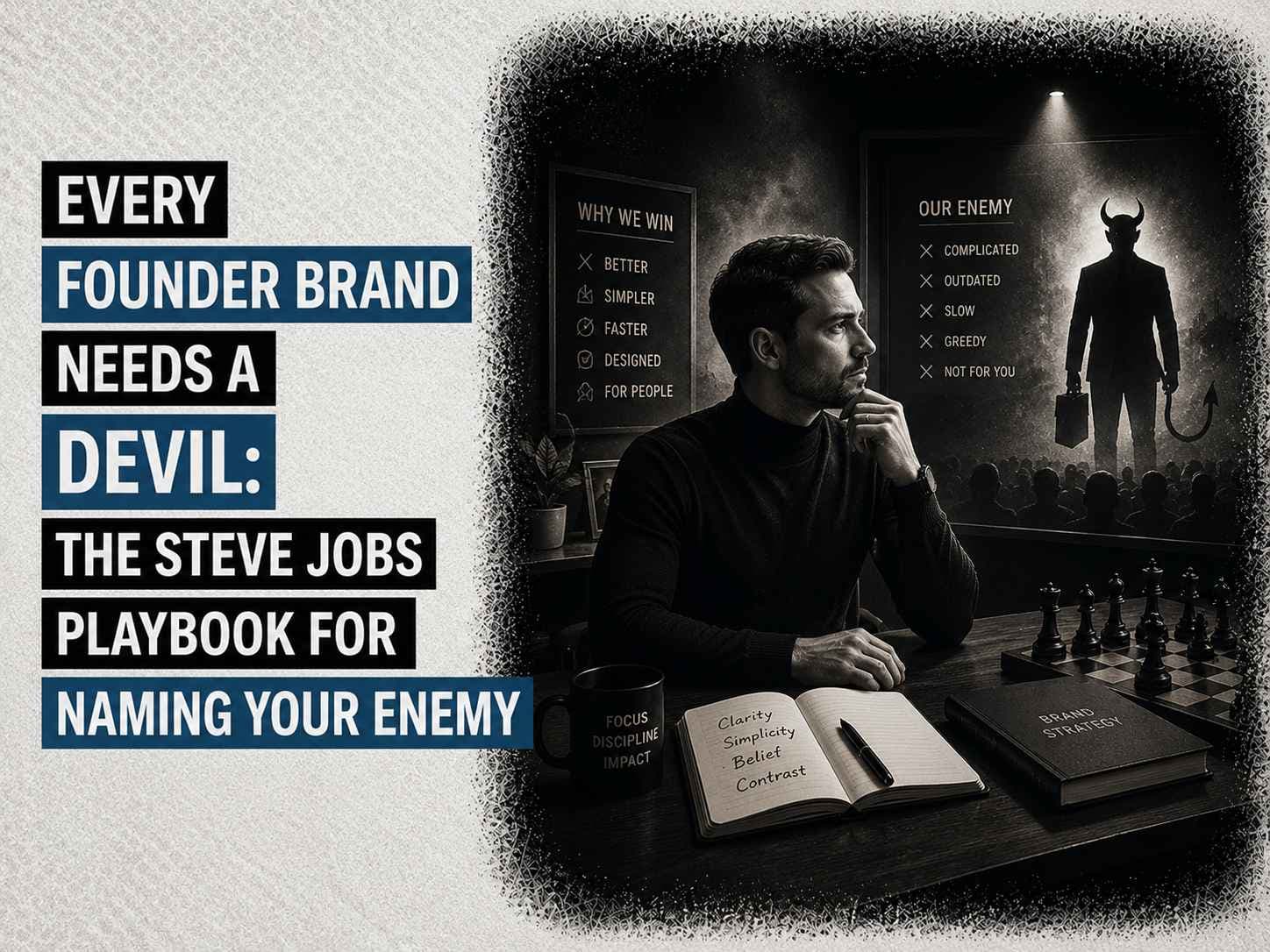
Every founder brand worth following names a devil. Eric Hoffer wrote the rule in 1951. AJ Kumar maps the four tests of a good devil and the neuroscience underneath. He explains why polite founders build nothing.
Key Takeaways
Steve Jobs aired the 1984 Macintosh ad once. It cast IBM as Big Brother. Apple built a brand over four decades on that devil.
Mass movements need a devil more than a God. Hoffer wrote it in 1951. Founder brands run on the same rule.
Your brain bonds harder with people who hate what you hate. In-group identity strengthens when an out-group is named. Hatred unites faster than love.
The four tests of a good devil are Tangible, Singular, Resonant, Survivable. Most founders fail one or all four. Cult brands pass them all.
Most founders refuse to name a devil because they want to be liked. The result is brand softness that no audience can rally behind.
Tesla, Patagonia, Apple, Liquid Death, and Limitless were built on visible enemies. The strength of the brand is proportional to the vividness of the devil.
Every founder brand needs a devil.

That refusal is the single biggest reason most founder brands stay invisible. The audience cannot remember a brand that is not against something. The brain has no place to file it. There is no enemy to bond against. There is no future to fight for. There is only a logo and a value proposition. That is the strategic game most founders refuse to play.
Apple has been built on a named devil for forty years. Tesla against legacy auto. Patagonia against fast fashion. Liquid Death against the boring beverage industry. The strength of a founder brand is proportional to the vividness of its devil.
Eric Hoffer wrote the rule in 1951 in The True Believer. He was studying religion and revolution. He was not writing about brands. But the rule applies to every cult brand running its code today.
Steve Jobs named the devil in 1984.
Steve Jobs named the devil in 1984. The Apple Macintosh launched on January 22, 1984. The launch ad aired during Super Bowl XVIII.
The ad ran sixty seconds. Ridley Scott directed it. The frame opens on rows of gray-suited workers marching through a tunnel. They sit in front of a Big Brother figure droning about ideological purity. A woman athlete sprints in with a sledgehammer and throws it through the screen. The voiceover lands the line. Apple Computer will introduce Macintosh on January 24. 1984 will not be like 1984.
That was Apple's devil. IBM as Big Brother. Conformity as the enemy. Apple as the rebellion.
The ad ran once. Apple built four decades of brand on that one statement of opposition. Every product launch since has been a continuation of the same posture. Different. Against. For the rebels. The devil shifted from IBM to Microsoft to the carriers to the music industry. The posture never changed.
That posture is the Brand Moat underneath every founder brand worth following. A founder without a devil has no posture. A posture is what separates a brand from a logo.
Your brain bonds harder against a shared enemy.

In-group identity is more than a social construct. It is a neural process the brain performs constantly. Cikara and Van Bavel published a wide-ranging review of intergroup neuroscience in 2014 in Perspectives on Psychological Science.
They synthesized two decades of fMRI work. The finding is consistent. Naming an out-group changes how the brain processes faces, behavior, intent, and trust. Out-group members activate threat circuits. In-group members activate reward and theory of mind circuits.
Hoffer described this in plain English thirty years before the brain scans existed. He wrote that hatred is the most accessible unifying agent of all. He noted that common hatred unites the most heterogeneous elements. He observed that we look for allies when we hate.
The brand application is direct. A brand without a named devil cannot activate the in-group circuit. The audience has no signal of belonging because there is no out-group to define against. A brand with a named devil activates both circuits at once. The audience bonds with the brand and against the enemy in the same neural event.
That bonding is what fires the Reinforce gate in ROAC, the deepest layer of audience attachment.
Hoffer wrote the rule. Most modern brands ignore it.
The line that survives every reread is from his chapter on hatred. "Mass movements can rise and spread without belief in a God, but never without belief in a devil." He continued. The strength of a mass movement is proportional to the vividness and tangibility of its devil.
He quoted Hitler answering a question about destroying the Jews. The reply was chilling. "No. We should have then to invent him. It is essential to have a tangible enemy, not merely an abstract one."
Hoffer was not endorsing the practice. He was observing the operating system. The fact that the worst actors in human history understood the rule does not invalidate the rule. It clarifies the stakes. The mechanics are the same for liberation movements and for atrocities. The founder chooses which one to build.
Modern founder brands have a softer version of the same dynamic. The devil is fast fashion, or extractive capitalism, or boring water, or corporate marketing, or fake gurus. The audience bonds against the named enemy. The product becomes the alternative the audience is willing to defend.
The audience does not buy the product. The audience buys the side.
The four tests of a good devil.
The four tests of a good devil are Tangible, Singular, Resonant, and Survivable. Most founders fail one or all four.
Tangible. Specific and visible, not abstract. "Bad design" is not a devil. "The man in the gray suit" is. A devil you cannot picture is not a devil.
Singular. One devil, not five. Hoffer wrote that the ideal devil, like the ideal deity, is one. Tesla had one devil: legacy auto. Patagonia has one devil: extractive capitalism. Apple's devil was IBM, then Microsoft, then carriers, but only one at a time. Multiple devils diffuse the energy. A founder with three enemies has no enemy.
Resonant. Your audience already fears or hates it. Naming a devil does not create the feeling. It names the feeling that already exists. Liquid Death did not invent the audience's boredom with bottled water. They named it and gave it a face. The audience felt seen. The brand grew into a $1.4 billion valuation by 2024 on the strength of that recognition.
Survivable. Punching the devil does not take you down with it. This is the test most founders skip. Tesla punching legacy auto worked because Tesla was outside their physical and political reach. A founder picks a devil that can sue them, blacklist them, or destroy their distribution. They have picked a weight, not a devil.
The four tests work together. Miss one, the brand softens. Pass all four, the audience bonds for life.
The polite founder builds nothing.

The pull is real. Naming a devil feels aggressive. It feels exclusionary. It feels like the kind of move that loses LinkedIn followers and Slack invitations. Most founders quietly decide that being likable is safer than being named. They publish content that does not offend. They build a brand designed to be acceptable to everyone.
The result is a brand acceptable to no one. The audience has no signal of belonging. The competition has no signal of opposition. The market has no place to file the brand. It dissolves into the noise.
When I started The Limitless Company, I had to name my own devil. It was not a competitor. It was the entire mode of corporate marketing that treats founders as decoration on top of a brand. That mode is one variant of Darketing. It uses brand mechanics to extract from people the founder does not serve. The decision to name it changed who found me. The right founders started leading with the same complaint.
That is the only test that matters. A founder brand without a devil is invisible. A founder brand with a devil is unforgettable to the right audience and useless to everyone else. The trade is the point.
How to name your devil this week.
How to name your devil this week is the founder's homework, not a marketing exercise.
First, identify the practice you cannot stand. The mode, the assumption, the behavior in your industry that you find unforgivable. Not the company. The practice. Companies change. Practices stay.
Second, give it a face. The mode needs to be embodied in a recognizable archetype. The man in the gray suit. The fake guru. The legacy auto exec. The image is what the audience will hold in their mind.
Third, run the four tests. Tangible. Singular. Resonant. Survivable. If the devil fails any test, you do not have a devil. You have a complaint.
Fourth, write the line. One sentence that names the devil without using a company name. Write it sharp enough that the right audience nods and the wrong audience walks away.
Fifth, repeat it. Every post. Every video. Every keynote. The devil is not a one-time launch. The devil is the spine of every piece of content for the next decade.
The polite version of the founder brand has had its run. The audience does not want neutral. The audience wants a side. Your job is to be it.
Frequently Asked Questions
Why does every founder brand need a devil?
A devil gives the audience a signal of belonging. In-group identity activates when an out-group is named. A brand without a named devil cannot fire that circuit. It stays invisible to the audience that would have defended it.
What was the devil in Apple's 1984 ad?
The ad cast IBM as Big Brother. It positioned conformity as the enemy and Apple as the rebellion against it. The ad ran once during the Super Bowl. It built four decades of Apple brand identity on one statement of opposition.
Can the devil be a person or does it have to be a category?
The devil can be a person, a practice, a category, or an archetype. The best devils are tangible enough to picture in one image. The man in the gray suit is a devil. The category of fast fashion is a devil. A vague concept like mediocrity is not.
What is the difference between a devil and a competitor?
A competitor is a company that sells what you sell. A devil is a practice or worldview your brand exists to dismantle. You do not need to name a competitor. You need to name a devil. Competitors come and go. Devils outlive product cycles.
Is it risky to name a devil publicly?
The risk is real but inverted. Naming a devil loses the audience that disagrees and bonds the audience that agrees. The greater risk is staying so polite that no audience bonds at all.
How does Eric Hoffer apply to modern marketing?
Hoffer wrote The True Believer in 1951 about mass movements in religion, politics, and revolution. He never wrote about brands. But the mechanics he described are the operating system every modern cult brand runs on. The role of the devil is central.