


Edutainment carries substance through delivery, and the combination is the only one of the three that converts attention into founder authority. The comparison below sorts the three by the single measure a founder brand runs on: what the attention becomes after the content ends.
Key Takeaways
Educational content teaches directly, holds the most substance, and loses the most viewers before the substance lands.
Infotainment stimulates without transferring anything: the audience remembers the feeling and forgets the source and the lesson.
Edutainment delivers real expertise through entertaining structure, which makes it the authority-building type of the three.
Peer-reviewed research on millions of viewing sessions shows engagement collapsing as educational videos lengthen.
The founder decision rule assigns each type a role: educational for high-intent capture, edutainment for authority, infotainment for nothing.
ROAC measures the difference: return on the attention created, never the volume of it.
The Three Content Types Split by Purpose, Not by Format

Format never separates the three types, because all three run on the same videos, posts, and podcasts. Purpose separates them. Educational content exists to instruct: the tutorial, the documentation, the direct explanation.
Infotainment exists to stimulate: information packaged as spectacle, where the feeling is the product. Edutainment exists to teach through entertainment: the lesson is the point, and the delivery is the vehicle that gets it watched.
Founders blur the three constantly because the surface looks identical. A market breakdown video is any of the three depending on what survives the watch: a skill, a mood, or a lesson attached to a name. The delivery-versus-substance axis sorts every piece in seconds, and the sorting predicts the commercial outcome.
Educational Content Holds Substance and Loses the Room
Pure educational content carries the most expertise per minute and retains the fewest people to receive it. Peer-reviewed research by Guo, Kim, and Rubin, analyzing 6.9 million video viewing sessions, found median engagement near full length for videos under six minutes and dropping toward 20 percent beyond twelve minutes.
Substance alone does not hold a room. The mechanism behind the exits is covered in why viewers skip educational videos: clarity feels easy, and easy feels finished.
Educational content still owns one job outright. A buyer searching a specific how-to arrives with intent, and intent substitutes for delivery. Documentation, tutorials, and direct answers serve that visitor better than any skit.
The failure mode is strategic, not tactical: founders who publish only educational content reach only the already-searching, and the already-searching are the smallest audience a market contains.
Infotainment Holds the Room and Delivers Nothing
Infotainment wins the watch and wastes it, because stimulation transfers no expertise and attaches no authority. News reactions, drama commentary, and trivia-paced takes hold attention through novelty and outrage.
The viewer leaves entertained and empty. The feeling gets remembered. The source does not, and the lesson never existed. The trap runs deeper for founders. Infotainment rents its relevance from the news cycle, so the content dies with the cycle and demands constant refeeding.
An audience assembled on stimulation follows the stimulation, not the expert, and stimulation is the one asset every competitor replicates by tomorrow. A founder measuring followers sees growth.
A founder measuring trust sees a crowd that learned nothing, believes nothing, and buys nothing. Media companies monetize that crowd through advertising. Founders monetize trust, and infotainment manufactures none of it.
Edutainment Carries Substance Through Delivery
Edutainment is the only type of the three built for the founder's actual job: converting expertise into recognized authority. The edutainment content strategy for founders runs on exactly this synthesis: a real lesson from real expertise, delivered through hooks, story, and stakes that earn the watch.
The viewer stays for the delivery, leaves with the substance, and attaches both to the founder's name. The type also compounds where the other two decay. Educational content waits for intent.
Infotainment expires with the cycle. Edutainment travels, because entertaining delivery earns shares while the embedded lesson keeps the founder's position attached to every share. One piece works the searching audience, the scrolling audience, and the referred audience at once.
Founders Measure the Difference by What the Attention Becomes
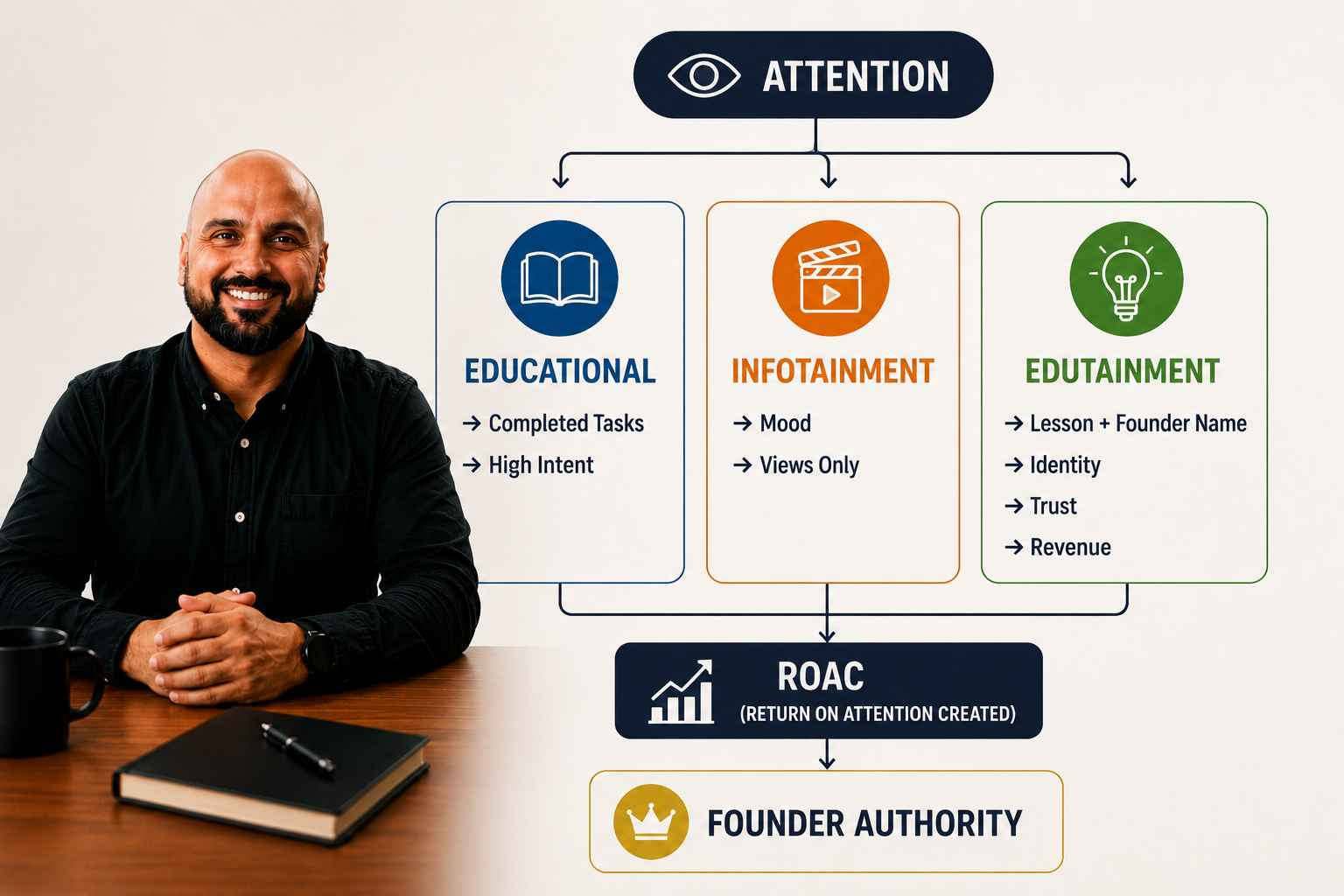
The three types produce three different residues, and the residue is the measurement. Educational content leaves a completed task. Infotainment leaves a mood. Edutainment leaves a lesson attached to a name, and the attachment is the raw material of authority.
ROAC, the Return on Attention Created measure from GURU, INC. by AJ Kumar, prices exactly this difference: identity value, trust value, and revenue produced by the attention, never the volume of the attention itself. A million infotainment views score lower than ten thousand finished lessons.
The decision rule assigns each type a role and a share. Educational content captures high-intent searchers and stays lean. Edutainment carries the authority build and takes the majority of the calendar, since content built for human consumption wins attention machines and people simultaneously.
Infotainment gets zero share, because a founder brand has no use for attention that converts to nothing. Edutainment, infotainment, and educational content split by delivery and substance. Educational content teaches and loses the room.
Infotainment holds the room and teaches nothing. Edutainment carries real expertise through entertaining delivery, which makes it the founder's authority engine. Founders build what compounds and ignore what merely performs.
Is Infotainment Ever Right for a Founder Brand
Infotainment fits businesses that monetize attention directly through advertising and media sales. Founders monetize trust, expertise, and inbound demand.
A founder borrowing infotainment tactics inherits its economics: high reach, zero transfer, and an audience loyal to stimulation rather than judgment.
When Does Educational Content Outperform Edutainment
Educational content outperforms edutainment at the moment of high intent: a specific search, a documentation lookup, a how-to with a task attached. Intent replaces delivery as the retention force. Outside that moment, delivery decides retention, and edutainment wins the open feed.
What Is an Example of Edutainment vs Infotainment
A founder explaining a pricing mistake through a story, ending with a decision rule, is edutainment. A founder reacting to a competitor's viral collapse for entertainment value is infotainment. Identical formats, opposite residues: one leaves a lesson, one leaves a mood.
Do Founders Mix the Three Content Types
Founders mix two of the three by funnel role: edutainment builds authority across the open audience, and educational content serves high-intent searchers near the decision. The mix stays deliberate, with each piece assigned one job before production starts.