
Every health authority brand operates somewhere inside that gray zone. The founders who master the language scale. The founders who ignore it stay small or face regulators.
Key Takeaways
Structure function claims describe how a product affects the body without claiming it treats disease
The 1994 DSHEA labeling laws still govern what health brands can legally say in 2026
"May support" is a structure function claim while "cures" or "treats" crosses into illegal drug claims
Health influencers who scale their platforms amplify both their authority and their regulatory exposure
Risk tolerance determines how aggressively a health brand operates inside the legal gray zone
Return on attention created compounds risk at the same rate it compounds visibility
What Structure Function Claims Actually Mean for Health Brands
A structure function claim is a statement that describes how a nutrient or dietary ingredient affects the normal structure or function of the human body. The FDA does not pre-approve these claims.
Manufacturers must notify the FDA within 30 days of marketing a product with such a claim and must carry the standard disclaimer: "This statement has not been evaluated by the FDA. This product is not intended to diagnose, treat, cure, or prevent any disease."
That disclaimer is the starting line. But it is not the finish line. The FTC also evaluates whether the surrounding advertising is deceptive, whether implied claims go beyond what the words literally say, and whether the brand has adequate substantiation for the claim. The disclaimer protects the label. The substance behind the claim protects the brand.
The distinction between a structure function claim and a disease claim is the difference between operating a compliant supplement brand and facing regulatory enforcement. "Calcium builds strong bones" is a structure function claim.
"Calcium prevents osteoporosis" is an authorized health claim that requires FDA pre-approval and significant scientific agreement. One sentence builds a brand. The other invites a warning letter, an injunction, or worse.
How the 1994 DSHEA Labeling Laws Still Control Health Brand Language
The Dietary Supplement Health and Education Act of 1994 established the regulatory framework that health brands still operate under today. That law is over 30 years old. The internet did not exist in its current form when Congress wrote it. Social media did not exist. YouTube did not exist. Influencer marketing did not exist. Yet the language rules created in 1994 still dictate what a health influencer with 10 million followers can say on camera in 2026.
This is not unusual. Most digital marketing regulations evolved from analog law. Email marketing laws descended from faxing regulations. The CAN-SPAM Act borrowed its framework from a world where a fax division could generate $400 million a year in revenue. Legislators applied what they understood from analog technology to a digital world.
The fit was imperfect. But the laws stuck. Structure function claim regulations followed the same pattern. Written for product labels. Now applied to YouTube thumbnails, Instagram reels, and podcast ad reads.
How Structure Function Claims Differ from Disease Claims and Health Claims

The FDA recognizes three categories of claims on dietary supplement labels. Structure function claims sit at the least regulated end of the spectrum. Health claims sit at the most regulated end. The distinction determines what language a health brand can use in every piece of content it publishes.
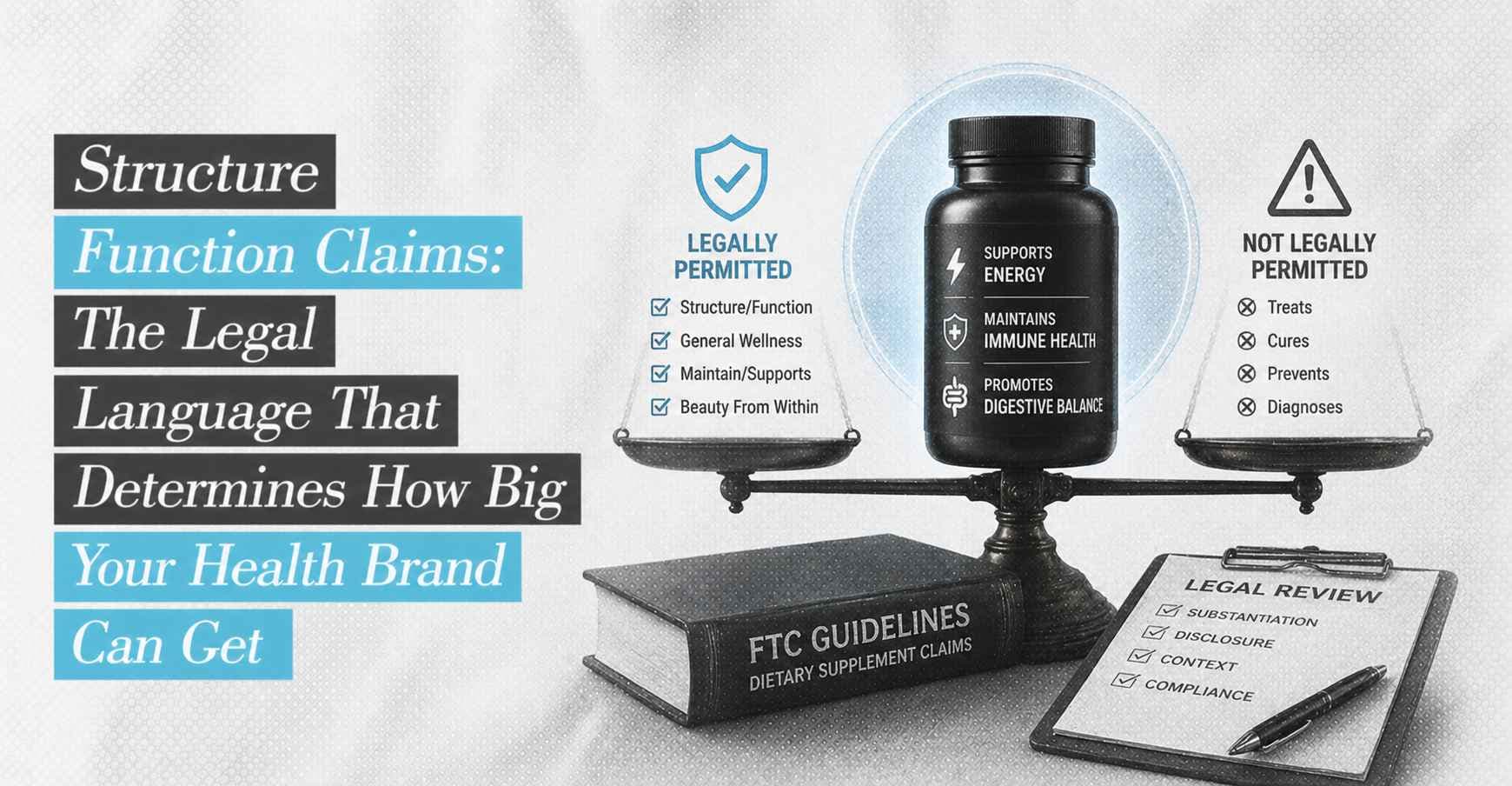
Structure function claims describe a relationship between a nutrient and the body. "Supports digestive health." "Promotes joint flexibility." "Helps maintain healthy blood sugar levels already within the normal range." These statements describe function without naming a disease.
Disease claims name a specific condition. "Reduces the risk of heart disease." "Treats arthritis symptoms." "Prevents diabetes." These require FDA pre-approval through a petition process that demands significant scientific agreement. No supplement brand gets that approval without years of clinical data.
The gray zone sits between those two categories. "Supports cardiovascular health" is a structure function claim. "Supports healthy cholesterol levels" can drift toward disease claim territory because cholesterol is a recognized risk factor for heart disease. Context determines whether that phrase stays compliant or crosses the line. That single word shift is where brands move from safe to exposed. The language is that precise.
Why Health Influencers Amplify Both Authority and Regulatory Risk

The legal standard for structure function claims applies at every audience size. A creator with 500 subscribers faces the same rules as one with 5 million. But enforcement follows visibility. The FDA and FTC do not have the resources to monitor every small creator making supplement recommendations in a home studio.
The practical risk of regulatory action increases as the platform grows. The bigger the audience, the higher above the radar line the creator flies.
This is where Return on Attention Created reveals its negative side. ROAC measures how attention compounds into authority and revenue. But every gate in the ROAC framework that amplifies reach also amplifies exposure.
When a health influencer's content registers with new audiences, retains viewers through a full video, resonates enough to generate shares, and reinforces trust through repeat viewership, the algorithm distributes that content further. If the language in that content contains structure function claim violations, the algorithm does not filter for legal compliance. It distributes the violation at scale.
A big time health influencer like Dave Asprey built Bulletproof into a household name by operating aggressively inside the gray zone. His language was calculated. His risk tolerance was high. He had legal counsel reviewing copy before it went live. A smaller creator copying Asprey's language without the same legal infrastructure takes the same regulatory risk with none of the protection.
How Risk Tolerance Determines Where a Health Brand Operates in the Gray Zone
The legal boundary between structure function claims and disease claims is not a thin line. It is a wide gradient. On one end sits language so cautious it barely says anything. On the other end sits language so aggressive it reads like a pharmaceutical ad. Every health brand picks a position on that gradient based on its risk tolerance.
I read Kevin Trudeau's Natural Cures "They" Don't Want You to Know About in 2008, back before anyone in my circle was talking about alternative health. That book cracked open an entire worldview for me.
Big pharma, big food, the regulatory machinery designed to protect incumbents. I was so fired up about organic and natural health that I was so excited to start a joint-venture with author and nutritoinist Kimberly Snyder in 2012, before organic was anywhere close to mainstream.
That early exposure led me to build Kimberly's brand from a local nutritionist charging for celebrity kitchen consultations into a seven-figure business. I saw the full arc from the inside. The language decisions that let a health brand scale. The language decisions that create legal exposure. The difference was never about the science. It was about the copy.
Kevin Trudeau went to prison. Not for being wrong about health. For making claims the FTC determined were deceptive. The line between "this may support your health" and "this cures your disease" is the line between building a brand and building a criminal case.
Risk tolerance without legal precision is just gambling. When the language crosses from persuasion into exploitation, it stops being marketing and starts being what I call darketing.
How Structure Function Claims Shape Content Strategy for Health Brands
Structure function claims are not just a labeling requirement. They are a content strategy constraint that shapes every asset a health brand produces. Every blog post, every video script, every email sequence, every product page, every social media caption operates under the same language rules.
A health influencer filming a video about a supplement cannot say "this product treats inflammation" on camera and then claim the statement was not a marketing claim because it appeared in educational content.
The FTC's Health Products Compliance Guidance makes clear that advertising includes social media content, influencer marketing, press releases, and any material that promotes a product. The format does not change the legal standard. A YouTube video carries the same regulatory weight as a product label.
Smart health brands build content systems around compliant language. They develop approved vocabulary lists. They train their content teams on the difference between "supports" and "treats." They create review processes that catch disease claims before publication.
This operational discipline is the difference between a health brand that compounds authority over years and one that gets a cease and desist letter that erases years of work overnight. Understanding how authority compounds through consistent, precise language gives health brands a structural advantage over competitors who treat compliance as an afterthought.
How Intermediary Sales Models Reduce Regulatory Exposure for Health Brands
Direct-to-consumer supplement sales carry the highest regulatory exposure. When a health influencer recommends a product in a video and links directly to a purchase page, the chain of evidence between the claim and the sale is short and visible. Regulators can draw a straight line from the content to the transaction.
Intermediary models lengthen that chain. A health influencer who directs viewers to "consult with a practitioner" instead of linking to a product page introduces a buffer between the content and the sale. The practitioner makes the product recommendation. The practitioner absorbs the regulatory risk of the specific claim. The influencer's content stays educational.
This structure costs more. Revenue splits with intermediaries shrink margins significantly, sometimes by a third or more depending on the arrangement. But the tradeoff is reduced regulatory exposure. Health brands that sell through practitioner networks, quiz-based recommendation engines, or independent third-party consultations trade margin for protection.
The economics shift. But the brand survives long enough to compound. A personal media company that builds distribution through compliant intermediary channels creates a more durable revenue model than one that relies on aggressive direct claims.
Why the Money Is in the Gray and What That Means for Health Brand Founders

Every health brand founder operating in the supplement space faces the same strategic question. How far into the gray zone are you willing to go? The cautious founder uses language so hedged that the copy barely converts. The aggressive founder uses language so direct that the copy converts immediately but creates regulatory exposure that compounds with every new viewer.
The calculated position sits between those extremes. Structure function claims exist specifically to give health brands a legal framework for making claims that sell without crossing into drug territory. "May support," "helps maintain," "promotes healthy function."
These phrases convert because they imply benefit without promising a cure. They work because the human brain fills in the gap between "may support" and "will fix." That cognitive gap is where the money lives. It is also where the legal risk concentrates.
The 2024 HHS Office of Inspector General report found that 20 percent of dietary supplements on the market included prohibited disease claims on their labels. Seven percent lacked the required FDA disclaimer entirely. These are not small brands hiding in obscurity.
These are products sitting on retail shelves in major stores. The regulatory system is stretched thin. Enforcement is inconsistent. But when enforcement does arrive, it arrives with consequences that range from cease and desist orders to criminal prosecution.
The founders who build lasting health brand authority master structure function claim language not as a legal checkbox but as a competitive advantage. Precise language builds trust with sophisticated consumers who recognize the difference between a credible health claim and a desperate sales pitch. It builds trust with practitioners who refer patients to compliant brands.
It builds trust with regulators who leave compliant brands alone while targeting the brands that operate above the radar with blatant violations. The money is in the gray. But the money that lasts is in the gray zone where language is precise, risk is calculated, and every claim can survive scrutiny.
Frequently Asked Question
What is a structure function claim in the supplement industry?
A structure function claim describes how a nutrient or dietary ingredient affects the normal structure or function of the human body. It does not claim to treat, cure, or prevent a specific disease. Examples include "supports immune health" or "promotes joint flexibility."
What is the difference between a structure function claim and a health claim?
A structure function claim describes a nutrient's role in the body without naming a disease. An authorized health claim describes a relationship between a substance and reduced risk of a specific disease. Authorized health claims require FDA pre-approval through a petition with significant scientific evidence. Structure function claims require only a 30-day notification to the FDA.
Can health influencers make structure function claims in videos and social media?
The FTC treats social media content, influencer marketing, and video as advertising when it promotes a product. Structure function claim rules apply to all formats, not just product labels. An influencer making supplement claims on YouTube carries the same legal obligation as a supplement label on a retail shelf.
What happens if a health brand violates structure function claim rules?
Consequences range from FDA warning letters and cease and desist orders to FTC enforcement actions and criminal prosecution. The severity depends on the nature of the violation, the size of the brand, and the regulatory history. Kevin Trudeau received a federal prison sentence for claims the FTC determined were deceptive.
What law governs structure function claims for dietary supplements?
The Dietary Supplement Health and Education Act of 1994 (DSHEA) established the regulatory framework for structure function claims. Despite being over 30 years old, DSHEA still governs what supplement brands and health influencers can legally say about their products in 2026.
How do health brands reduce regulatory risk when marketing supplements?
Intermediary sales models reduce direct regulatory exposure. Directing consumers to practitioners, quiz-based recommendation tools, or third-party consultants creates distance between the content creator and the product sale. This structure reduces margins but increases legal protection.
Why do structure function claims matter for content strategy?
Every piece of content a health brand publishes operates under the same language rules as a product label. Blog posts, video scripts, email sequences, and social media captions all carry regulatory weight. Brands that build compliant language into their content systems protect their authority from regulatory disruption.