
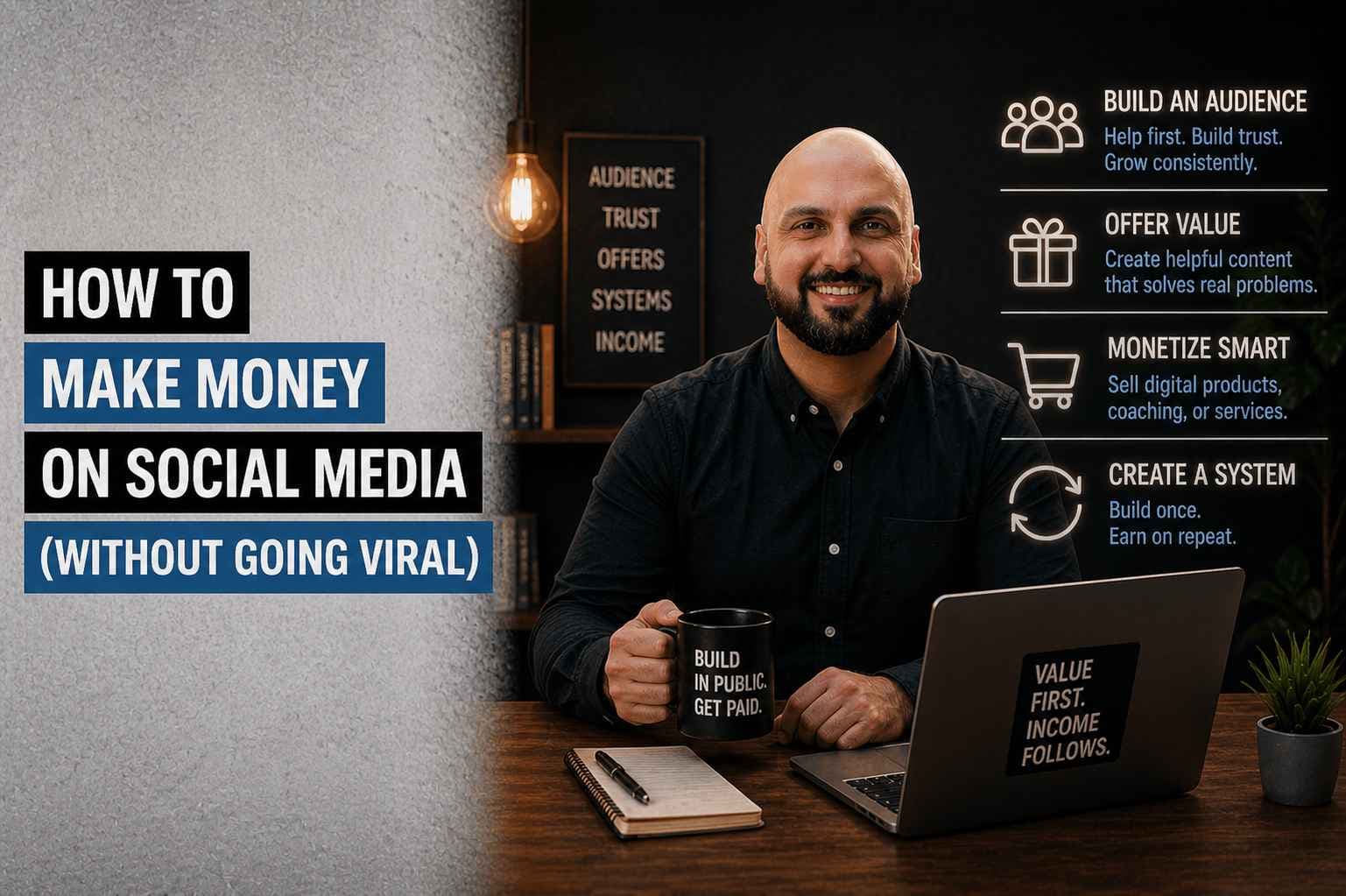
Four require massive scale or strong product margin. The fifth, authority, is the only path built for founders, coaches, consultants, and service operators. Goal congruence is what turns attention into revenue.
Key Takeaways
Going viral does not make most businesses money. Random reach pulls in the wrong audience and trains the algorithm to send more of it.
Social media is a game with three strategic layers: Goals, Moves, and Obstacles. The goal you pick decides everything underneath it.
There are five money goals on social media. Only one is built for founders, coaches, consultants, and service operators.
Fame Money is a treadmill, not a destination. Even MrBeast lost views in 2025 and announced a 2026 grind to recover.
Niche Fame Money pays through brand deals but does not compound trust toward a high-ticket offer.
Authority Money builds compounding off-platform revenue: leads, contracts, and clients without virality.
Virality Is Not How Most Businesses Make Money On Social Media
Most people are chasing the wrong outcome on social media.
They see a video hit a million views and assume that is what winning looks like. So they make broad content, swing for virality, and wait for the money to follow. The money does not follow. Worse, virality often hurts the next ten videos.
The algorithm reads the wide audience as your audience and sends you more of them. The on-target viewers who could become buyers get diluted in the flood.
This pattern repeats across every niche for over fifteen years. The view counts climb. The bank account stays flat. The problem is not effort. The problem is goal mismatch.
Social Media Is A Game: Goals, Moves, And Obstacles

Social media has structure, like any real game. Three strategic layers run it.
Goals are what you are trying to achieve. Moves are the content actions you take to get there. Obstacles are what stands in your way and what you spend your time and resources fighting through. The three layers connect in a chain.
The goal you pick decides which moves are correct. The moves you make decide which obstacles matter. Pick the wrong goal at the top, and every layer underneath misaligns.
Picture a founder with a $5,000-per-month coaching business who sets a Fame goal because views look like winning. The moves that follow are broad entertainment, trend-jacking, and viral hook engineering. The obstacles they fight are low view counts and slow follower growth. They spend a year there. None of it touches their pipeline.
The actual game for that founder is Authority. The right moves are niche teaching, recurring authority formats, and hooks built for qualified buyers. The real obstacles are weak positioning, no pipeline, and unclear authority signal. The wrong goal made them fight the wrong battles.
I write more about this in the social media strategic game. Get the goal right, the moves and obstacles align. Get it wrong, the rest cannot save you.
There Are Five Money Goals On Social Media
Five goals exist for monetizing content. Most advice treats them as one.
Each goal demands a different scoreboard, different moves, and a different business model behind it. The first two are media-business goals. The next two are product-business goals. The fifth is the service-business goal, and most readers belong to it.
The five money goals are Fame Money, Niche Fame Money, Lifestyle Product Money, Education Product Money, and Authority Money. Each optimizes a different layer of the creator economy. Picking the wrong goal is the biggest reason content fails to convert.
Fame Money: Why Even MrBeast Cannot Sustain It

Fame Money is the goal where attention itself is the product.
It pays full-time creators through platform ad revenue, AdSense, and broad brand deals. The math requires audiences in the millions. The creator is the product, not the seller. It works for full-time creators whose entire business model is built on platform attention. It does not work for almost anyone else.
The trap inside Fame Money is that it is never evergreen. It is a treadmill. Even MrBeast admitted in late 2025 that his recent content was not as strong as his earlier work. He pledged "ultra grind mode" for 2026. His April 2026 releases pulled 34 million and 38 million first-day views.
Both fell below his historical highs. YouTube also reduced long-form home feed recommendations by up to 80% in late 2025. If the largest player in the game cannot rest, no one in Fame Money can. Authority compounds across decades. Fame must be re-earned every week.
Niche Fame Money: Brand Deals That Do Not Compound
Niche Fame Money looks safer than Mass Fame Money. It is still a treadmill.
Niche Fame pays through topic-specific sponsorships, vertical brand deals, and speaker fees. It works for educators, journalists, and niche media brands whose business is reach inside a vertical. The income is real but transactional. Brand deals get paid out, then the cycle resets. Stop posting and the deals dry up.
Nikki Haskell is a great example of Niche Fame Money done well. We helped her build a "grandfluencer" identity around a recurring format. She now pulls brand deals from companies like Absolut and Anastasia Beverly Hills, with over a million followers.
The brand-deal flow is real. The structural problem is that the income depends on her continuing to post and continuing to entertain. The persona has to be maintained. Niche Fame does not compound a high-ticket offer in the background. There is no off-platform asset that keeps producing while the creator rests.
Product Money: When Lifestyle Or Education Drives The Sale

Product Money is the path where content sells a tangible product.
Two versions exist. Lifestyle Product Money is how lifestyle and CPG brands sell. The content does not explain the product. It associates the product with an aspirational identity. Apparel, beauty, snacks, and impulse-purchase categories monetize this way. The conversion happens because the viewer wants to belong to the world the content shows.
Education Product Money is how complex products sell. The content has to teach the buyer why the product solves a problem they did not fully understand they had. Supplements, software, advanced consumer tech, and most innovative products live here. The conversion happens after the viewer is educated, not before.
Both paths require three things most service businesses do not have. Strong product margin. Inventory or fulfillment. A working conversion engine. If you sell expertise, time, or services, Product Money is not your path.
Authority Money: How Founders Make Money Without Virality
Authority Money is the path most readers should be on.
It is the game played by founders, coaches, consultants, agencies, and B2B operators. Anyone who sells expertise rather than inventory. The goal is not maximum reach. The goal is maximum trust at scale, with the right buyer. Three things compound it together.
The time the right viewer spends with you. The relevance of what you teach to a real decision. The usefulness they can apply to produce a result.
Kimberly Snyder built her brand on Authority Money. She started as a celebrity nutritionist charging $500 per hour in private kitchens. We restructured her content around a recurring authority format that taught the science behind her approach.
She grew to 16 million unique visitors and 150,000 email subscribers. Three New York Times bestsellers. A multi-million dollar brand built on books, programs, and partnerships. She did not become a viral creator. She became the trusted source.
NonToxicDad shows the second move on this board. He was pulling 40 to 50 million monthly views across all channels in Niche Fame mode. The views were not translating into revenue the way we wanted. We kept the hook DNA but transitioned the architecture to Authority Money. Views dropped, and off-platform revenue started flowing in ways Niche Fame never could.
How To Pick Your Money Goal Without Picking The Wrong One
The right path depends on what kind of brand you have. A person plays Authority. A company can play Product, but the founder still plays Authority. Both layers can exist in the same business.
If you sell services, coaching, consulting, agencies, or B2B, play Authority Money. Your scoreboard is pipeline, not views. If you run a product business (CPG, B2C, e-commerce, software), the corporate brand handles the product game.
That is Lifestyle Product Money for impulse products and Education Product Money for complex ones. The founder still plays Authority Money on the personal brand. Companies sell products. Founders sell trust. If your business is full-time content creation with no off-platform offer, play Fame Money and prepare for the treadmill.
This is why I write in GURU, INC. that Authority Money is the only goal engineered to drive ROAC's full Return Side: Visibility, Demand, and Outcomes. Fame Money lives in Visibility. Product Money runs from Visibility into Demand. Authority Money is the only path that completes the chain into the attention economy Outcomes that fund a real business.
Mike Ferry is the proof at scale. Without ever going viral, he built the Mike Ferry Organization into a $50M annual coaching empire. Tens of thousands of real estate agents trained on the system. I worked there as a teenager, and the lesson never left me. Authority compounds when the goal is right. It collapses when the goal is borrowed from someone playing a different game. You can read more in the Mike Ferry personal brand blueprint.
If your content has views and no revenue, you are playing the wrong game. Pick the right goal. The right moves and the right obstacles fall in line.
Frequently Asked Questions
Can you really make money on social media without going viral?
Yes, and for most businesses it is the only sustainable path. Authority Money lets a small but qualified audience produce real off-platform revenue through high-ticket services or deals. Going viral is a media-business strategy, not a service-business one.
How many followers do you need to make money on social media?
Fewer than most people think. The math depends on the path. A consultant with 2,000 high-trust followers can outearn a creator with 200,000 random followers. The first audience converts. The second one consumes.
Why does going viral sometimes hurt a business?
The algorithm tracks who watches your content and uses that signal to find similar viewers. A viral video pulls in a wide and random audience. The algorithm assumes that audience is your audience. It serves your next videos to similar people who do not convert.
What is the best metric for tracking social media revenue?
DM volume, calls booked, applications submitted, email replies, and pipeline. Views and follower count are inputs. Revenue-relevant metrics show how often attention turns into action with people who could buy.
Why is Fame Money called a treadmill?
Fame Money has to be re-earned every week. Algorithms shift. Audience tastes shift. Even MrBeast saw view declines in 2025. Authority Money compounds across years because trust does not reset when the algorithm changes.
How long until Authority Money produces real revenue?
Most operators see qualified DMs and calls within the first 30 to 60 pieces of content. That assumes the goal is engineered correctly from day one. Trust compounds slowly, then accelerates.