
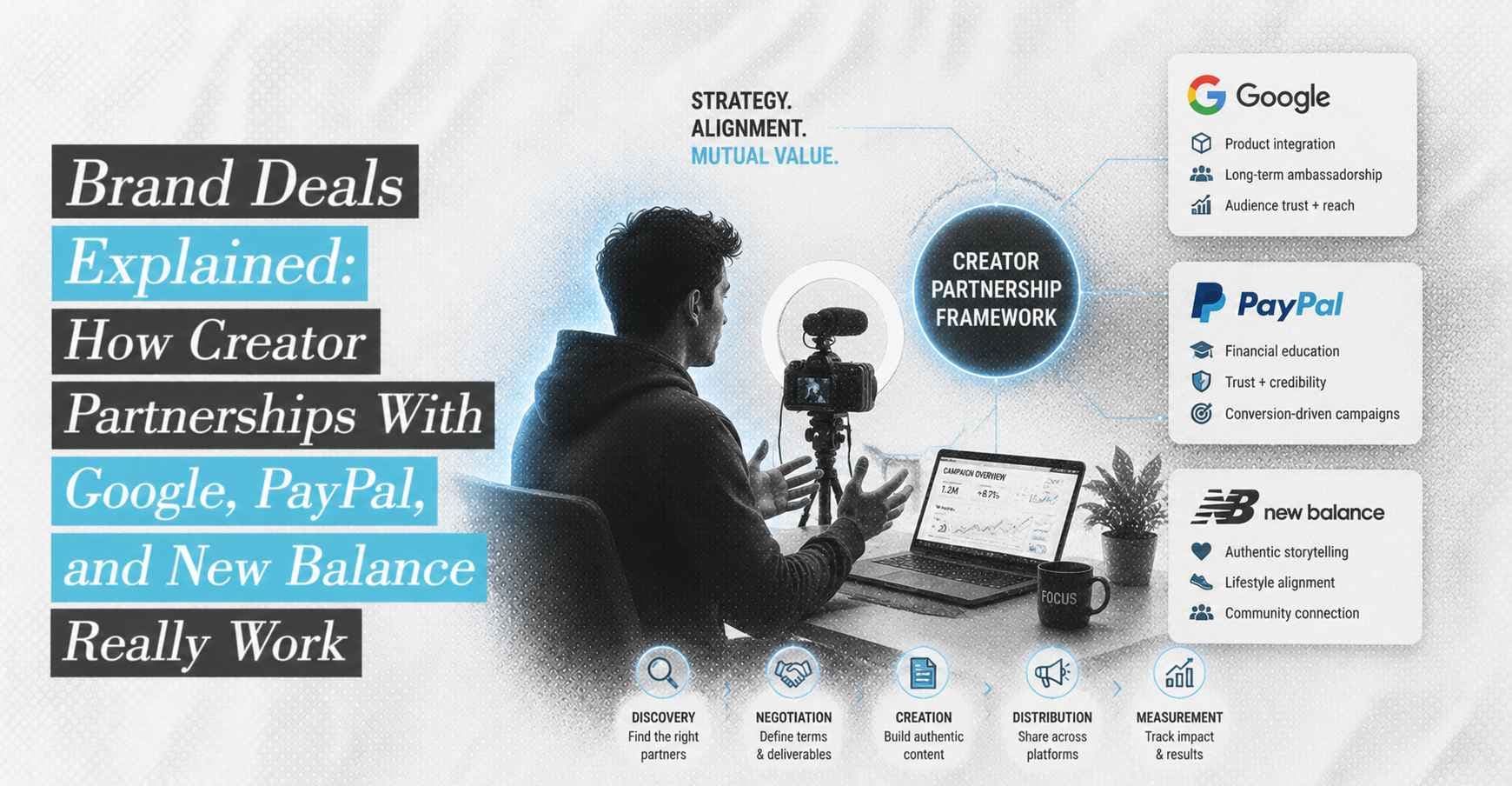
AJ Kumar’s clients have closed partnerships for clients with Google, PayPal, New Balance, Burt's Bees, Intuit, and Absolut Vodka, alongside William Morris, Viral Nation, and Digital Brand Architects. Brand deal revenue flows through three channels: integration, campaign, and licensing income. Licensing is the line item most creators leave on the table.
Key Takeaways
A brand deal is a transaction between two assets, the creator's audience and the brand's business objective.
Creator brand deal revenue flows through three channels: integration income, campaign income, and licensing income.
Licensing rights for brand ad campaigns can add 25 percent or more on top of the base content fee.
The four deal types are standard, ambassador, licensing, and full campaign, each with different economics and time horizons.
Top talent agencies like William Morris and Viral Nation can double or triple a creator's deal value through professional negotiation.
Creative restrictions scale with budget, but the highest-performing creator content keeps full creative freedom intact.
How Brand Deals Work as a Two-Asset Transaction
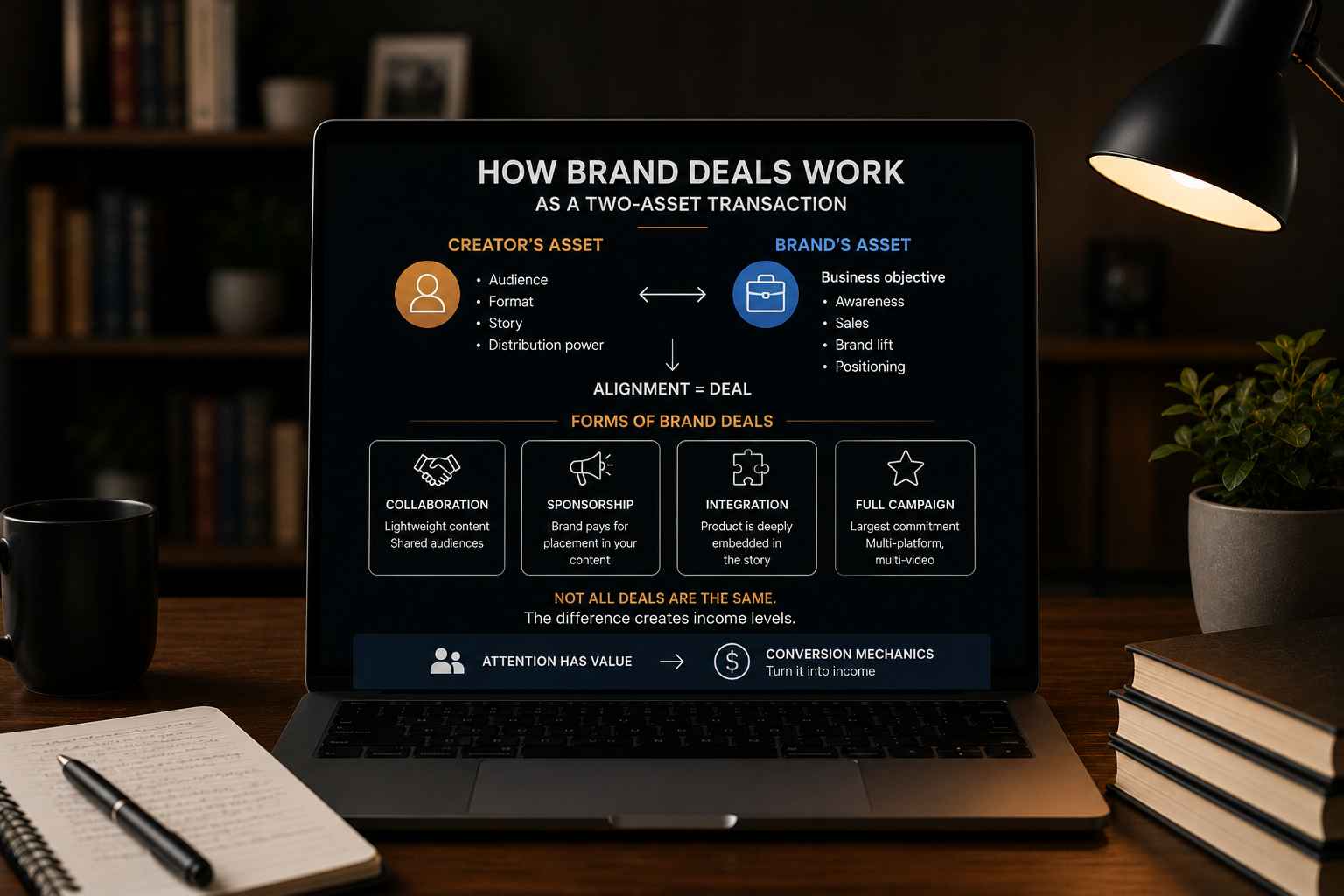
A brand deal is a transaction between two assets. The creator brings an audience, a format, a story, and distribution power. The brand brings a business objective: awareness, sales, brand lift, or positioning.
When those two things align, you have a deal. The form that deal takes varies widely.
A collaboration is a lightweight content piece where both parties share audiences. A sponsorship means the brand is paying for placement inside your existing content. An integration is a deeper embed, where the product becomes part of the story. A full campaign is the largest commitment: multi-platform, multi-video, full creative involvement from both sides.
Most creators treat all brand deals the same. They are not. The difference separates creators earning a few hundred dollars per post from creators building real revenue streams.
This is one piece of how the attention economy works for creators. Attention has value. Conversion mechanics are what turn it into income.
How Creator Brand Deals Generate Revenue Through Three Channels
Brand deal revenue flows through three channels, and most people only think about the first one.
Integration income is the most common form. The sponsored YouTube video. The TikTok mention. The Instagram Reel with a product placement. A brand pays you to include their product or message inside your content. You keep creative control. The deal is a one-off or a short series. Compensation ranges from a few hundred dollars to tens of thousands depending on audience and niche.
Campaign income is where the economics get more interesting. The brand does not want one video. They want a package. Multiple videos across platforms, a brand ambassador role, and product placement woven into a narrative across weeks or months.
I have closed campaign deals that bundled story shoutouts, long-form YouTube integrations, and paid UGC for the brand's own channels. When you move into campaign territory, you are not a creator. You are a media partner.
Licensing income is the one most creators overlook entirely. A brand pays for the rights to use your content or likeness in their own advertising. Ad whitelisting is the most valuable form. The brand runs your content as a paid ad through their own ad accounts. That access is rare, and creators should price for it.
Why Licensing Is the Most Overlooked Revenue Stream in Brand Deals
Licensing income is the line item most creators leave on the table. When a brand uses your face, your content, or your name in campaigns, that usage carries real monetary value. You should be compensated for it.
When a deal includes licensing or usage rights, charge a premium. I have seen creators add 25 percent or more when the brand repurposes content for paid ads. That content runs 30, 60, sometimes 365 days inside the brand's ad account. That is not a one-time video. That is a media asset.
This is the 3C Formula I write about in GURU, INC.: Content, Commerce, Concert. Brand deals sit inside the Commerce layer. Only when the creator treats content as an owned asset, not a one-time service, does the layer compound. Licensing is the proof.
How the Four Brand Deal Types Differ on Commitment and Economics
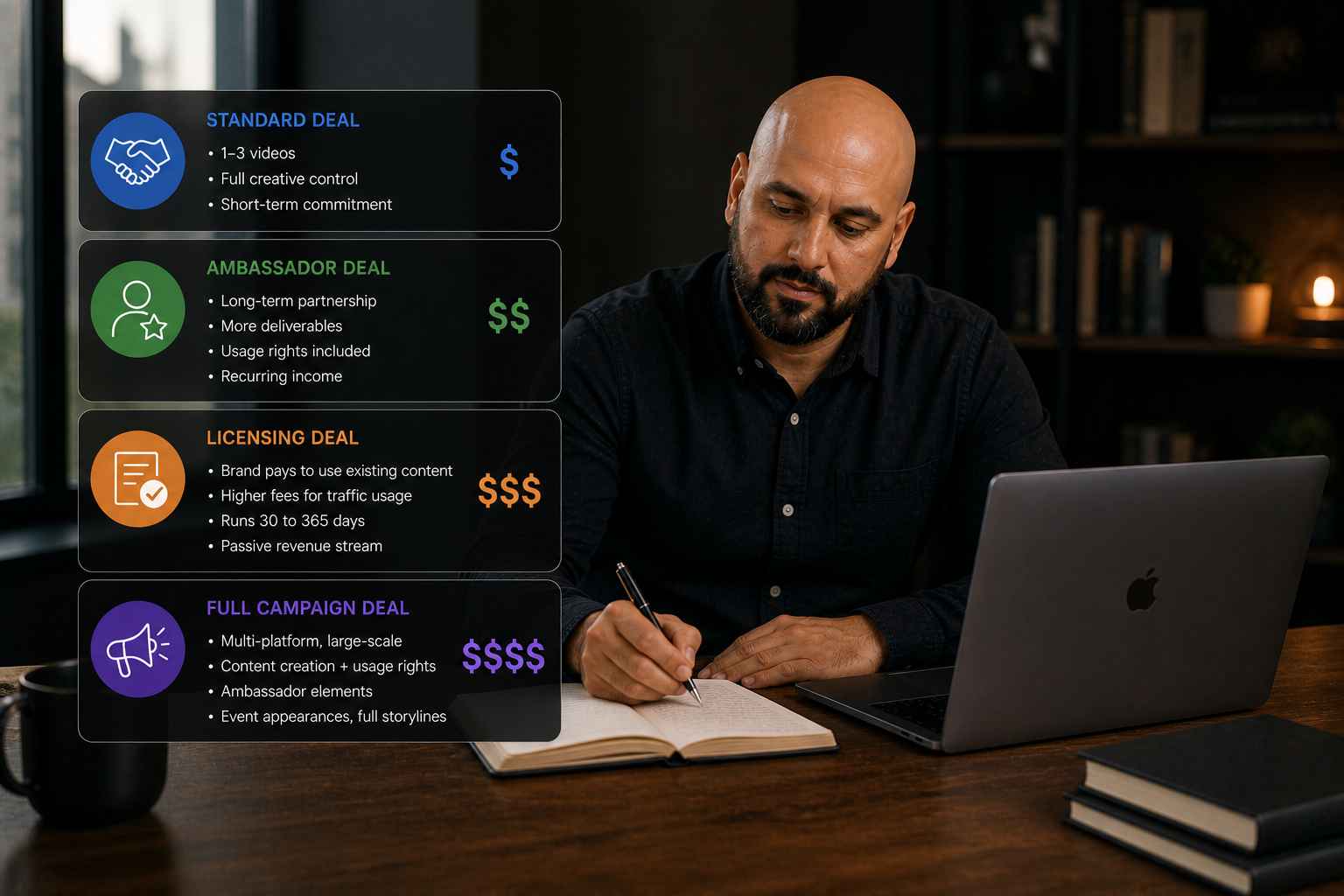
Brand deals split into four types, each with different economics and time horizons.
A standard deal is the entry point. One to three videos, full creative control, short-term commitment. Most creators start here, and there is nothing wrong with that. You make content, you get paid, you move on.
An ambassador deal is a longer-term partnership. You become the face of the brand for an extended period. More deliverables, higher pay, and usage rights are typically built into the agreement. Ambassador deals create recurring income and reduce the constant hunt for new one-off sponsors.
A licensing deal can generate revenue without any new filming. The brand pays for the rights to run your existing content in their ad campaigns. Higher fees for traffic usage, typically running 30 to 365 days. If you have built a real content library, licensing turns into a passive revenue stream. That library is the foundation of a personal media company.
A full campaign deal is the largest and most complex. Multi-platform, bigger budgets, full storylines. These deals include content creation, usage rights, ambassador elements, and sometimes event appearances. Some of the biggest deals I have helped facilitate have been full campaigns with companies like Google and PayPal. These are not quick Instagram posts. They are media partnerships.
Who Manages Brand Deals Between Creators and Brand Teams
A brand deal involves more people than most creators realize until they are inside a negotiation.
On the creator's side, you are working with managers or agents. Their job covers outreach, negotiation, contract handling, timeline management, and deliverables tracking. I have worked alongside agencies like William Morris, Viral Nation, and Digital Brand Architects on behalf of my clients. A good manager does not find deals. They protect you from bad ones.
On the brand's side, a team handles creative approvals, budget allocation, legal review, and performance evaluation. Behind that, legal and finance handle contract finalization, payments, usage rights enforcement, and invoicing.
What management does day to day goes deeper than most creators expect. They identify decision-makers. They negotiate rates, timelines, usage rights, edit approvals, and renewals. They protect the creator by making sure the deal is fair and aligned with the creator's brand value.
If you are handling all of this yourself, that time is not going into content creation.
This is also why a real personal brand moat matters at this level. The stronger your positioning as a recognized expert, the more leverage your management team has in every negotiation. Brands pay a premium for creators whose audience trusts the recommendation, because that trust is what moves the purchase decision.
Why Creative Freedom Is the Real Trade-Off in High-Budget Deals
Bigger budgets bring more creative restrictions. I have mixed feelings about this.
On one hand, I understand it. A company spending $50,000 or $100,000 on a creator partnership wants to protect the investment. They have brand guidelines, legal teams, and marketing objectives. They want script approval. Sometimes multiple rounds of revisions. Specific messaging requirements. Control over how their product is presented.
On the other hand, the most effective creator content I have seen works because the creator has full creative freedom. The audience trusts the creator, not the brand script. When a brand forces too many restrictions, the content starts feeling like a commercial instead of a recommendation. Audiences can tell the difference inside the first three seconds.
Look at Warren Phillips, the wellness educator behind NonToxicDad. He grew past one million followers and 30 million monthly views. His hook scares brand managers: "This product is canceled." That voice is the asset. The minute he hands over the script, the asset is gone.
The best deals are the ones where the brand trusts the creator to do what they do best. They provide guardrails, not a script. They share key messages and let the creator translate them into their own voice, format, and style. That is where the real performance lives. This is why I keep telling founders that social media is a strategic game. You play it on purpose. You do not rent out the stage.
There are situations where heavy restrictions work in the creator's favor. When a brand wants your content in their ads and your likeness across campaigns, restrictions carry a higher price tag. You are giving up more control. You should be compensated for it.
Know what you are trading. Make sure the economics reflect it.
Five Principles for Negotiating Higher Brand Deal Rates
Five principles separate creators who negotiate from creators who get negotiated.
Treat your content as a media asset. Know your audience, your format, and your reach before any brand call. Your work is a balance sheet item, not a favor.
Understand the deal type before you sign. A standard deal and a full campaign are different commitments with different economics. Read the contract for which one you are agreeing to.
Charge separately for usage rights. If a brand wants to run your content as ads, that is not a bonus. That is a separate line item. Price it in.
Get someone in your corner. A manager, an agent, or a media lawyer changes the entire dynamic. The right representation can double or triple a deal's value. Managers typically take 15 to 20 percent. The deals they secure pay for the fee many times over.
Do not sacrifice creative freedom cheaply. Your audience follows you for a reason. The moment your content sounds like a marketing department wrote it, you lose what made you valuable.
The revenue architecture behind brand partnerships is one piece of what I cover in GURU, INC.. The creator economics layer of an authority brand rewards founders who stack multiple income streams on a single audience. Brand deals, licensing, digital products, consulting, speaking. Each revenue stream reinforces the others.
Brand deals are not transactions. Done right, they amplify both the creator and the brand. Only if you understand the mechanics.
Frequently Asked Question
How much do brand deals pay creators?
Pay depends on audience size, engagement quality, platform, and deal type. Micro-influencers with 10,000 to 50,000 followers typically earn $200 to $1,000 per sponsored post. Mid-tier creators command $5,000 to $25,000 per campaign. Full campaigns with major brands can clear six figures.
How do creators find brand deals?
Most early deals come through inbound DMs, creator marketplaces, and warm introductions from other creators. As authority grows, brands and agencies reach out directly, and a manager begins running outbound pitches into specific brand categories. The shift from inbound to managed outbound is usually where deal sizes step up.
What is ad whitelisting in a brand deal?
Ad whitelisting is when a brand runs the creator's content as a paid advertisement through the creator's own social account. The ad appears to come from the creator, which raises trust and conversion. Whitelisting always sits as a separate line item on top of the content fee.
How long does a brand deal contract typically last?
A standard one-off deal runs 30 to 90 days from filming to delivery. Usage windows run 30 to 365 days. Ambassador deals run six to twelve months and sometimes longer. Full campaign deals scale with the brand's broader marketing calendar.
Are exclusivity clauses normal in brand deals?
Yes, but they are negotiable. Brands often request category exclusivity, meaning the creator cannot promote a direct competitor for a defined window. Exclusivity narrows future deal flow. The rate should reflect the income the creator is locked out of earning.
What do brands look for when picking creators for partnerships?
Brands evaluate audience alignment, engagement quality, content consistency, niche authority, and brand safety. The factor that pays the highest premium is trust transfer. That is the degree to which a creator's audience treats a recommendation as personal. High save and share rates inside a focused niche outperform raw follower count almost every time.