

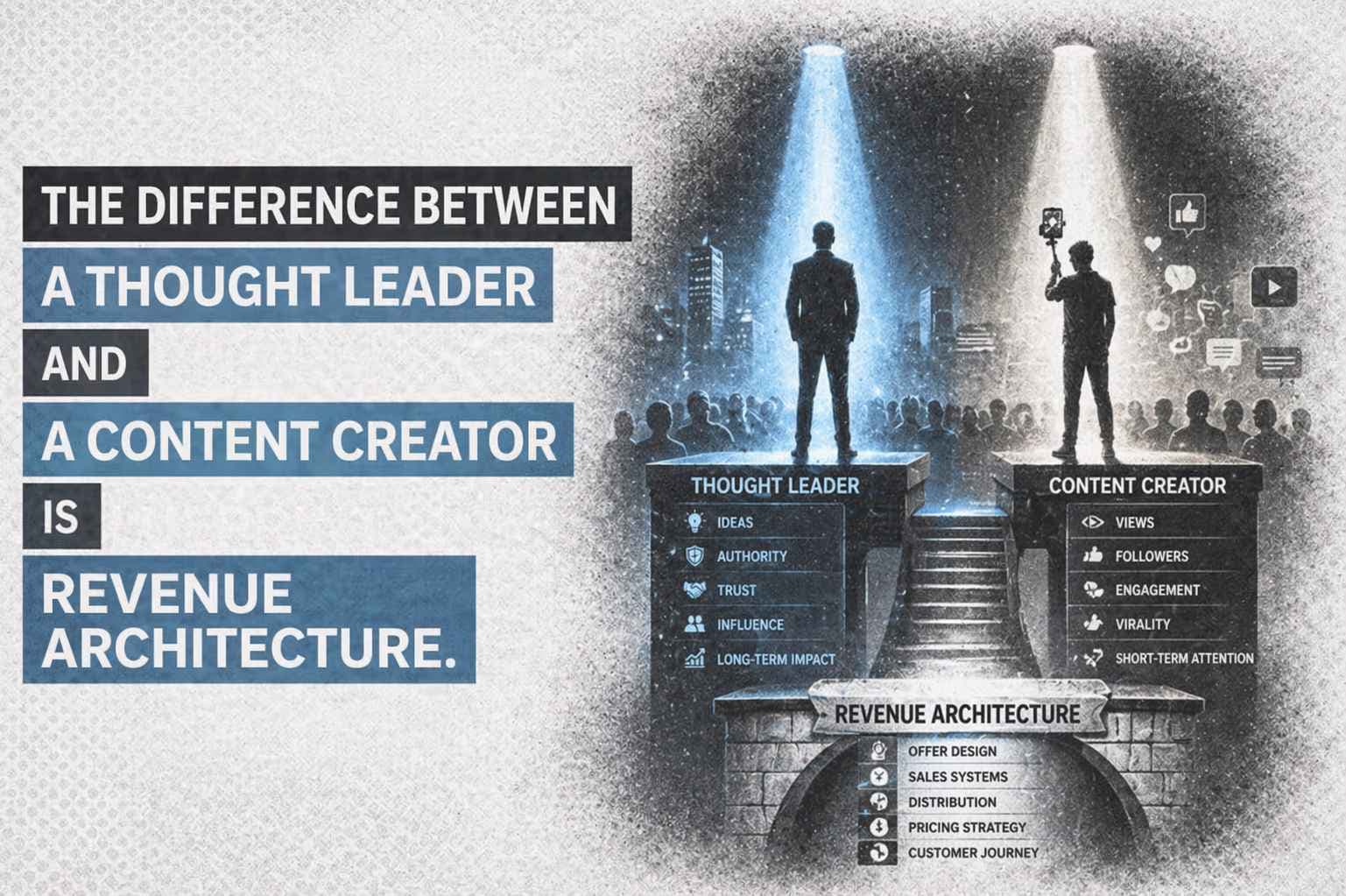
It is revenue architecture. Content creators monetize attention through ads, sponsorships, and merchandise. Thought leaders monetize trust through advisory work, deal flow, and equity. This article explains the three-layer revenue stack that separates the two operators and why the market pays different multiples for each.
Key Takeaways
Content creators monetize attention through ads, sponsorships, and merchandise, all of which are priced per impression
Thought leaders monetize trust through advisory work, speaking, deal flow, and equity, all of which are priced per relationship
The revenue test is simple: does the content generate inbound business opportunities or does it only generate engagement numbers
Alex Hormozi is the clearest public case study of a thought leader revenue architecture, where content is distributed free because the portfolio is the monetization layer
The thought leader revenue stack has three layers: direct (advisory and consulting), indirect (deal flow and partnerships), and equity (portfolio and brand valuation)
In practice, trust-based revenue often clears higher effective multiples than attention-based revenue at comparable audience sizes
How Content Creators Monetize Attention While Thought Leaders Monetize Trust

The content creator economy is priced per impression. Every revenue stream, from CPM to sponsorship rate card to merchandise margin, scales linearly with the attention the creator captures. Lose the attention, lose the revenue.
The thought leader economy is priced per relationship. Advisory retainers, speaking fees, deal flow, and equity stakes do not scale with raw impressions. They scale with the depth of trust a specific audience places in a specific operator on a specific topic. A thought leader with 50,000 trust-weighted followers can generate more revenue than a creator with five million impression-based followers in the same category.
Both operate in public. Both publish content. Both chase visibility. The split happens downstream, in the revenue architecture attached to the visibility. Creators convert visibility into impressions. Thought leaders convert visibility into access.
How the Revenue Test Separates the Two Operators
There is one question that exposes which operator someone is. Does the content produce inbound business opportunities, or does it only produce engagement numbers?
Engagement is followers, likes, shares, and comments. Inbound is qualified DMs, advisory inquiries, speaking offers, partnership pitches, and deal flow from people with capital. A creator can post a viral piece that generates a million views and zero business conversations. A thought leader can post a niche essay that generates ten comments and three advisory calls worth six figures each.
The test works in both directions. When a content creator stops posting, attention drops and revenue follows within weeks. When a thought leader stops posting, the advisory pipeline already booked continues to close, the speaking schedule is set a year out, and the equity positions keep compounding. The architecture is the difference.
How Alex Hormozi Built a Thought Leader Revenue Architecture

Alex Hormozi is the clearest public example of a thought leader revenue architecture operating at scale. He prices his books at 99 cents on Kindle. He posts long-form videos and clips free across every platform. He refuses sponsorships. By the conventional creator economy playbook, the numbers should not work.
They work because the business underneath is not content. It is Acquisition.com, a portfolio of companies Alex and Leila Hormozi take equity positions in. Every post and every book chapter is a filter that sorts the audience into two groups: people who consume for free and operators whose businesses fit the portfolio thesis. The content is the lead magnet. The portfolio is the product.
Hormozi has publicly framed the content operation as a deal-flow engine for Acquisition.com rather than a profit center in itself. The payoff is the equity upside in the portfolio companies the content routes in. That is thought leader math, not creator math.
How the Direct Revenue Layer Converts Authority into Advisory Income
The direct layer is the fastest revenue a thought leader can activate. Consulting, advisory retainers, coaching, workshops, and speaking fees all sit here. The transaction is explicit. Trust built through public content converts into paid access to the operator's expertise.
Pricing in this layer is decoupled from audience size. Seth Godin commands keynote fees that exceed what many creators with much larger audiences can charge for a single appearance. The price is not a function of reach. It is a function of the authority the audience assigns to the operator on a specific topic.
This is also the layer where most experts hesitate, because pricing trust feels harder than pricing impressions. The solution is positioning clarity. The same positioning work that makes a LinkedIn profile function as an authority asset also makes advisory pricing defensible. Clarity in positioning precedes premium in pricing.
How the Indirect Revenue Layer Converts Authority into Deal Flow
The indirect layer is where authority compounds beyond direct billing. Every introduction, every referral, every partnership request, and every investor meeting that arrives because a post landed with the right reader sits in this layer.
Neil Patel's personal brand routes enterprise clients to NP Digital. The agency revenue is indirect, but the authority driving it is the public content. Gary Vaynerchuk's decade of public posting built the pipeline that sustains VaynerMedia. The math is the same. Public trust functions as a sales channel with near-zero marginal cost after the content is live.
Most founders underestimate this layer because it is harder to measure than ad CPM. The causation is real but delayed. A post from two years ago can generate a partnership inquiry this quarter that closes next quarter. Attribution looks fuzzy. The compounding does not.
How the Equity Revenue Layer Converts Authority into Portfolio Value
The equity layer is the endgame of the thought leader revenue architecture. It is where authority stops being a cash flow source and starts operating as a valuation multiplier.
Naval Ravikant used his public authority on startups and investing to build AngelList and to take angel positions in companies where founders wanted him on the cap table because his backing was a market signal. Tim Ferriss invested early in Uber, Twitter, Facebook, Shopify, and Alibaba because audience trust opened founder access that capital alone could not buy. The content produced deal access. The deals produced equity. The equity produced the outcomes that rewrote personal net worth.
Hormozi routes the same architecture through Acquisition.com. Oprah Winfrey routed it through OWN, Weight Watchers equity, and the Harpo portfolio that compounded for decades. The pattern is consistent. Authority becomes a portfolio sourcing advantage that capital alone can not replicate.
Why Trust Revenue Clears Higher Multiples Than Attention Revenue

In practice, trust-based revenue often clears higher effective multiples than attention-based revenue at comparable audience sizes. A creator with a million subscribers earning sponsorship rates can bring in less per year than a thought leader with fifty thousand subscribers charging advisory fees, speaking fees, and collecting equity carry on portfolio deals.
The reason is structural. Attention revenue has a ceiling set by the CPM market. Trust revenue has a ceiling set by the deal size a relationship can open. A keynote can be 50,000 dollars. A consulting retainer can be 250,000 dollars per year. A single equity position can be worth seven figures when the company exits. Those ceilings sit orders of magnitude apart.
The market is not rewarding hype. It is rewarding to reduce risk. A trust-weighted operator lowers the buyer's decision cost because the relationship has already been pre-verified through the content. That risk reduction is what the premium pays for. This pattern shows up across in my creator economy article whenever a named operator outperforms much larger creators in the same niche.
How to Rebuild a Content Creator Operation into a Thought Leader Architecture
The shift from content creator to thought leader is not a content shift. It is a revenue architecture shift. Output can stay identical while the monetization model changes.
Three moves make the rebuild concrete. First, add a direct revenue layer by offering advisory, workshops, or a productized consulting service priced per relationship, not per impression. Second, instrument the indirect layer by tracking inbound inquiries as a pipeline, not as social metrics. Third, define the equity path, which could be a portfolio of angel positions, a holding company like Acquisition.com, or equity-for-authority arrangements with operators that the content reaches.
None of this requires a larger audience. Most of it requires a sharper point of view and a documented body of work that credentials the operator on a specific topic. The same discipline that separates credentials from authority applies here. Creator's post. Thought leaders build the architecture that turns posting into outcomes. The full model is mapped in GURU, INC., and across my other articles on Personal Brand Authority.
FAQ
What is the simplest definition of the difference between a thought leader and a content creator?
A content creator is priced per impression and monetizes attention through ads, sponsorships, and merchandise. A thought leader is priced per relationship and monetizes trust through advisory work, speaking, deal flow, and equity. Same public surface, different revenue architecture underneath.
Can a content creator also be a thought leader?
Yes, and many top operators are both. The shift happens when the revenue architecture moves from per-impression income to per-relationship income. Most creators who make the transition do so by adding advisory, consulting, or equity layers on top of the existing content operation.
Does thought leadership require a large audience?
No. Audience size often matters less than audience quality and positioning clarity. A small, trust-weighted audience of decision makers can produce more thought leader revenue than a large audience of casual consumers, because the revenue is priced against the depth of the relationship, not the size of the reach.
How long does it take to build a thought leader revenue architecture?
Most operators see advisory and speaking revenue within 12 to 24 months of consistent public content tied to a clear positioning. Deal flow and equity layers typically take longer to compound because they depend on repeated exposure and trust across multiple business cycles.
What is the most common mistake when trying to make the shift?
Copying content creator tactics while expecting thought leader outcomes. Running sponsorships, optimizing for views, and chasing viral formats trains the audience to consume attention, not to convert trust into business. The architecture has to be built deliberately.
How does this connect to the book GURU, INC.?
GURU, INC. maps the full progression from expert to recognized authority, including how the revenue architecture evolves at each stage of the Guru Ladder. The thought leader versus content creator distinction is one instance of the broader pattern the book documents across multiple industries and audience sizes.