
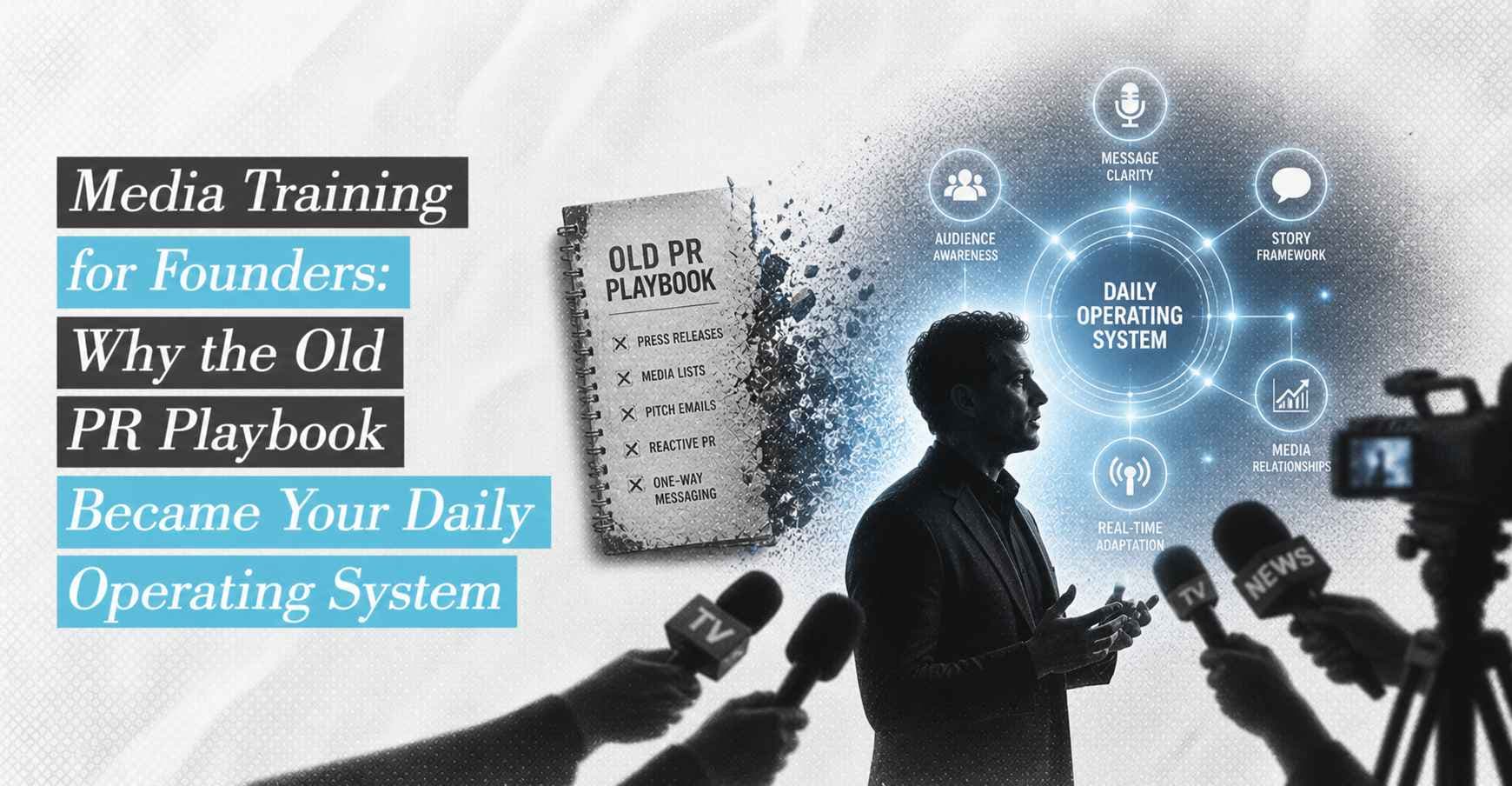
The frameworks that once helped CEOs survive a Bloomberg sit-down now power every post, video, and clip a founder publishes. Bridging, flagging, hooking, the headline-proof-bottom-line structure: same techniques, new surface. Most founders run them by accident. The ones who run them on purpose win.
Key Takeaways
Traditional media training was built for the once-a-year interview, not the daily content publishing schedule founders run today across LinkedIn, podcasts, and YouTube.
The headline, proof points, and bottom line structure works for every post, podcast, and keynote. Not only press interviews.
Bridging keeps founders on message during long-form podcasts, where most narrative drift happens after the 40-minute mark.
Flagging makes one idea stick when nobody is taking notes. It is how every viral founder clip becomes the line that gets repeated.
Hooking is the only currency the algorithm rewards. Without a strong opener, no amount of substance gets seen.
The old PR rule of "never go off the record" now applies to every Slack screenshot, hot mic, and behind-the-scenes moment a founder lets exist.
Old media training was built for the one-day-a-year founder.
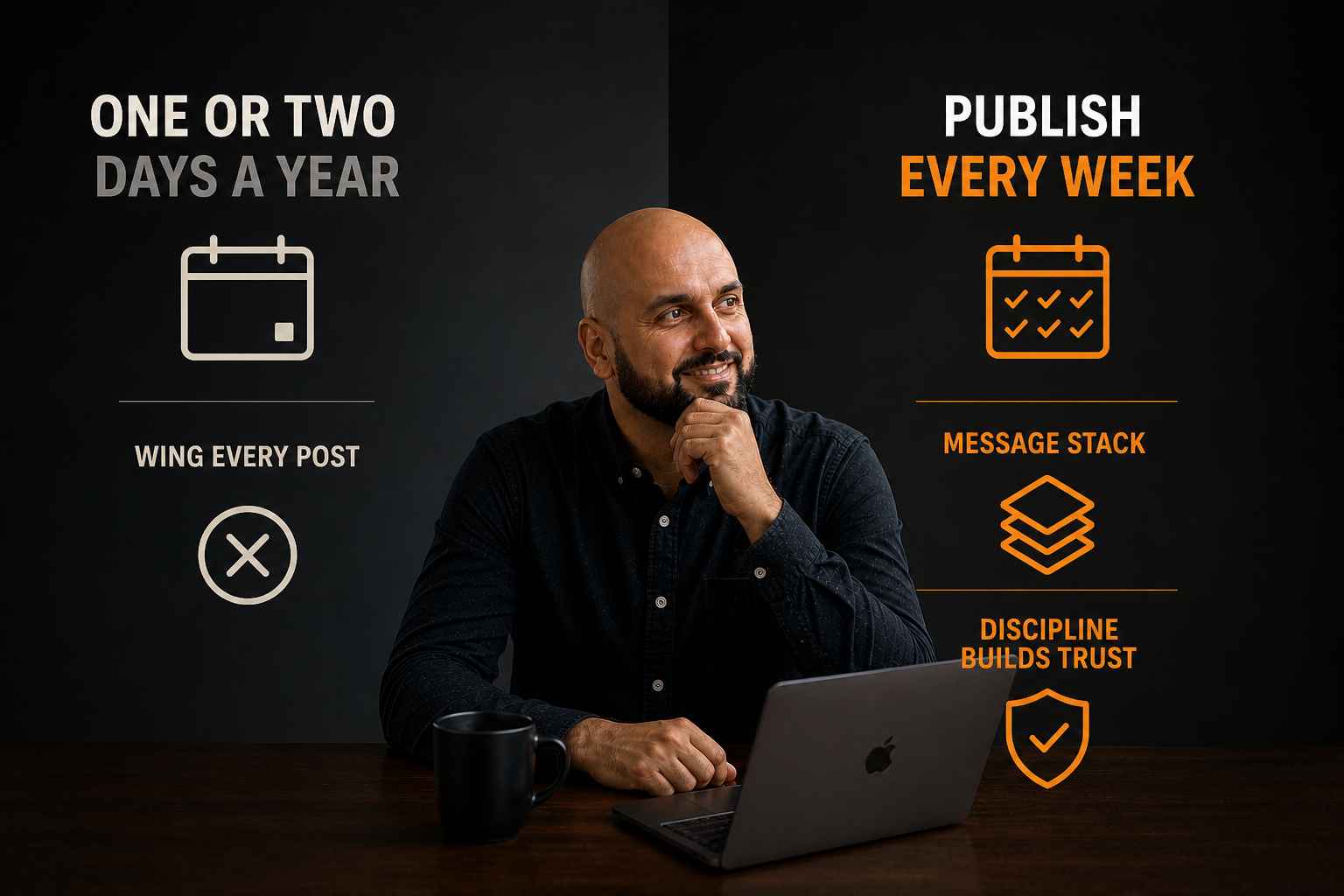
Most founders have received zero formal media training. Most CEOs of public companies have. The reason is simple. Until ten years ago, founders rarely sat across from a reporter. Press hits were occasional. Podcasts were a side hobby. LinkedIn was a resume.
Traditional media training was built for that world. A two-hour session with a former TV producer. Practice answering hostile questions. Memorize three key messages. Avoid five trap phrases. Walk in once or twice a year, perform under pressure, walk out.
That model is over. Today many founders publish a podcast episode, a video, and ten posts in a single week. That output dwarfs the press footprint of most CEOs from a decade ago. LinkedIn posts. YouTube clips. Substack issues. Podcast guest spots. Internal all-hands clips that leak to X.
The training has not caught up. So most founders run their content with no framework, no message stack, no discipline. They wing every post. That works at zero followers. It collapses at one million.
Every founder now runs a personal newsroom.
Old media training assumed a journalist sat between you and the audience. The journalist asked the questions. The journalist edited the quote. The journalist decided what made it to print.
That filter is gone. When you publish on LinkedIn, you are the reporter, the editor, the headline writer, and the spokesperson. The founder is the network. The audience is the readership. Every post is on the record by default.
I write about this in GURU, INC. through a model I call the Personal Media Company. It has five components: programming, distribution, monetization, operations, and measurement. Programming is the editorial layer. The thing real newsrooms hire a managing editor for, and the thing most founder feeds do not have.
Without programming, content output is reactive. With programming, it is intentional. Old media training was a programming function. We used to outsource it to a publicist for the rare event. Now you have to run it in-house, every day, for yourself.
The three-part message stack works for every format, not only interviews.
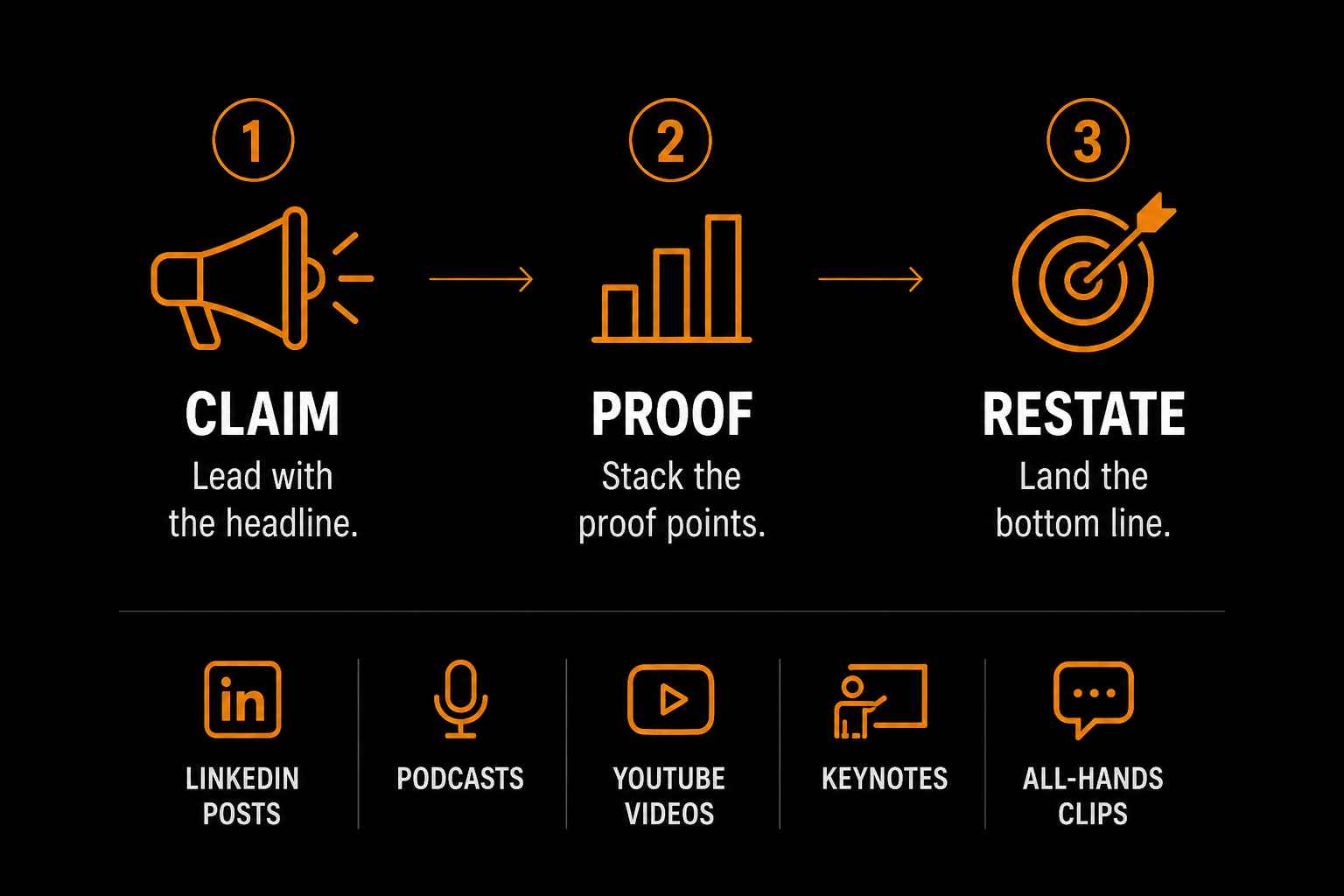
Traditional media training teaches a structure called headline, proof points, bottom line. Headline is the overarching point. Proof points are the data, anecdotes, or examples that support it. Bottom line restates the headline at the end. The whole structure was designed so a quote pulled from any part of the interview still served the message.
That structure is exactly how every great LinkedIn post works. It is how every keynote opens, develops, and lands. It is how every YouTube video that holds attention is built. State the claim. Prove it. Restate it.
Most founders write content the opposite way. They warm up. They build to the point. They reveal the headline at the end. That works in a TED talk where the audience is already locked in. It does not work in a feed where attention has a three-second window. Building personal brand authority at scale requires the inverted shape, not the polished one.
When I script content for founders, I use the same three-part structure publicists used in 1995. Lead with the claim. Stack the proof. Land the bottom line. Same architecture. New surface.
Bridging keeps you on message when the podcast runs long.
Bridging is the technique of redirecting a question back to your core message without dodging it. Common bridges include "what is important to know is" or "let me put that into perspective." Both help a spokesperson pivot from a tangential question to a higher-value answer.
Most founders do not need bridging on a 60-second clip. They need it on a 90-minute podcast. By minute 40, the host is improvising. The questions wander. The energy dips. Without a bridge ready, the founder follows the host into territory that does not serve the brand.
I watch this collapse in real time on long-form podcasts. The host asks a charming question about childhood, college, or a side hobby. Interesting story. Wrong message. Forty minutes of unmonetizable content. A simple bridge would have moved the conversation back to the work. The damage on a 90-minute podcast almost always lives in the back half.
Bridging is not deflection. It is editorial discipline. The same discipline a managing editor enforces in a real newsroom. The founder running the strategic game of social media has to enforce that discipline on themselves.
Flagging is how one idea sticks when nobody takes notes.
Flagging is a verbal flare. Phrases like "the main point is" or "if you remember only one thing." It signals to the audience that the next sentence matters more than the surrounding content.
In a print interview, flagging tells the journalist which sentence to put in the headline. In a podcast, it tells the listener which 30 seconds to clip and share. In a LinkedIn post, it tells the algorithm which line gets the dwell time. Every modern format rewards flagging because every modern format compresses.
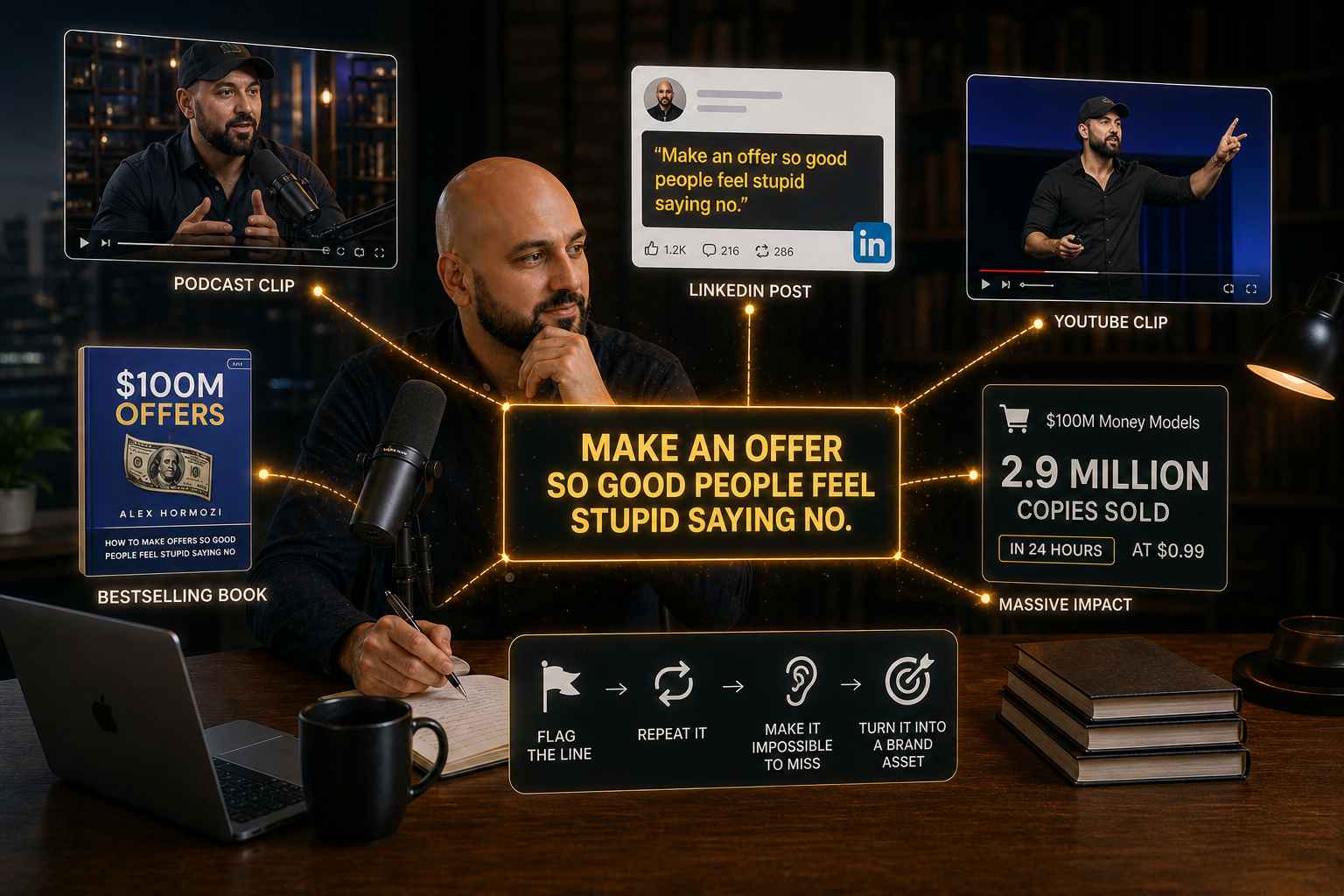
Alex Hormozi flags one line across every channel he runs. "Make an offer so good people feel stupid saying no." He repeats it on podcasts, posts, books, and keynotes for years. By the time someone picks up $100M Offers, they have heard the line a hundred times. His next book, $100M Money Models, sold 2.9 million copies in 24 hours at $0.99.
Flagging turns a sentence into a brand asset. Flag the line you want quoted. Repeat it. Make it impossible to miss.
Hooking is the only currency the algorithm rewards.
Hooking is the technique of opening a media moment with something the audience cannot ignore. "Most people do not know" or "our data reveals" or "the question nobody is asking." These phrases were designed to push a story past a journalist's filter. They do the same thing past an algorithm.
Inside my framework ROAC, short for Return on Attention Created, attention moves through four neurological gates. Register. Retention. Resonate. Reinforce. The hook works at the Register gate. If a piece of content does not register in the first second, none of the other three gates ever fire. The biology of brand building is unforgiving on this point.
Old media training treated hooks as an option. New media training treats them as a requirement. The headline is not the polish on the post. The headline is the post. Without it, the rest of the work does not exist.
"Off the record" no longer exists at scale.
Old media training drilled one rule into every executive. Never say "off the record." The phrase implied the reporter would protect the comment. The reporter usually did not.
Today there is no off the record at all. Every Slack message can be screenshot. Every Zoom can be recorded. Every internal all-hands clip can leak to X within hours. The hot mic is permanent. The deleted tweet is archived. The forwarded email gets screenshot.
So the old defensive rules now operate as ethical defaults. Do not say in private what you would not say in public. Do not write in Slack what you would not put on LinkedIn. Do not assume any conversation is contained. The founder running a personal media company operates on the assumption that everything they say or write is, eventually, content.
This is not paranoia. It is the working condition. Founders who internalize it move with intention in every channel. The ones who do not eventually have a clip leak. It costs them more than the brand moat they spent years building.
The new media training is a daily discipline, not a panic drill.
Old media training was a fire drill. Practice once. Hope it never burns. New media training is a daily standard. The founder shows up to every podcast, post, video, and keynote with the same toolkit. The same three-part stack. The same bridge phrases ready. The same flag lines drilled in.
Repetition is the point. The brain remembers what it sees fired in the same sequence over time. Authority is not built by volume or charisma. It is a stack of small mechanisms fired in the right order, repeatedly, with consistency. That is the same logic behind Joel Osteen's one-show content system. A 30-minute sermon, rehearsed for five days, delivered to a 45,000-seat venue.
Founders winning right now are not more polished. They are more deliberate. They run the headline-proof-bottom on every post. They bridge mid-podcast without breaking flow. They flag the one line they want clipped. They open every video with a hook that earns the next ten seconds.
You do not need a publicist for this. You need the discipline a publicist used to provide, applied to the work you publish anyway. The reporter is gone. The newsroom is yours. Run it like one.
Frequently Asked Questions
What is the difference between traditional PR media training and founder media training?
Traditional PR training prepares an executive for a specific reporter event. Founder media training is the operating discipline applied to every podcast, post, and video the founder publishes. The founder runs it daily, without a publicist managing the moment.
Do founders still need professional media training if they have communications experience?
Yes. Communications experience helps with internal messaging and team alignment. Founder media training is about turning that into a public-facing system that runs across every channel the founder owns.
Which media training techniques transfer best to LinkedIn content?
The headline-proof-bottom-line structure, hooking openers, and flagging the quotable line. These three turn a generic update into a post the audience remembers and the algorithm rewards.
How do you bridge effectively in a long-form podcast without sounding scripted?
Use natural transitions like "what is important here is" or "the bigger picture on that is." Have three or four bridge phrases rehearsed enough that they feel reflexive, not memorized.
Should a founder still avoid jargon the way old media training advised?
Yes, with one update. Avoid jargon that adds friction. Keep the language that signals depth to the audience you serve. The old rule was clarity. The new rule is clarity calibrated to the room.
How often should a founder review their media training fundamentals?
Quarterly. Platforms change. Format conventions shift. The founder who trained for LinkedIn in 2022 is not trained for LinkedIn in 2026. Refresh the playbook on a clock.
Can media training for founders be self-taught?
Yes, with discipline. The frameworks are public. The challenge is repetition. Most founders read the techniques once. The ones who win drill them weekly until the techniques run on autopilot.