

An early-stage founder builds an audience by testing ideas, not by posting more. The first phase runs as Proof of Concept, the opening stage of the Personal Media Company Model. The founder earns the first audience by documenting the problem they solve, not by pitching a product.
Two platforms beat eight, and a clear point of view beats raw output. The founder reads the signal, then invests in what earns attention.
Key Takeaways
An early-stage founder needs Proof of Concept, not a higher posting volume.
Proof of Concept means testing ideas in their simplest form to gather data.
Most early content fails on purpose, because failure is the signal.
The audience forms around the problem the founder solves, not the product.
One depth platform and one discovery platform outperform spreading across eight.
A point of view builds recognition faster than output does.
Audience-building stalls when a founder tests without a system to hold the trust.
An early-stage founder does not need more content. They need Proof of Concept.
An early-stage founder builds an audience by testing ideas, not by posting more. Most advice says post daily and stay consistent. That advice is the reason most founders stop by week two.
The founder I write for here is the expert with a track record and no audience. Twenty years of knowledge, real clients, an empty profile. This founder does not have a content problem. This founder has a starting problem.
The fix is a shift from broadcasting to testing. Broadcasting assumes you already know what your audience wants. Testing assumes you do not, and treats early content as the way to find out.
Start by testing ideas, not by building a library.

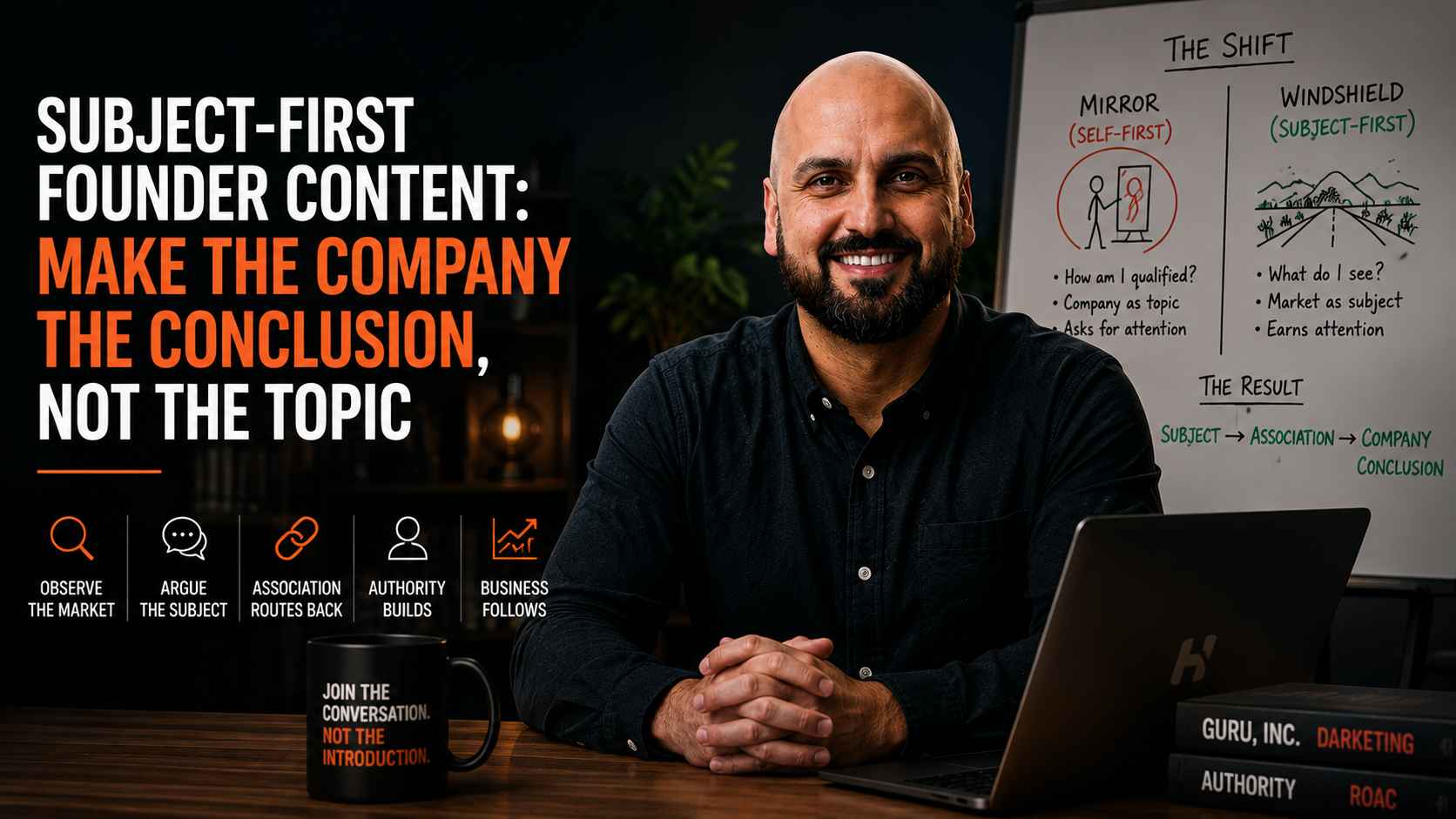
A founder starts an audience by treating the first phase as Proof of Concept. Proof of Concept is the opening stage of the Personal Media Company Model, the system documented in GURU, INC.
Proof of Concept means one thing: test content ideas in their simplest form, with no production value. A raw post. A short clip filmed on a phone. A single observation about your field.
Why most of what you test should fail
Most of what you test will not land, and that result is the point. Each idea that fails removes a guess. Each idea that earns a reply tells you where attention lives. The founder gathers data, not a library of polished assets nobody asked for.
I have watched experts waste a year producing a content catalog before knowing if a single theme resonated. The founders who start faster test small, read the result, and move.
Build the audience around the problem, not the product.
A founder earns the first audience by documenting the problem they solve, not by pitching. This is the point almost every credible voice agrees on, and it holds.
The market follows the founder who teaches what they are learning about a problem. Warren Phillips, known as NonToxicDad, built to 30 million monthly views by speaking to a problem parents felt, long before any pitch. Content became market research that happened to build trust.
What to post when there is nothing to launch yet
A founder posts what they notice, what surprised them, and what they got wrong. The mistakes carry more signal than the wins. A reader does not follow a product announcement. A reader follows a person who makes a confusing problem clearer.
Pick one depth platform and one discovery platform, not eight.
A founder builds an audience faster on two platforms than on eight. The instinct to be everywhere splits the founder thin and starves every channel of momentum.
The two platforms serve different jobs. The two platform roles are defined below:
Depth platform: the place the founder proves expertise through long-form, where the thinking is visible.
Discovery platform: the place new people first encounter the founder through short, sharp ideas.
Dr. Ben Lynch grew a supplement business on the back of long-form video, where depth did the convincing. Distribution beats volume, because one idea placed well travels further than ten posts scattered across channels nobody watches closely.
Audience comes from a point of view, not from output.
An audience forms around a founder's point of view, not their posting frequency. Output without a position produces noise. A position repeated produces recognition.
Repetition of one clear idea builds familiarity. Familiarity builds trust. A founder known for one sharp belief beats a founder posting about ten loosely related topics. The early-stage founder is not trying to be seen by everyone. The founder is trying to be known by the right people.
A founder reads the signal, then invests in what works.

A founder graduates from testing by reading the signal and investing in the formats that earn attention. This move separates a founder who keeps testing forever from one who starts compounding.
The honest pattern is uncomfortable. Testing without a position is guessing. Most early-stage founders carry a positioning problem, not a content problem, and more content never solves a positioning problem. If the testing keeps producing noise, the missing piece is clarity on the right next move, which is the work I do on a strategy call.
A few questions decide whether that early audience compounds or stalls.
Building an audience versus going viral
A founder builds recognition with the right people. Virality brings volume that rarely converts. The two outcomes look similar on a dashboard and behave nothing alike.
A viral post spikes and fades. A recognized point of view compounds, because each piece reinforces the last. The early-stage founder who chases reach trains an audience that came for a moment. The founder who builds recognition trains an audience that came for them. The difference is the gap between attention that expires and content systems that compound founder authority.
Why an established expert starts at zero audience
Expertise and audience are two different assets. A founder earns the first through years of work. The second stays at zero until the founder builds it on purpose.
This is the invisible expert: deep knowledge, real results, and almost no public recognition. The market cannot follow what it cannot see. The starting point is not a lack of credibility. The starting point is a lack of visibility, which is the gap between expertise and recognition. Closing that gap is the entire job of the first phase.
Common early-stage audience-building mistakes
Four patterns stall most early founders. The four mistakes are listed below:
Chasing virality instead of building recognition.
Posting daily for two weeks, then disappearing for a month.
Spreading across eight platforms instead of two.
Measuring follower count instead of trust.
Each mistake shares one root. The founder treats audience-building as performance instead of testing. Performance burns out. Testing compounds, because every result feeds the next decision.
Frequently Asked Questions
How do early-stage founders build an audience with content?
Early-stage founders build an audience by treating early content as Proof of Concept, testing which ideas earn attention before scaling. The founder tests in the simplest format, reads the response, and invests only in what works. This approach replaces broadcasting with deliberate testing.
Should a founder build an audience before launching a product?
A founder builds an audience around the problem before the product exists, because the audience that follows the problem becomes the first market. The content documents the problem, not a release date. By launch, the founder addresses people who already trust the perspective.
What should a founder post when there is nothing to show yet?
A founder posts what they are learning about the problem they solve, not updates about a product nobody can see. Observations, mistakes, and questions outperform announcements. Demonstration of thinking builds more trust than a teaser ever does.
How long does it take a founder to build an audience?
A founder sees early signal within months and durable trust over quarters, because recognition compounds with repetition. The first weeks produce data, not a following. Consistency on one point of view turns that data into recognition over time.
Does a founder need a large audience to make money?
A founder needs a trusted audience, not a large one, because authority determines revenue more than size does. A small audience that believes the founder converts better than a large one that scrolls past. Trust, not headcount, carries the business.