


Your brand depends on interconnected systems, content, distribution, positioning, and monetization, that feed each other the way the body's circulatory, respiratory, nervous, and digestive systems do.
When you stop feeding your brand with consistent content and visibility, it does not pause. It decays. The brands that survive long-term are the ones that consistently deliver three things: identity value, trust value, and leverage value, the same Three Forces that govern Personal Brand Authority.
The Tree-Falls-in-the-Forest Problem
If a tree falls in a forest and no one is around to hear it, does it make a sound?
For founders and expert creators operating in the attention economy, the answer is no. If no one sees your expertise, it does not exist in the marketplace. It does not generate trust, attract clients, or create opportunity. Full stop.
I wrote about this in GURU, INC. because it is one of the most common traps I see experts fall into. They try to be the best at what they do before they start showing up. They wait until their knowledge feels complete enough to share. While they wait, the market fills in around them. Someone with less experience but more visibility takes the space they could have owned.
Expertise alone is not enough. People do not buy the best product or service. They buy what they know exists.
Why Your Brand Operates Under Biological Law
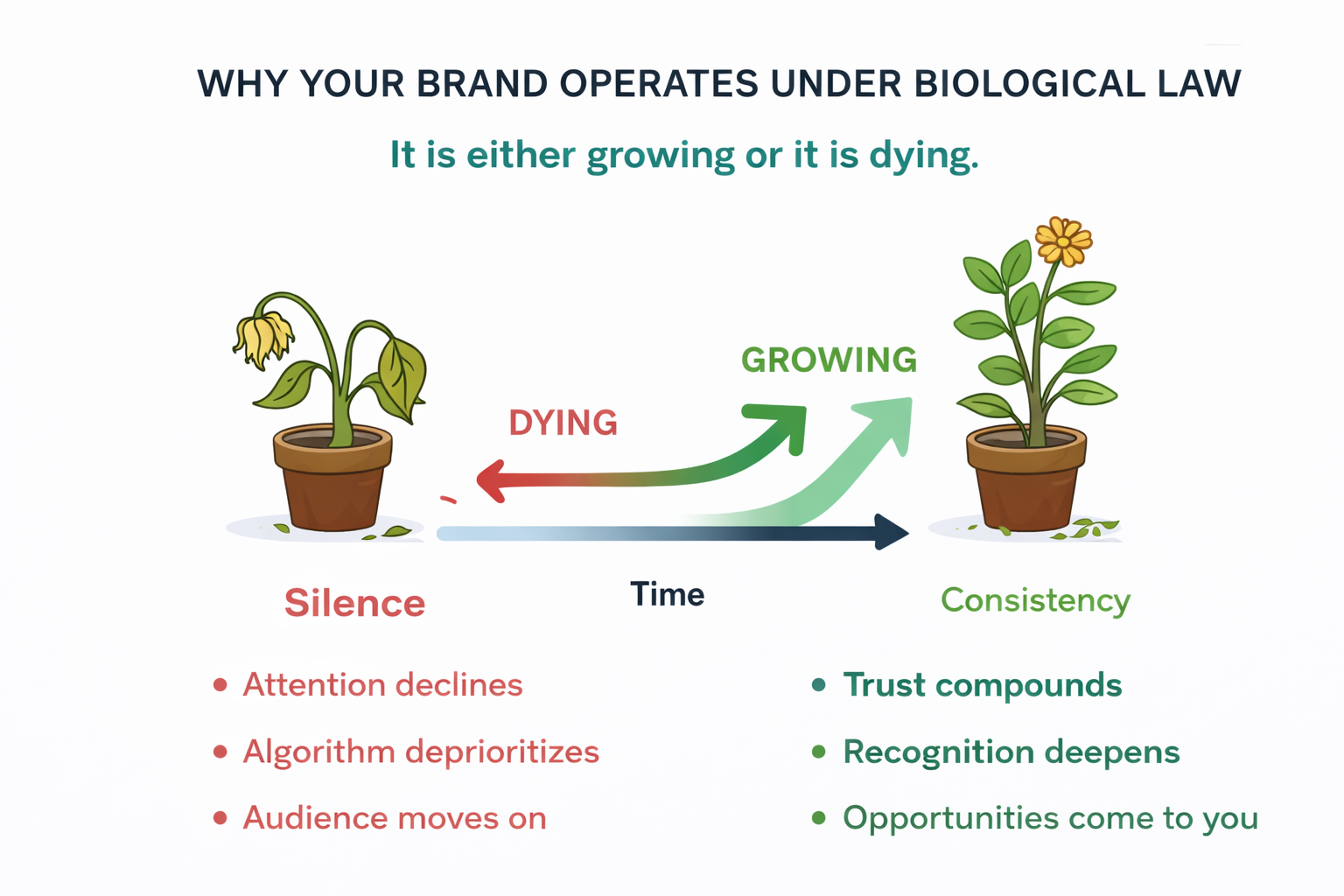
Your personal brand is not a house you build once and maintain. It is a living organism governed by one fundamental law: it is either growing or it is dying.
Neuroscience research on biological value shows that every living organism exists within a homeostatic range. At one end, the organism flourishes. Its systems run efficiently. It adapts, responds, and grows. At the other end, viability declines. The organism weakens.
The critical insight: there is no standing still. Every living system moves in one direction or the other. The inputs it receives determine which direction.
When you consistently create content, show up with a clear point of view, and build visibility with your audience, your brand moves toward flourishing. Trust compounds. Recognition deepens. Opportunities come to you instead of you chasing them.
When you go quiet, your brand does not pause. Attention atrophies. The algorithm deprioritizes you. Your audience starts associating the problems you solve with someone else who keeps showing up.
The Four Body Systems That Keep a Brand Alive
A personal brand stays alive through multiple interconnected systems that feed each other, the same way the human body does.
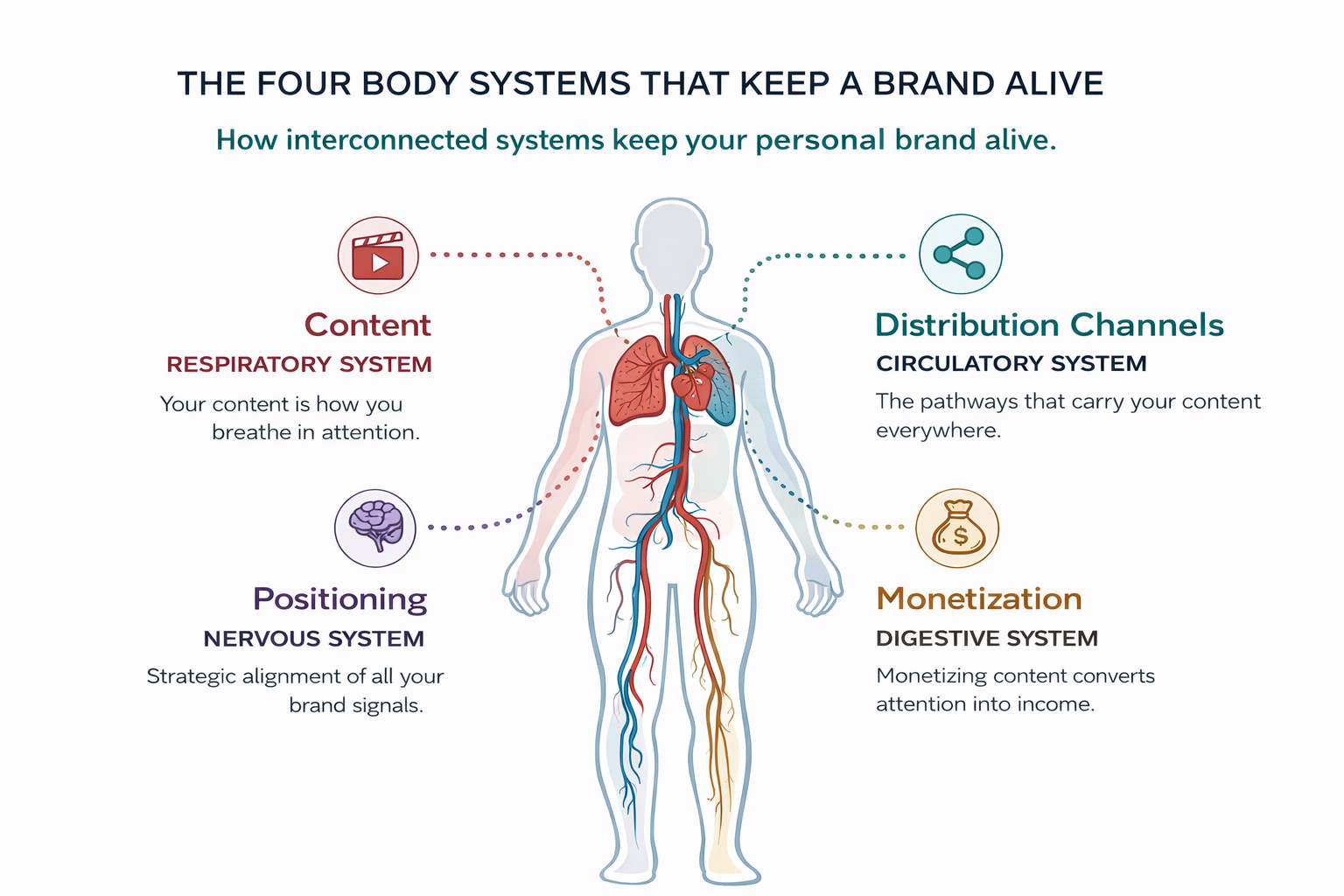
Content Is the Respiratory System
Your content is how your brand takes in attention and converts it into something usable. Every video, every post, every newsletter is a breath. When you stop breathing, the oxygen supply to everything else gets cut off.
The format matters as much as the frequency. Content that educates and entertains simultaneously keeps the respiratory system healthy because it gives audiences a biological reason to keep paying attention. The brain rewards insight discovery with dopamine. That reward mechanism turns a casual viewer into a loyal audience member.
Distribution Channels Are the Circulatory System
YouTube, Instagram, TikTok, LinkedIn, your email list, your podcast. These are the pathways that carry your content to every part of your audience ecosystem. If the channels are healthy and active, your ideas reach the people who need them. If the channels go dormant, the content you create has nowhere to travel.
Positioning Is the Nervous System
Positioning is the coordination layer that makes sure every piece of content, every platform, every interaction sends the same signal. Without clear positioning, your brand's systems fire in conflicting directions. The audience gets confused. The message fragments. Nothing compounds.
This is why treating social media as a strategic game matters. Strategy coordinates the signals. Without it, the nervous system breaks down.
Monetization Is the Digestive System
Your offers, products, services, and monetization convert the raw material of attention into the energy your business needs to sustain itself. Without it, you can have all the visibility in the world and still starve. That includes brand deal partnerships where audience trust becomes a monetizable asset and licensing income where content you already created generates ongoing revenue.
The point is not that every brand needs all of these systems running at full capacity from day one. The point is that a living organism needs its systems working together. When they are connected and healthy, the brand does not survive. It flourishes. When they break down, the whole organism declines.
How the Most Powerful Personal Brands Built Complete Ecosystems
The strategies that built the most dominant personal brands in history follow this exact biology.
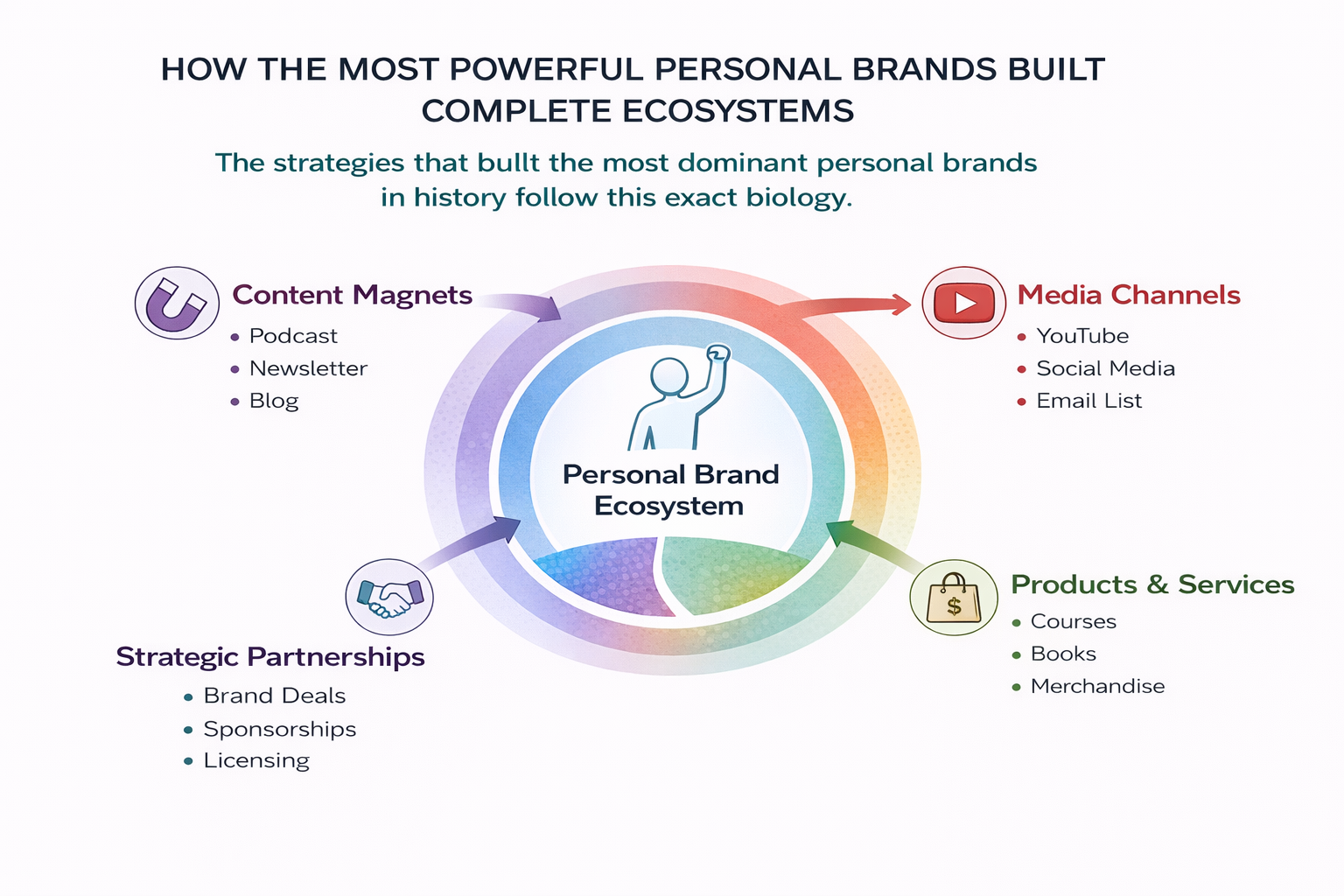
Oprah Winfrey did not build an empire on a talk show alone. The Oprah Winfrey Show was the heartbeat. Around it she built Harpo Productions, O Magazine, Oprah's Book Club, a film and television production arm, and eventually the Oprah Winfrey Network. Each was a different system inside the same organism. The show fed the magazine. The magazine deepened the relationship between episodes. The Book Club drove conversation back to the show. Each system fed the others. That is why her brand did not survive for 25 years. It compounded into the most powerful personal media company of its era.
Martha Stewart did the same thing from a different angle. Martha Stewart Living was the show. She also built the magazine, the books, the Kmart product lines, the digital content, the licensing deals. She took practical expertise and turned it into Martha Stewart Living Omnimedia, a complete ecosystem of interconnected systems. Every touchpoint reinforced the same identity. Every system pumped the same values through the entire organism.
These were not random expansions. They were body systems. Each performing a specific function, but all circulating the same thing: attention, trust, and value.
Instead of TV networks, it is YouTube. Instead of print magazines, it is newsletters and Substacks. The biology is the same. The brands that build interconnected systems survive and compound. The brands that rely on a single channel are one algorithm change away from cardiac arrest.
Why Going Dark Kills Your Brand Momentum
Most founders believe they can build something, take a break, and come back to it where they left it. That belief is wrong because attention is a flowing resource, not a static asset.
Every second spent on your content means your viewer actively chose you over infinite alternatives. That decision comes with an opportunity cost. The higher that cost, the higher your responsibility to deliver meaningful value and to keep delivering it.
When you go dark, you are not competing. You are forfeiting.
I see this pattern constantly. An expert builds momentum. Content gains traction. They get busy with client work and stop posting for a few weeks. When they come back, engagement dropped. The algorithm does not push their content. Leads dried up.
The answer is biology. The organism was not being fed. It started to decline. The market filled the space they vacated.
The Survival Mode Trap
When a brand starts declining, most experts respond by going into survival mode. Posting reactively instead of strategically. Chasing trends instead of building positioning. Making content decisions based on panic rather than purpose.
In biological terms, this is an organism under stress redirecting all resources toward short-term survival instead of long-term growth. Survival mode content rarely builds trust. It builds noise.
The experts who avoid this trap treat their content like a system, not a task. They build what I call a Personal Media Company: an operation that produces content the way a media company programs shows. With intentionality. With recurring formats. With a clear identity the audience can recognize and return to. This is the foundation of a Content & Social Media Strategy that keeps the brand alive regardless of what the market does.
The Three Nutrients Your Brand Needs to Survive
The brands that survive and compound over time consistently deliver three things. These map directly to the Three Forces that govern Personal Brand Authority.
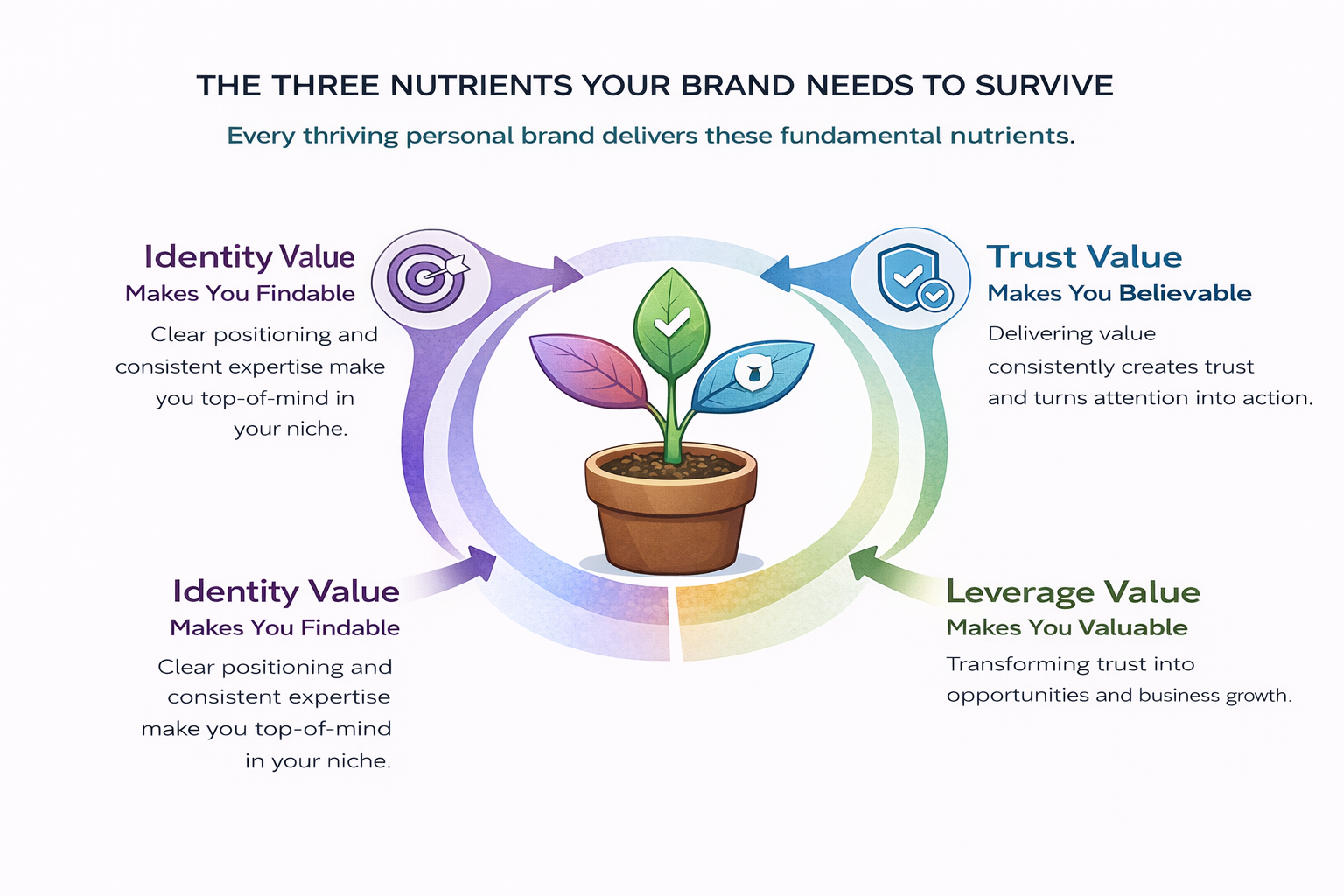
Identity Value (Makes You Findable)
The mental association your audience builds between your name and a specific area of expertise. When someone thinks about your topic, do they think about you? That association does not happen by accident. It is built through consistent positioning, a clear category, and content that reinforces who you are over and over again.
Trust Value (Makes You Believable)
The relational capital that turns attention into belief and belief into action. Trust is what makes someone watch your video and then buy your product, not because you sold them, but because you changed how they see the problem. Trust is built through delivering more value than expected, consistently, until the brain creates a shortcut: "this person reliably delivers."
This is what happened with Nikki Haskell, who built 1 million followers at 84 by showing up consistently with the same energy and identity across every piece of content. Her audience did not follow her because of a single viral moment. They followed her because the organism was alive, breathing, and unmistakably her, every single day.
Leverage Value (Makes You Valuable)
The ability to turn attention into tangible business outcomes. Pricing power. Partnerships. Distribution. Speaking invitations. Book deals. Inbound leads that come to you because your name precedes you. Leverage is what separates influence from authority.
Measuring Whether the Organism Is Healthy
I developed Return on Attention Created (ROAC) specifically to measure whether your content is producing these three outcomes. Most people track vanity metrics. They count calories when they should be checking whether the organism is actually getting healthier. ROAC tracks whether content builds identity, deepens trust, and creates leverage, the real indicators of a brand moving toward flourishing. This is part of the broader Creator Economics framework I built for founders who treat their brand as a business, not a hobby.
What Happens When You Stop Feeding the Organism
Living organisms do not exist in isolation. They exist in ecosystems. When one organism weakens, others move in to fill the niche.
Your market works the same way. When you go quiet, your competitors keep creating. New voices emerge in your category. AI-generated content floods the space. And the audience, which is always looking for someone to trust, starts forming bonds with whoever shows up consistently.
Your brand is alive right now. The question is whether you are feeding it what it needs to grow, or letting it slowly starve while you wait for the perfect moment to show up.
The perfect moment was yesterday. The second best moment is right now.
Frequently Asked Questions About the Biology of Brand Building
What does it mean that your personal brand is a living organism?
Your brand operates under the same fundamental law as any biological system: it is either growing or declining. There is no neutral state. When you consistently feed your brand with content, visibility, and strategic positioning, it flourishes. When those inputs stop, the brand decays. Audiences move on, algorithms deprioritize dormant accounts, and competitors fill the space.
What is the tree-falls-in-the-forest problem for personal brands?
The tree-falls-in-the-forest problem describes what happens when an expert has genuine knowledge but no visibility. If no one sees your expertise, it produces zero business value in the marketplace. People do not buy the best product or service. They buy what they know exists. AJ Kumar identifies this as one of the most common traps experts fall into.
Why does going dark on social media hurt your personal brand?
When you stop creating content, your brand does not pause. Attention is constantly redistributed. Algorithms deprioritize inactive accounts. Your audience begins forming trust with whoever shows up consistently in your space. Rebuilding momentum after going dark requires significantly more effort than maintaining it.
What are the four body systems of a personal brand?
Content is the respiratory system, taking in attention. Distribution channels are the circulatory system, carrying content to the audience. Positioning is the nervous system, coordinating consistent signals across every platform. Monetization is the digestive system, converting attention into business energy. These systems must work together for the brand organism to flourish.
What are the three nutrients a personal brand needs to survive?
Personal brands need identity value (the mental association between your name and your expertise), trust value (relational capital that turns attention into action), and leverage value (the ability to convert attention into tangible business outcomes). These map to the Three Forces of Personal Brand Authority and are measured through the ROAC framework.
How does ROAC measure whether your brand is healthy?
ROAC (Return on Attention Created) measures how effectively your content creates attention and what that attention produces for your business. Instead of tracking vanity metrics, ROAC tracks whether content builds identity, deepens trust, and creates leverage. It tells you whether the organism is getting healthier, not whether it is being fed.


